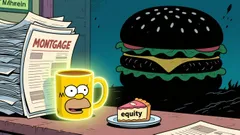
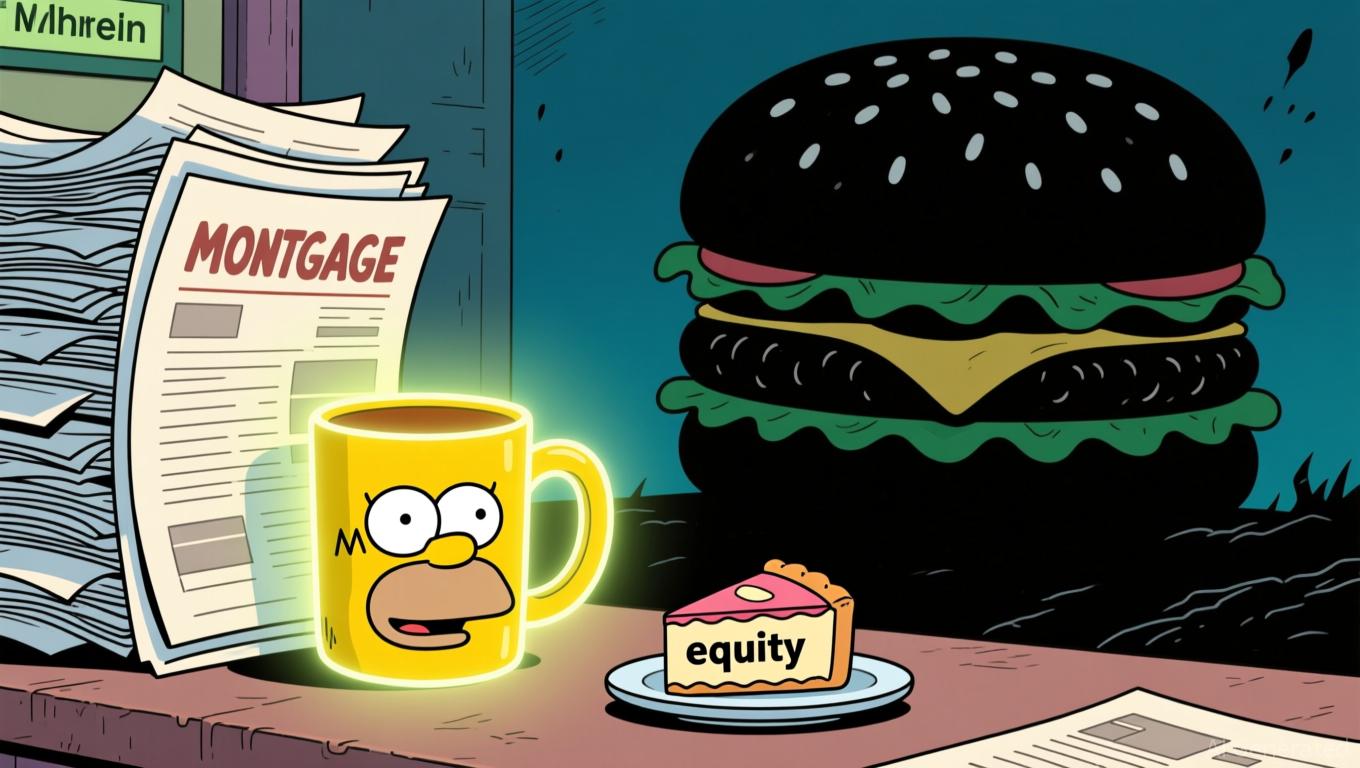
The Simpsons "Treehouse of Horror" meal hit Jack in the Box drive-thrus this week: Monster Tacos, a Krusty Burger, and a glow-in-the-dark collectible cup that lit up the leak threads before the chain even announced it. It is a fun menu, and it is generating headlines, which is the whole point of a limited-time offer. The problem is what those headlines do to a retail investor who recognizes the brand and decides to run the numbers. "Famous name, stock down a lot, big dividend" is the sentence to write down, because every piece of it is a year out of date in a way that leads in exactly the wrong direction.
Here is the number that upends the cheap-stock story: Jack in the Box's shares trade around $14.86, yet the company owes far more than that. Its stock-market value is about $285 million. Its enterprise value — the price of the whole company, debt included — is roughly $1.7 billion. That gap is not a mystery or a bargain. It is debt. About $1.4 billion of net debt sits ahead of the shareholders, and the balance sheet is already underwater.
The building with the mortgage nobody mentions
Put away the ticker for thirty seconds. Imagine you own a rental building worth $100,000 that carries a $90,000 mortgage. Someone offers to buy "your share" for $10,000. You are not being offered the building — the bank owns $90,000 of it and gets paid first. What you own is the residual: whatever is left of the building's value after the mortgage is satisfied. Your $10,000 slice is real only as long as the rents cover the debt payments and the value holds. If the building cannot service the mortgage, the bank's claim swallows the whole thing, and your slice can go to zero even though the structure is "worth" $100,000.
Quick Backtesting Tool
Now label the props:
- The $100,000 building is the enterprise value — everything the company is worth to everyone who has a claim on it.
- The $90,000 mortgage is the net debt, money owed to lenders before you see a dime.
- Your $10,000 slice is the market cap — the value of the common stock.
- The building manager's rent is operating cash flow.
- The monthly mortgage bill is interest expense plus required debt service.
That is the whole machine, and it maps onto Jack in the BoxJACK-- cleanly. The stock is worth roughly $285 million; the debt attached to the company is worth about $1.4 billion. In the rental building, your slice is 10% of the asset. Here the equity is about a sixth of enterprise value, and it is not because the brand is small. It is because lenders hold most of the building, and the accounting already says the total claims exceed the assets: book equity is negative, around -$901 million.
A yield the company stopped paying
The "big dividend" part of the misconception deserves its own autopsy, because it is where a data service can fool you. Punch the ticker into some quote tools and you may still see a double-digit dividend yield — roughly 11 to 12% depending on the source. That figure is the old $1.76 annual payout ($0.44 a quarter) divided by today's crushed share price. But here is the part the yield formula leaves out: Jack in the Box stopped paying it. As part of the "JACK on Track" restructuring announced April 23, 2025, the company discontinued the dividend immediately, redirecting the cash to debt paydown. The last check went out weeks before that announcement. There is no dividend today.
A high printed yield that nobody is being paid is not income. It is a fossil record of how far the price has fallen. And a fat yield on an equity that is cash-starved and heavily levered is usually a distress signal rather than a bargain sign. The number that screens as "juicy income" is actually the same number that says "this claim was marked down."
Why the price fell, and what the burger is really for
This is not a healthy business hiccuping. In the quarter ended July 5, 2026, same-store sales fell 1.1%, and restaurant-level margin slipped to 17.6% from 17.9% a year earlier. The economics of its biggest market took a direct hit when California's fast-food minimum wage climbed to $20 an hour under AB 1228, and the fallout is visible in management's own actions: it is closing 150 to 200 underperforming restaurants, selling select owned real estate to pay down debt, exploring strategic alternatives for the Del Taco brand, and running the company under an interim CEO after the permanent one lasted fourteen months. The stock is down more than 80% from its highs and about 21% this year, though it has bounced roughly a third of the way off a 52-week low near $9 over the past four months as investors priced in a slower, less lethal trajectory.
That is where the Simpsons meal belongs in this story. It is the same limited-time-offer playbook every struggling chain runs: a traffic bump that can lift a single quarter. Management says fourth-quarter same-store sales are running in the low-single-digit positive range, helped by an earlier limited-time platform. It is a real lever, but a marginal one. The store count barely moves, the margin barely moves, and the debt barely moves. The center of the investment case is not the menu; it is whether the company can turn burgers into cash faster than it spends it.
Right now it is not. Trailing twelve-month free cash flow is negative — roughly -$6.6 million, as operating cash flow of about $74 million is consumed by about $81 million of capital spending. A company that spends more to maintain itself than it generates is not piling up money to retire that mortgage; it is borrowing to stand still. Management does project full-year interest expense of about $81 million, and it says it has already cut debt by $244 million since April 2025, taking net leverage down from about 6.9 times to 6.3 times EBITDA. That is real progress in the right direction, and it explains some of the recent bounce.
Where the model breaks
The leverage cuts both ways, and this is the point where the "building with a mortgage" analogy has done its job and starts to mislead. An equity that is a small residual claim is a coiled spring: a modest improvement in cash flow, or a big paydown of debt, can swing the shares violently upward, because a given dollar of extra payout is spread over a tiny slice. That asymmetry is part of why the stock jumped a third of the way off its low even while the business was still shrinking. The opposite is also true — "last in line" means the shareholders absorb every miss first. And enterprise value is not fixed; asset sales shrink the building even as they pay down the mortgage, so the arithmetic is always moving.
So "the equity is worth almost nothing" is not a forecast. It is the framing of the question. Whether the residual grows or disappears depends on one thing.
The only number worth watching
The menu makes money, but the stock is paid in cash. After a year of paying no dividend, selling real estate, and carrying a negative equity balance, the only thing that actually reaches shareholders is free cash flow. So if you remember one test for Jack in the Box, use this one: does free cash flow turn positive, and does someone still owe $1.4 billion of unsecured net debt that gets paid first? Track the net leverage, which was 6.3 times at the last report; track the proceeds from a possible Del Taco sale and the store-closure drag on franchise margins, which management figures at roughly $80,000 each. If the cash turns positive and the debt keeps falling, that shrunken residual claim gets real. If the cash stays negative, the equity is a claim on almost nothing — no matter how good the collectible cup looks.
Buy the Krusty Burger for the glow-in-the-dark cup. Just don't confuse a traffic promotion with dividend income, and don't confuse a low stock price with a cheap company. The stock is the last claim on a building whose mortgage is bigger than the slice you'd be buying.