
Oil Nears $100 and Inflation Fears Return, Watch 5 Alpha Plays With Nearly 14% Average Extended Upside
Last week was less about chasing returns than avoiding bad entries. Four of our five setups never triggered, keeping the portfolio out of trades that failed to confirm, while the only activated position remained above its closing stop as the S&P 500 finished essentially flat. That discipline becomes even more important this week as the market backdrop turns more complicated: higher energy prices, elevated Treasury yields, and renewed inflation concerns are beginning to challenge some of the trades that worked best earlier in the year. Yet the obvious beneficiaries are already attracting plenty of attention, making risk-reward increasingly important. Instead of simply following the headline trade, this week's five selections focus on companies where supply disruption, infrastructure demand, improving execution, or defensive earnings can create their own upside. Their initial targets offer roughly 7% average upside, while extended targets average nearly 14%, with every position tied to a defined entry trigger and closing stop.
Best Trade This Week: CF IndustriesCF-- (CF)
Market cap: Approximately $20 billion Rating: Buy Role: Immediate pullback opportunity
Action: Buy within the $133.50–$135.50 zone. Investors looking for additional confirmation can add after a close above $136.75.
Strength: CF Industries provides a more differentiated way to trade the disruption in global energy and commodity markets. The company is one of the world's largest nitrogen fertilizer producers, with a North American production base that benefits from comparatively reliable and competitively priced natural gas.
Conflict in the Middle East has reduced fertilizer exports from an important producing region while making transportation through the Strait of Hormuz more expensive and less predictable. This supports global nitrogen prices and improves the relative position of North American producers. Demand should also remain supported by the need to rebuild agricultural inventories and maintain crop yields.
Beyond the immediate commodity cycle, CF has begun construction on Blue Point One, a large low-carbon ammonia project that could expand the company's addressable market into energy, industrial, and international clean-fuel applications.
Why now: The stock recently reached approximately $139 before pulling back toward its rising short-term averages. The underlying catalyst remains intact, but the retracement has removed some of the short-term excess and created a cleaner entry.
Technical: MA3 remains above MA7, while MA7 is above MA10. The stock is consolidating above its former breakout zone rather than surrendering the advance. Support sits around $132–$133, with $136.75 representing the first level that could restart momentum.
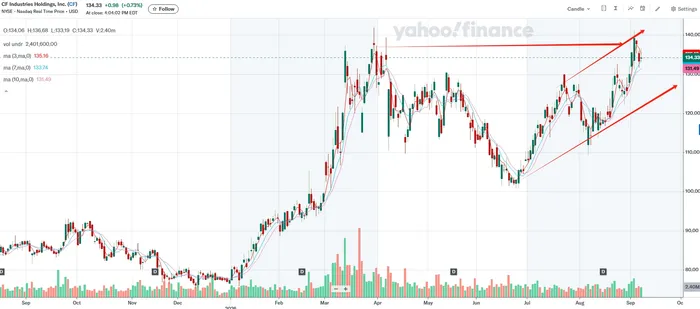
Short-term target: $142, representing approximately 6% upside. If nitrogen prices remain elevated, the extended target is $148, or approximately 10% upside.
Stop loss: Close below $129.50, approximately 4% downside.
Invalidation: A close below $129.50 would break the recent higher-low structure. An unexpected reopening of Middle Eastern fertilizer capacity could also weaken the supply-disruption thesis.
Frontline (FRO)
Market cap: Approximately $10 billion Rating: Buy on Breakout Role: Geopolitical momentum trade
Action: Buy after a close above $47.25. A pullback into $45.50–$46 followed by a bullish close would provide an alternative entry with better risk-reward.
Strength: Frontline operates one of the world's largest fleets of crude-oil tankers. The company can benefit when geopolitical disruption forces oil to travel longer distances, alters traditional shipping routes, or reduces the availability of vessels willing to operate near conflict zones.
The current opportunity is not simply based on oil reaching a higher price. Tanker profitability depends more directly on vessel demand, voyage distance, and shipping rates. Energy-security concerns are changing trade patterns, while countries may eventually need to rebuild depleted oil inventories. Both developments can support tanker utilization even if crude prices stop rising.
Frontline is already converting unusually strong tanker conditions into cash flow. It has secured portions of its fleet at attractive charter rates, reduced financing costs, and announced both regular and special shareholder distributions.
Why now: The stock is approaching resistance after a controlled series of higher lows. Unlike several oil producers, its RSI has not reached an extreme level, leaving room for another momentum leg if the breakout confirms.
Technical: MA3 is above MA7, which is above MA10. All three averages are rising, while the stock remains close enough to them to avoid a severely extended setup. Resistance is concentrated around $47–$47.25.
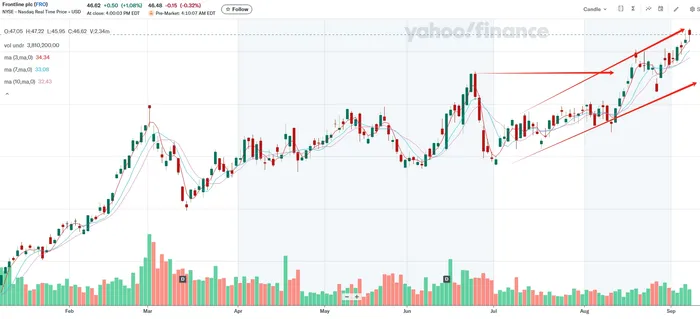
Short-term target: $50, approximately 7% upside. If tanker rates remain elevated, the extended target is $53.50, representing approximately 15% upside.
Stop loss: Close below $44.30, approximately 5% downside.
Invalidation: A close below $44.30 would break the rising short-term structure. Rapid geopolitical de-escalation could also reverse tanker-rate expectations, so this position should not be averaged down.
Amphenol (APH)
Market cap: Approximately $202 billion Rating: Buy on Reclaim Role: Large-cap AI infrastructure and industrial compounder
Action: Require the stock to hold above $80.80 and close back above $82.75 before entering. A breakout above $84.10 would provide stronger confirmation.
Strength: Amphenol supplies the connectors, cables, sensors, antennas, and high-speed interconnect systems required across data centers, aerospace, defense, industrial equipment, automobiles, and communications networks. This makes it an AI infrastructure beneficiary without requiring investors to directly chase semiconductor valuations.
As AI clusters become larger and more power-intensive, moving data efficiently between processors, servers, and networking equipment becomes increasingly important. Amphenol participates in this physical connectivity layer while maintaining broad exposure to defense modernization, commercial aerospace, and industrial electrification.
The company's acquisition strategy adds another growth engine. Recent transactions have expanded its position in high-speed digital testing, high-voltage systems, aerospace, and defense, while the integration of CommScope assets is progressing better than initially expected.
Why now: The stock has spent several weeks digesting its previous advance. Recent price action suggests buyers are defending the $80–$81 area, but a reclaim above $82.75 is needed before the setup becomes actionable.
Technical: MA3 remains above MA7 and MA10, although the latest pullback has brought the stock close to those averages. This compression can precede another breakout if support holds. A move above $84.10 would clear the recent resistance zone.
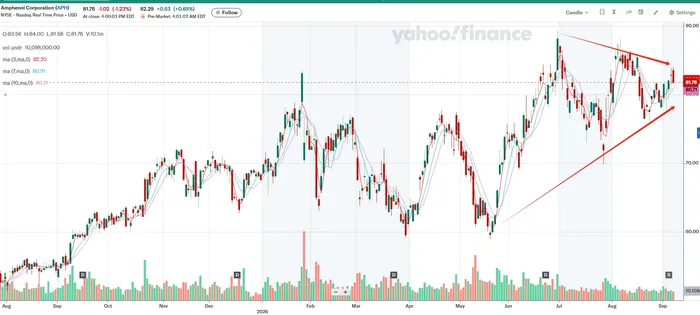
Short-term target: $88, approximately 8% upside. A sustained breakout could extend toward $92, representing approximately 13% upside.
Stop loss: Close below $79.20, approximately 3% downside.
Invalidation: A close below $79.20 would break short-term support and turn the current consolidation into a deeper correction.
Docusign (DOCU)
Market cap: Approximately $12 billion Rating: Buy on Confirmation Role: Software re-rating opportunity
Action: Buy only after a close above $66.50. More conservative investors can wait for a breakout above $68.50, although that would reduce the initial reward-to-risk ratio.
Strength: Docusign is attempting to evolve from an electronic-signature company into an intelligent agreement-management platform. Its opportunity is to help businesses search, analyze, negotiate, approve, and manage contracts rather than simply sign them.
This transition is becoming more credible as customers adopt Docusign's AI-native agreement tools. Its platform can review clauses, identify risks, extract information from existing contracts, automate renewal workflows, and connect agreement data with widely used enterprise AI assistants.
The company has also introduced tools that allow customers to build governed contract agents for specialized tasks. If adoption continues, agreement management could become a new growth engine and gradually change the market's perception of Docusign as a mature pandemic-era winner.
Why now: Recent results showed continued adoption of the agreement-management platform and triggered a positive initial reaction. The stock subsequently pulled back toward support rather than fully surrendering the move, creating a potential second-entry opportunity.
Technical: MA3 remains above MA7, with MA10 rising underneath the stock. The $64–$65 region is the first support zone, while $66.50 is the recovery level needed to confirm that buyers are returning. The chart becomes considerably stronger above $68.50.
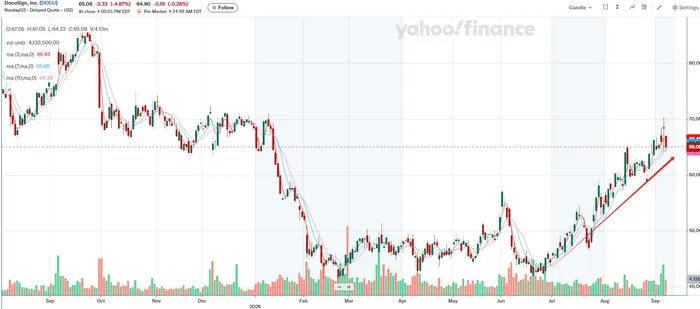
Short-term target: $70.50, approximately 8% upside. If the software re-rating gains momentum, the extended target is $75, representing approximately 15% upside.
Stop loss: Close below $62.40, approximately 4% downside.
Invalidation: A close below $62.40 would erase the post-results improvement and suggest that investors remain unwilling to assign a higher valuation to the new platform strategy.
Pediatrix Medical Group (MD)
Market cap: Approximately $2.2 billion Rating: Buy on Breakout Role: Defensive small-cap turnaround
Action: Buy after a close above $27.30. An alternative entry could develop if the stock tests $26.30–$26.50 and subsequently closes back above $26.80. Reduced position sizing remains appropriate because of the company' smaller market capitalization.
Strength: Pediatrix provides neonatal, maternal-fetal, pediatric intensive-care, and other specialized physician services through relationships with hospitals and healthcare systems. Demand for these services is less dependent on discretionary consumer spending or economic growth, giving the company defensive qualities in an uncertain market.
The more important investment story is the operational turnaround. Pediatrix has exited weaker practices, refocused on its core hospital-based operations, stabilized its revenue-collection infrastructure, and improved the efficiency of its remaining network. These changes have created a more focused company with stronger cash generation and a healthier balance sheet.
Management has also been repurchasing shares, which can increase the benefit of operational improvement for remaining shareholders. Future growth could come from expanding existing hospital relationships, selective acquisitions, or partnerships across women's and children's healthcare.
Why now: The stock has been consolidating tightly beneath resistance while the broader market becomes more selective. Its defensive revenue base, improving operations, and share repurchases offer a company-specific path to appreciation that does not require lower interest rates or stronger consumer spending.
Technical: MA3 is above MA7, while the short-term averages are compressed near MA10. The stock remains above its rising MA20 and MA50, indicating that the larger trend is still constructive. A close above $27.30 would clear the recent trading range and confirm renewed momentum.
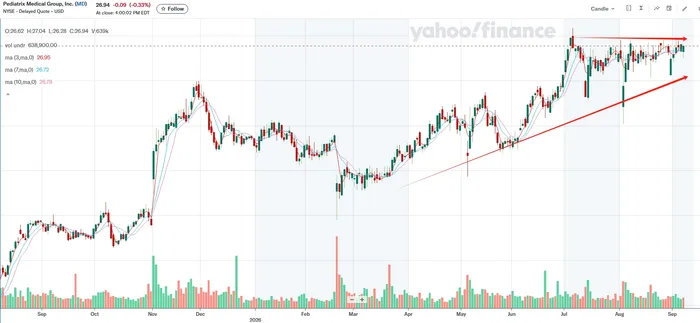
Short-term target: $29, representing approximately 8% upside. If the breakout attracts stronger buying, the extended target is $31.25, or approximately 16% upside.
Stop loss: Close below $25.70, approximately 5% downside.
Invalidation: A close below $25.70 would break the recent consolidation and weaken the longer-term turnaround pattern. Deteriorating hospital volumes, reimbursement pressure, or renewed collection problems would also damage the fundamental thesis.
Priority Ranking and Execution Plan
1. CF Industries: Best overall combination of an immediate entry, bullish moving-average structure, geopolitical tailwind, and company-specific growth catalyst.
2. Amphenol: Highest-quality large-cap selection. The stock is not yet actionable, but a reclaim above $82.75 would create an attractive entry into AI infrastructure without directly chasing a semiconductor leader.
3. Docusign: Most interesting software re-rating opportunity. The upside depends on investors recognizing that intelligent agreement management can become more important than electronic signatures alone.
4. Pediatrix Medical Group: Lower-risk small-cap selection built around operational improvement, defensive demand, and share repurchases rather than binary clinical results.
5. Frontline: Strong short-term momentum, but also the greatest sensitivity to geopolitical headlines. The $47.25 closing trigger is essential.
This week's portfolio should be built in stages rather than purchased as an equal-weight basket at the opening. CF Industries is immediately actionable within its buy zone. Amphenol and Docusign require recovery confirmation, Frontline needs either a breakout or disciplined pullback, and Pediatrix must clear its established trading range. If a trigger never occurs, the stock is not considered an activated recommendation. That distinction remains essential while oil, inflation expectations, and Treasury yields continue changing the market's leadership from one session to the next.

Independent investment research powered by a team of market strategists with 20+ years of Wall Street and global macro experience. We uncover high-conviction opportunities across equities, metals, and options through disciplined, data-driven analysis.
Latest Articles
Unlock Market-Moving Insights.
Subscribe to PRO Articles.
Already have an account? Sign in
Stay ahead of the market.
Get curated U.S. market news, insights and key dates delivered to your inbox.


AInvest
PRO
AInvest
PRO



