
AI's Massive Backlogs Are Creating a Dangerous Illusion, and the Infrastructure Trade May Be Way Too Inflated
The AI boom has found another number for investors to chase: backlog. CoreWeaveCRWV-- ended June with roughly $104 billion of revenue backlog. OracleORCL-- finished fiscal 2026 with $638 billion of RPO, MicrosoftMSFT-- reached $678 billion, AmazonAMZN-- disclosed roughly $496 billion of longer-term performance obligations, and DellDELL-- has booked more than $130 billion of AI-server orders over the past year. SB Energy is preparing to enter public markets with roughly $439 billion of project backlog despite having no operating AI data centers yet. The contracts are mostly real, often long-dated and increasingly backed by OpenAI, NvidiaNVDA-- or investment-grade hyperscalers. The problem is what the market is doing with them. One underlying AI customer can create a cloud commitment, a data-center lease, a server order and Nvidia GPU revenue at the same time. Investors may be putting premium valuations on several layers of the same end demand.
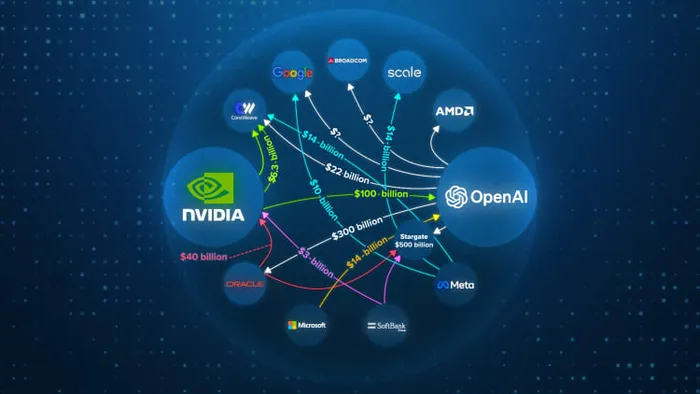
A $20 billion compute commitment from an AI lab can become contracted future revenue for a cloud provider. The cloud company signs a multibillion-dollar data-center lease, the developer borrows against it and orders servers, Dell or HPE books hardware backlog, Nvidia sells the GPUs, and power and cooling suppliers add another layer of orders. The market may suddenly see $40 billion or more of visibility across several companies even though much of the chain traces back to the same original customer. There is nothing wrong with the accounting. The risk is economic: contract growth across the supply chain can look like demand diversification when it is really demand multiplication.
More Backlog Now Means More Capital Too
That matters because AI backlog is nothing like traditional software backlog. A SaaS company can convert another dollar of RPO with limited incremental investment. AI infrastructure usually needs the capital first. CoreWeave spent $9.4 billion on capex in Q2 and expects $35 billion–$39 billion this year while building capacity to fulfill its contracts. Oracle's $638 billion RPO gives huge visibility, but fiscal 2026 also produced negative $23.7 billion of free cash flow and required tens of billions in outside financing. Some Oracle agreements look better because customers prepay for or supply GPUs, shifting part of that burden away from Oracle. A $10 billion contract that arrives with customer-funded hardware is worth far more to equity holders than a $10 billion contract that requires another multibillion-dollar check before revenue starts.
More backlog is therefore no longer automatically bullish. It can improve revenue visibility while increasing capex, depreciation and financing needs at the same time. CoreWeave is the clearest example. The contracts are strong, but every new commitment creates another need for GPUs, power, buildings and funding. Oracle is running a larger and financially stronger version of the same race. Even hyperscalers face the basic math. Amazon or Microsoft will not struggle to honor a data-center lease, but they can still earn a disappointing return if AI utilization, pricing and incremental cloud margins fail to justify the capital already locked in.
Big-name backing lowers credit risk. It does not guarantee good economics.
That distinction is becoming more important as Nvidia, OpenAI, SoftBank and hyperscalers appear on multiple sides of the same projects. SB Energy's enormous backlog is supported by OpenAI demand, SoftBank capital and Nvidia involvement. Nvidia is investing directly, supporting obligations tied to OpenAI's lease and supplying the GPUs. That makes the project much easier to finance. It also means the hardware supplier is helping support infrastructure that ultimately buys its own hardware. The sales are real, but part of the demand chain is increasingly being supported by the same ecosystem that benefits when the project gets built.
Anthropic shows a similar structure through large compute commitments to Lambda and Nscale:
AI lab → cloud/neocloud → data center → financing → Nvidia GPUs
If AI monetization keeps accelerating, the structure works. If monetization falls short, nobody needs to default for stocks to get hurt. The AI lab can fulfill existing commitments but delay the next expansion. The cloud provider keeps recognizing backlog but slows new capacity. The data-center operator keeps collecting rent while expected returns fall. Nvidia still ships the current GPUs while the market cuts expectations for the next wave.
The real risk is therefore wider than CoreWeave leverage. The AI buildout is creating contract-linked balance sheets across labs, clouds, data centers, server vendors and chip suppliers. The same few customers can sit behind several layers of reported visibility
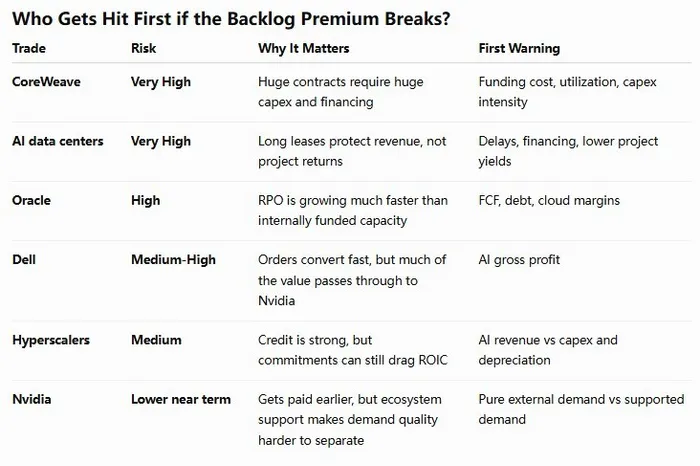
The first victims are unlikely to be the companies with the weakest contracts. They are more likely to be the companies whose valuations need those contracts to convert quickly, cheaply and at very high utilization.
CoreWeave sits at the top of that list. It does not need to lose a major customer to disappoint. Financing can get more expensive. GPU rental economics can weaken. Utilization can miss. Any of those can damage equity value while backlog remains at a record. Data-center developers carry the same problem over longer periods. A 15-year take-or-pay agreement can protect revenue and still produce a weak equity return if the campus costs more to build, takes longer to deliver or needs another expensive technology upgrade.
Oracle has less balance-sheet risk, but its backlog explosion is forcing investors to ask how much capital must be deployed before those contracts become high-return cloud revenue. The key number is no longer $638 billion of RPO. It is the free cash flow generated after building the capacity behind it.
Dell sits on the other side. Its backlog converts faster, so duration risk is much lower, but a large portion of AI-server revenue flows straight through to Nvidia and other suppliers. Record server orders therefore matter less if gross profit does not rise with them.
Nvidia still has the strongest position in the chain because it generally gets paid before the infrastructure owner proves the long-term return. That advantage is real. But its increasing role as investor, guarantor and ecosystem financier means investors should start separating pure external demand from demand helped by Nvidia capital or credit support. That distinction may not matter while financing is abundant. It will matter a lot more if the market tightens.
A big contract does not need to disappear. A campus can open nine months late. Debt can price 150 basis points above the original model. GPU rental rates can fall faster than expected. A hyperscaler can move more workloads to custom silicon. Utilization can come in at 70% instead of 90%. A customer can fulfill its existing deal and simply decline the next expansion.
The backlog headline barely changes. The stock can still fall 30%.
That is the risk investors should focus on. The economic value of backlog can deteriorate long before the backlog itself falls. CoreWeave can report another record contract while financing spreads widen. Oracle can add RPO while free cash flow deteriorates. Dell can ship more AI servers while incremental margins disappoint. A data-center operator can have a fully leased campus while project returns compress.
Three questions now matter more than the headline backlog:
How independent is the end demand? How much capital is required before it converts? How much profit is left when it does?
The AI boom can remain real and the infrastructure trade can still be inflated. OpenAI can genuinely need the compute. AWS can genuinely win the contract. A developer can genuinely lease the campus. Dell can genuinely ship the servers. Nvidia can genuinely sell the GPUs.
But those are not necessarily five separate increases in end demand. They may be five layers of valuation sitting on the same AI dollar. The danger is that only a small crack is needed. Lower utilization, tighter financing or weaker returns at one point in the chain can quickly hit the next, turning what looks like a company-specific backlog issue into systemic risk for the entire AI trade.

Independent investment research powered by a team of market strategists with 20+ years of Wall Street and global macro experience. We uncover high-conviction opportunities across equities, metals, and options through disciplined, data-driven analysis.
Latest Articles
Unlock Market-Moving Insights.
Subscribe to PRO Articles.
Already have an account? Sign in
Stay ahead of the market.
Get curated U.S. market news, insights and key dates delivered to your inbox.


AInvest
PRO
AInvest
PRO



