
The Next Defense Repricing May Start With a $4 Million Missile, but the Biggest Winner May Sit Lower in the Stack
The defense trade has spent the past several years benefiting from a simple equation: more wars, depleted inventories and larger procurement budgets. Ukraine and the Middle East are now exposing a weakness that another round of defense spending cannot solve by itself. A Patriot interceptor costing roughly $4 million can be forced to engage a drone worth only $30,000–$50,000. The interception may work perfectly, but the economics are poor when the attacker can launch dozens more while replacement missiles require long lead times and constrained production capacity. That is starting to change the Pentagon's procurement problem. The question is no longer only how many interceptors the military needs. It is which weapon should be used against which threat, and how cheaply that engagement can be repeated thousands of times. Patriot remains critical against ballistic and sophisticated cruise missiles, but small drones increasingly need to be pushed into cheaper layers such as electronic warfare, directed energy and lower-cost kinetic interceptors. That creates a different defense trade from the one investors have been buying for the past three years: the next incremental dollar may generate far more earnings for companies sitting below the premium-missile layer than another dollar of traditional replenishment spending.
A $35,000 drone does not need to destroy a Patriot battery to create value for the attacker. Forcing the defender to spend millions of dollars and consume scarce inventory can already make the attack economically successful. This is why Western stockpile shortages matter even with U.S. defense spending above $900 billion. Ukraine continues seeking additional Patriot missiles while production capacity remains tight, and the same mismatch exists across multiple interceptor categories after years of heavy use. Increasing the number of premium missiles helps, but it does not fix the exchange ratio. The more sustainable answer is a layered architecture in which electronic warfare attempts to defeat the threat first, lasers and cheaper kinetic systems handle lower-end targets, and high-end missiles are preserved for threats that justify the cost. The Pentagon does not need to choose between Patriot and lasers. It needs enough cheaper layers underneath Patriot that a small drone stops consuming the most expensive ammunition in the stack.
That shift is moving beyond PowerPoint. AeroVironmentAVAV-- recently received a $464.8 million Army award for the Enduring High Energy Laser program using its LOCUST platform, moving directed energy from another technology demonstration into actual production. That distinction matters much more than the headline "laser weapon" suggests. Directed energy has spent decades proving that it can work while generating limited recurring revenue. A production program means the military is beginning to budget for fielded systems. The 30-kilowatt LOCUST systems are aimed largely at smaller Group 1–3 drones, exactly where the cost-per-kill problem is most severe. The system does not have to replace Patriot to justify the program. It only has to remove enough cheap targets from the engagement chain that the military can save its most expensive interceptors for higher-value threats.
The setup is particularly meaningful for AVAVAVAV-- because the contract is large enough to matter. Fiscal first-quarter revenue reached roughly $480 million, bookings were about $700 million and funded backlog rose to around $1.5 billion. A few hundred million dollars of directed-energy procurement therefore has much greater earnings sensitivity for AeroVironment than a similar award would have for RTXRTX-- or L3HarrisLHX--. LOCUST also sits beside autonomous systems, loitering munitions and counter-UAS products rather than carrying the entire company thesis. The next question is no longer whether the laser works. It is whether the Army award becomes a recurring procurement category through larger follow-on quantities, international adoption or expansion into other services. If that happens, directed energy starts moving from a catalyst into a meaningful part of AVAV's revenue mix.
The more interesting part of the trade, however, is that the cheapest solution may not fire anything at all. CACI sits further down the engagement cost curve through detection, identification and non-kinetic counter-UAS systems. If a drone can be disrupted electronically, the military avoids spending even a lower-cost missile. That gives CACI a different economic role from AVAV: not necessarily destroying every threat itself, but reducing the number of threats that ever reach the kinetic layer. As drone attacks become larger and more coordinated, the ability to determine which target is real, which can be jammed and which requires a physical intercept becomes more valuable. This is why the counter-drone opportunity should not be viewed as a single "laser trade." The budget is moving toward an architecture.
L3Harris occupies the middle of that architecture. VAMPIRE and related counter-UAS systems provide a lower-cost kinetic response and have begun moving across multiple services, giving LHXLHX-- credible exposure to the same procurement shift. The weakness is scale. A $100 million counter-UAS program validates the technology but does not change consolidated earnings for a company the size of L3Harris. AVAV therefore offers far more upside sensitivity if spending accelerates, while LHX is the more diversified expression.
RTX is where the investment argument becomes less obvious. The easy conclusion is that cheap drones threaten Patriot economics and therefore pressure Raytheon. That is too simple. High-end missile threats are not disappearing, Patriot inventories still need years of replenishment, and the system remains essential for targets that cheap interceptors cannot handle. More importantly, RTX already participates in the lower-cost layer through Coyote. Earlier Army procurement implied a unit cost dramatically below Patriot, while newer versions expand non-kinetic and reusable capabilities. RTX therefore has a hedge that many investors overlook: it can continue earning from high-end replenishment while Coyote absorbs part of the drone-defense mission that no longer makes sense for Patriot.
That changes how the four stocks should be viewed.
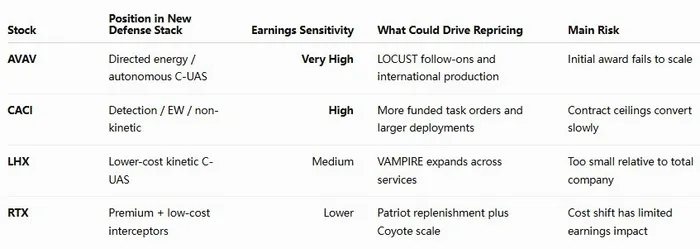
The ranking is not based on which company has the best defense technology. It is based on how much the procurement shift can change earnings relative to the current business. AVAV ranks first because directed energy moving into production can materially change its growth profile. CACI ranks second because the market still focuses heavily on kinetic solutions while electronic defeat can offer even better engagement economics. LHX has solid exposure but needs much larger procurement volumes to move the consolidated numbers. RTX is not the cleanest repricing trade, but it may be the best protected incumbent because it participates at both the expensive and lower-cost ends of the defense stack.
This is also where the article differs from the familiar "drone warfare is bullish for defense tech" argument. Drone demand itself is already well understood. What matters now is where the Pentagon moves the next dollar of procurement. The marginal budget does not necessarily go to another premium interceptor. It can move toward sensors, software, jamming, lasers and cheaper kinetic systems that allow the same defense network to handle more targets without burning through its most scarce ammunition. That can change revenue mix even while overall defense spending remains high.
For AVAV, the next confirmation is straightforward: follow-on LOCUST quantities. Another meaningful Army award or larger international program would show that directed energy is becoming a recurring procurement category rather than a one-off production contract. CACI needs its counter-UAS contract ceilings to convert into funded task orders, while LHX and RTX need VAMPIRE and Coyote to move into materially larger annual production. If those volumes fail to appear and most incremental funding remains concentrated in traditional missile replenishment, the cost-per-kill shift may remain strategically important but financially small. AVAV carries the most downside in that scenario because LOCUST has the greatest potential to change its earnings profile; RTX is the least dependent on the thesis because Patriot replenishment remains strong regardless.
The setup therefore does not require the Pentagon to abandon Patriot or reduce premium-missile spending. It only requires a larger share of incremental counter-drone dollars to move toward cheaper layers of the stack. AVAV has the highest earnings sensitivity to that shift, CACI offers the less crowded non-kinetic exposure, while RTX remains the incumbent best positioned to protect its high-end franchise and participate through Coyote. The key signal from here is procurement volume, not another successful demonstration.

Independent investment research powered by a team of market strategists with 20+ years of Wall Street and global macro experience. We uncover high-conviction opportunities across equities, metals, and options through disciplined, data-driven analysis.
Latest Articles
Unlock Market-Moving Insights.
Subscribe to PRO Articles.
Already have an account? Sign in
Stay ahead of the market.
Get curated U.S. market news, insights and key dates delivered to your inbox.


AInvest
PRO
AInvest
PRO



