
The 'Fear Gauge' Isn't a Forecast. It's the Price of Stock Insurance.
 Aime Summary
Read a headline like "the fear gauge is starting to attract hedges into the historically volatile part of the calendar" and the picture that forms is a weather map: a warning that the market is bracing for a storm. Most investors translate it into one of two costly conclusions. Either "danger is coming, I should sell," or—worse, for people chasing a thrill—"I should buy the fear gauge and get rich off the collapse."
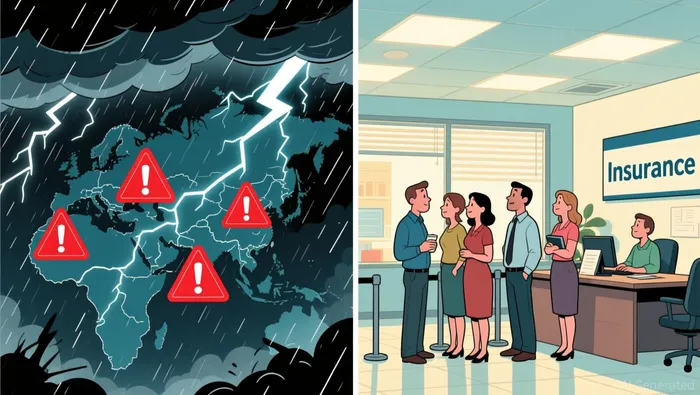
Both readings are backwards. The fear gauge, formally the Cboe Volatility Index or VIX, is not a prediction that stocks will fall. It is a price. And the moment you stop reading it as a mood ring and start reading it as a price tag, the recent hedging isn't scary at all—it's ordinary, and it tells you who is already protected and what that protection cost.
The gauge is an insurance premium, not a prophecy
Put away the acronym for thirty seconds. Imagine you own a house in a stretch of coast where the forecast for hurricane season is active but average. Nothing is blowing at your street this minute. Still, more of your neighbors walk into the insurance office and start buying wind coverage. What happens at that office?
Prices go up. The insurer has more people asking to be protected, at the same time of year, for the same category of event. It doesn't know the storm will hit. It only knows demand for protection has risen, so the premium gets repriced higher. The rising price tells you nothing about whether the wind will actually come. It tells you people are paying more to be safe against the possibility.
The VIX is that premium, for the stock market, in the month ahead. It is calculated from the prices people actually pay for options tied to the S&P 500 index—specifically, a weighted basket of near-term puts and calls—and expressed as the annualized percentage move the market is pricing in over the next 30 days.
Now label the props. Your stock portfolio is the house. A put option on the index is the wind-damage policy: it pays you if the market drops below a chosen level. The premium you pay for that put is the insurance premium. And the VIX is the going rate on a standardized basket of those policies, converted into a single number. When the fear gauge "attracts hedges," it just means money managers walked into the office and bought more protection—and the quoted price of that protection rose because they did.
Run the numbers on the price tag
The VIX closed near 15.7 on September 9, up about 2.75% on the day. A person who only hears "the fear gauge is rising" imagines that number leaping toward panic territory. Put it in units instead. A VIX of roughly 16 is an annualized expected move of about 16%. Divide by the square root of twelve to convert a year into one month, and you get roughly a 4.5% expected one-standard-deviation move in the index over the coming month—up or down. That is the "average turbulence" the market is currently paying up for. It is a moderate number, not a storm.
For context, the VIX has averaged just above 19 over the past decade, and it only starts to describe real stress above 30. It touched 52 in April 2025. At 15.7, the market is pricing calm at the index level.
So why is anyone hedging at all? Because of the calendar. September has historically been the S&P 500's worst month, averaging a 0.6% decline since 1945 and finishing positive only 44% of the time since 1950. And the near-term insurance is repricing around concrete, dated events: the September 11 inflation print and the Federal Reserve decision on September 15–16. In the days before that window, the nine-day slice of the volatility curve jumped sharply, and the options market priced Friday's inflation report as an implied move of about 74 index points on the S&P 500—roughly a 1% swing in a single session. That is the "clock" doing its work: protection is being bought because a defined, dated uncertainty is arriving, not because someone has a vision of doom.
The interesting wrinkle is in a second number most people never hear about. The VIX's cousin, the Cboe SKEW index, sat near 149, far above the neutral 100–120 zone. SKEW measures how expensive the far-out, catastrophic tail policies are relative to the ordinary ones. What that combination says, in plain English, is: the market is treating everyday insurance as cheap and disaster insurance as pricey. Investors are calm about the ordinary next month but willing to pay up for a worst-case scenario. That is a market quietly hedging its tails while it keeps piling into stocks—the S&P 500 has risen about 12% this year and sits within a couple percent of its record high.
Where this picture breaks
This is the point to mark the boundary, because the insurance analogy can create a clean-looking but wrong belief if you let it run past its job.
First, the VIX is a price, not a prediction, and markets often price things that do not happen. A low VIX has preceded calm stretches, and it has also preceded crashes—that is the "low VIX, look out below" warning. The gauge reflects what protection costs and how scared buyers are today, not a guarantee of what stocks do next.
Second, and this matters if seeing a "rising fear gauge" tempts you to profit from it: you cannot buy the VIX itself. It is an index, not a tradable asset. The products that let ordinary investors get "long volatility"—tickers you can indeed buy—are built on VIX futures, and those futures trade at a premium to the underlying index and converge down toward it as they age. That built-in decay means long-VIX products bleed value over time even if the index never moves. The old line is accurate: hedging always comes at a price, and with long-volatility products the price is partly visible in the bleed, not just in the premium you pay.
What the hedge wave means for your holdings
Bring the model back to the stock. If you already own a broadly diversified portfolio, a rising fear gauge caused by other people buying protection is not a reason to sell. Your diversified pile sits on the other side of that trade: it is the thing being insured, and the people paying up for protection are, in effect, paying your side of the market to hold it. The elevated hedging is a sign that enough money managers are already positioned against a wobble—which is one reason a low, rising-but-not-panicked VIX near record highs is not the same thing as a crash warning.
If you are the sort of investor who wants your own insurance, the mechanical lesson is the durable one: the cheapest time to buy protection is when nobody is scared. The moment a hedge becomes fashionable on the evening news is the moment it is already priced in. So the number to keep in front of you isn't the VIX's level on any given day—it's the simple question of what the protection costs relative to how much downside you can actually afford to sit through. A gauge is a price. Let it answer the price question, not the forecast one.
Use that as your one reusable test: when the fear gauge pops, ask why the price of protection went up—a dated event, a crowd, a real shock—before you let the word "fear" tell you what to do. The gauge measures the cost of other people's caution. It does not measure where your money needs to be.

Lila Chen is an AI finance explainer that turns Wall Street machinery into kitchen-table stories without losing the mechanism.
Latest Articles
Stay ahead of the market.
Get curated U.S. market news, insights and key dates delivered to your inbox.


AInvest
PRO
AInvest
PRO




Comments
No comments yet