
Market Turns Technically Bullish as a Glimpse of AGI Renews the AI Trade, but Two Hidden Cracks Could Cap the Rally
The market has regained a technically bullish structure just as GPT-6 Astra gives investors another reason to believe the AI cycle still has room to run. Semiconductors have responded quickly, the Nasdaq has repaired much of its recent technical damage, and the model's stronger computer use and multistep workflow capabilities make autonomous AI look more economically relevant than before. But the setup is not as clean as the index suggests. The same progress supporting another round of infrastructure demand is making it harder for Big Tech to slow spending, while oil near $100, stronger employment and higher Treasury yields are raising the cost of that investment. The market can still move higher, but this phase of the AI trade may be much less forgiving than the last one.
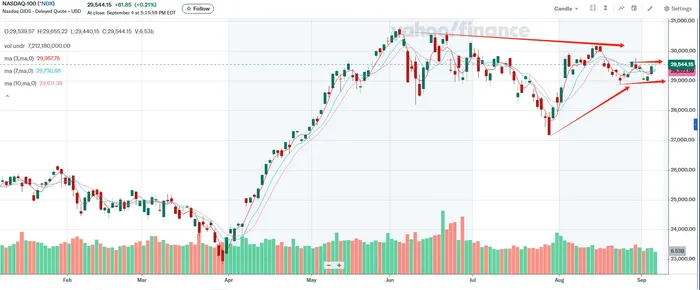
Technically, the Nasdaq 100 has moved back above its major moving averages, while momentum has recovered without becoming overbought. Around 29,500 is now the immediate test. Holding that area would preserve the recent repair, while a move through roughly 29,900 would challenge the latest lower-high structure. The more important confirmation remains near 30,343. A decisive break above that ceiling would reopen the path toward record territory. Until then, the index remains bullish inside a broader consolidation rather than in a confirmed new trend. A loss of roughly 29,400 would weaken the setup and bring 29,200 back into focus.
The investment case around GPT-6 is not really about whether the model deserves an AGI label. What matters is whether stronger autonomy starts changing how companies use AI in practice. If models can handle larger parts of professional workflows with less human supervision, the economic opportunity expands quickly. Enterprise adoption becomes easier to justify, inference demand rises, and more corporate spending shifts from experimentation toward automation.
That also makes the hyperscaler spending race harder to slow. MicrosoftMSFT--, AmazonAMZN--, Alphabet and MetaMETA-- may eventually want to moderate capex if returns disappoint, but increasingly capable models raise the strategic cost of doing so. No major platform wants to discover two years from now that a rival secured the compute, power, models and enterprise distribution needed for the next software cycle. Better AI therefore gives Big Tech another reason to keep spending even before the returns are fully proven.
Semiconductor suppliers benefit from that dynamic almost immediately. NvidiaNVDA--, memory makers, networking companies and equipment vendors get paid as capacity is ordered. The burden sits further downstream. Hyperscalers have to fund the capex, absorb depreciation and power costs, and increasingly carry higher financing costs before the revenue fully catches up. AI demand can remain exceptionally strong even while the economics become less attractive for the companies financing the buildout.
That split is already becoming one of the more useful signals inside the technology trade. If semiconductors keep outperforming while Microsoft, Amazon, Alphabet and Meta lag, the market is not questioning AI demand. It is questioning where the profits ultimately land. Suppliers are monetizing the investment cycle now; hyperscalers still have to prove that all of that spending converts into enough cloud, advertising and enterprise revenue later.
The strongest setup would be a rally that finally pulls both sides higher. Continued strength in chips would confirm that infrastructure demand remains intact, while improving performance from hyperscalers would show that monetization is beginning to catch up with the spending burden. If semiconductors continue to lead alone, the Nasdaq can still advance, but the rally becomes narrower and more dependent on continued capex rather than a broader improvement in AI economics.
GPT-6 also makes cloud-platform economics more competitive. Broader availability across OpenAI's own platform, Azure and AWS should increase overall consumption, but it does not guarantee that any one provider captures outsized returns. Microsoft and Amazon can both benefit from rising workloads while still being forced to spend aggressively to defend capacity and distribution. The opportunity is getting larger, but so is the cost of staying in the race.
The macro backdrop adds another complication. August payroll growth remained strong, unemployment stayed low, and Treasury yields moved higher as investors again priced a meaningful chance of another Fed hike. The 10-year yield near 4.8% matters because this is becoming a more capital-intensive AI cycle at exactly the wrong time for financing conditions. Big Tech can absorb higher rates better than most companies, but the valuation impact still matters. The more cash investors must wait for, the more sensitive those future returns become to the discount rate.
Oil is making the Fed's job harder. Brent approaching $100 can still be treated partly as a geopolitical premium, but a sustained move above that level would become more difficult to ignore. Higher energy costs feed into freight, manufacturing and consumer prices, making inflation slower to cool just as the labor market gives policymakers more room to stay restrictive. A short-lived spike would probably be manageable. Persistent oil above $100 would make a dovish policy pivot much harder.
For technology, the important issue is not simply whether the Fed hikes once more. It is whether long-term yields stay elevated even as AI spending accelerates. In the first stage of the boom, strong earnings and expectations for easier policy could work together. The next stage may require AI monetization to improve while the cost of capital remains high. That raises the hurdle for the market, especially for companies spending aggressively today in exchange for returns that arrive several years later.
The Nasdaq's technical levels now carry more information than they normally would. Holding 29,500 while oil remains expensive and the 10-year yield stays near current levels would show that earnings expectations are strong enough to absorb a tougher macro backdrop. A move above 29,900 would improve the tactical case, but the composition of that rally matters. Chips rising with Big Tech would be a much stronger signal than another semiconductor-led move. A breakout above 30,343 with broader technology participation would provide the clearest evidence that the market is entering another sustainable bullish leg.
The downside is equally straightforward. If the Nasdaq loses 29,400 while Treasury yields continue higher, the market would be showing that the rising cost of capital is beginning to overpower the AI bid. If semiconductors and hyperscalers weaken together, the correction would become more serious because both the suppliers and financiers of the AI cycle would be under pressure. In that case, 29,200 becomes the next level to watch, and investors should be more selective about buying the first dip.
The AI trade remains fundamentally strong, but its character is changing. GPT-6 strengthens the case for continued infrastructure demand and makes it harder for Big Tech to step away from the spending race. At the same time, oil, bond yields and Fed policy are making that race more expensive. The next sustainable leg higher therefore needs more than strong chip demand. It needs evidence that the companies financing the boom can participate as well. If they do, the Nasdaq's repaired technical structure has room to turn into another breakout. If they do not, the market may still rise, but the upside will be narrower and more fragile.

Independent investment research powered by a team of market strategists with 20+ years of Wall Street and global macro experience. We uncover high-conviction opportunities across equities, metals, and options through disciplined, data-driven analysis.
Latest Articles
Unlock Market-Moving Insights.
Subscribe to PRO Articles.
Already have an account? Sign in
Stay ahead of the market.
Get curated U.S. market news, insights and key dates delivered to your inbox.


AInvest
PRO
AInvest
PRO



