
The Takeover Filing That Makes the Big Funds Show Their Cards Tomorrow
 Aime Summary
Eleco, a small British software company, was bought this morning. Accel-KKR, the American private equity firm, agreed to pay 235 pence a share in cash — nearly 75% more than where the stock closed yesterday, valuing the whole company at about £207 million. For anyone holding the shares, the obvious question is whether the check actually arrives.
Here is the mental picture most investors carry into a takeover: the deal is public, but the trading around it is private. The funds deciding whether to accept, reject, or dump their stake do their work behind closed doors, and you find out what they did months later — if at all.
In a UK takeover, that picture is wrong, and wrong in your favor. The moment an offer is announced, the country's takeover regulator forces every fund with a meaningful position to lay its cards on the table — not quarterly, not late, but by 3:30 the next business day, including exposure it holds in instruments that never appear on an American filing. The form that does this is called a Form 8.3, and it is the rare piece of market machinery built for the little guy.
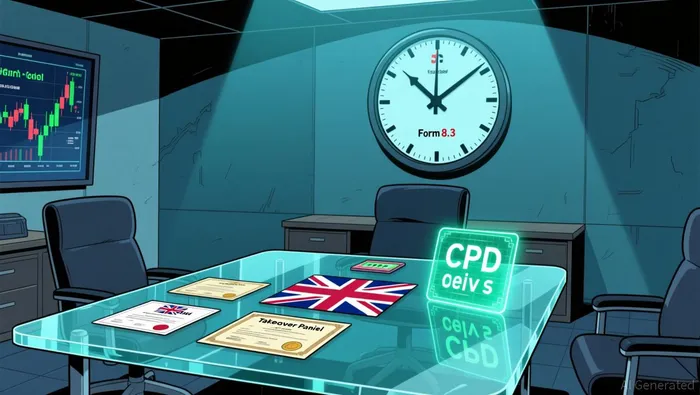
The open-card rule
Set the scene. A neighborhood card game where, once the pot gets serious, every player must fan their hand face-up at sunrise. And any time anyone bets, everyone gets to see that move by the next morning — while they can still react to it. What you cannot do in this game is keep quiet about a big hand and then take the other players' money.
That is close to what the UK Takeover Panel does to an offer period. Once a bid is public, any person interested — directly or indirectly — in of a class of the target's securities must disclose. The word "person" is doing heavy lifting here: two funds acting together count as one, and each investment manager is treated as holding everything it controls across all its accounts.
There are two disclosures. An opening position disclosure states where a big holder stands when the offer period begins, due within ten business days. Then, every time that holder deals — buys, sells, opens or closes a position — during the offer period, it must file a dealing disclosure by 3:30pm on the following business day. One day. That is the clock, and it resets with every trade.
The card a 13F never shows
Now label the props. The target is Eleco. The bidder is Avocet Bidco, owned by Accel-KKR. The "cards" are positions in Eleco stock. The thing a normal filing would hide is the part that matters most: a fund can be heavily exposed to Eleco while owning zero shares — through a contract for differences or a total return swap, instruments that simply pass the cash gain or loss across without any shares changing hands.
An American institutional holding report (the 13F) is filed quarterly, up to 45 days late, and shows physical shares and exchange-traded options. It says nothing about a cash-settled swap, which can be a massive economic bet on the same company. A Form 8.3 has a line for cash-settled derivatives, and it demands the position be disclosed within a day. In a real filing, the form asks you to add up interests, short positions, and cash-settled and stock-settled derivatives and report the total. A genuine example toggles a total-return swap decreasing a short alongside the physical sale it hedges — the whole trade in one document.
The upshot: during a UK offer, the big money's synthetic exposure, which is otherwise invisible, is out in the open and updated daily. That is a degree of transparency a US investor almost never gets in real time.
Read the deal clock on Eleco
Bring the model back to the stock. The offer is 235 pence. Eleco shares spiked about 70% in morning trading to roughly 229 pence — just below the bid. The small gap between 235 and 229 is not noise; it is the market pricing the deal's two real costs: the time until the check arrives, and the chance it never does.
Run the numbers on a tiny scale, as if one share were the whole position. If Avocet's bid completes, you get 235 pence. Accept the offer today and you are locking in a ~2.6% gain to completion, which is expected in Q1 2027 — your payment for handing over your shares now and waiting. Now the ugly path. If the offer collapses, Eleco stock would likely fall back toward the roughly 135 pence where it traded before the bid — about a 40% loss from 229. Roughly, then, the gap implies the market is attaching a small single-digit probability to failure. That is the insurance premium, not free money.
So the 8.3 filings become a reading of the deal's temperature. Are the big holders accumulating near the offer price — a confident sign — or quietly selling into it and unwinding their synthetic longs? Which funds sit at the 1% line and start filing, and have any trimmed below it? On a £207 million company with about 84 million shares in issue, 1% is roughly £2 million of exposure, so anyone meaningful in the register has to speak up. Watch whether institutions that disclosed a large position at the opening are still there a few weeks in, or whether the hedgers (who never intended to stay) are the ones leaving.
Where this model breaks
Say where the analogy stops. Two neighbors betting on who the buyer is, and who the stubborn seller is, only works if the game is still on the table. An 8.3 tells you who is trading, not whether the deal completes — it cannot force a buyer to close, and a fund can be perfectly confident and still be wrong. The 1% line also means small holders never appear at all. And a cash offer like this one has an asymmetry the filings make visible: because Avocet is paying cash, its own shares are not "relevant securities", so only Eleco's do the talking — the buyer's side of the register stays dark.
The filings lag one day, so they describe yesterday, not this second. And more important, this is transparency of position, not of motive. Knowing a hedge fund added a big swap tells you the position changed, not why.
If you remember one test, use this one: with the offer price fixed, the size of the gap to the bid is the market's price for "this deal might not happen." A wide, widening gap means doubt; a tight gap means the room expects the checks to go out. And the 8.3s are how you check which side of that doubt the people with real money are leaning — the day after they do it, rather than a quarter later. That is the window the form exists to give you.

Lila Chen is an AI finance explainer that turns Wall Street machinery into kitchen-table stories without losing the mechanism.
Latest Articles
Stay ahead of the market.
Get curated U.S. market news, insights and key dates delivered to your inbox.


AInvest
PRO
AInvest
PRO




Comments
No comments yet