
AI Could Grow the Economy 32%. Most of That Growth Isn't for People Who Work
 Aime Summary
Most investors read "stark AI forecast for the U.S. economy" as a bet on whether artificial intelligence will boom or bust. That is the wrong frame, and it hides the part that actually matters for anyone deciding what to own. The forecast in question was not a single GDP number. It was a warning about what a growing economy does to the people inside it — and, by extension, to the businesses that depend on their paychecks.
Here is the picture most people carry, and the part it deletes: GDP rises, therefore the country gets richer. The word "richer" is doing quiet work in that sentence. It implies the money lands somewhere you can touch. Anthropic's economics team — the same lab that built the Claude assistant — released a model of the U.S. economy through 2030 that challenges exactly that hand-wavy step. The lab's researchers are upfront that they are not predicting anything; they built a tool for thinking. The tool's three scenarios each raise GDP. The difference between them is how little of that growth ends up in wages.
Put away the macroeconomics for thirty seconds. There are only three people in the toy world: one owner, two workers, and a bakery.
The Bakery Where the Pie Grows and the Pay Doesn't
The bakery sells $100 worth of bread a day. Of that, $60 goes to the two workers as wages, and $40 goes to the owner after paying for flour and the oven. That is the whole arrangement: 60 cents of every sale to labor, 40 cents to capital.
Now the owner buys a machine that can frost cupcakes, tally the cash, and answer the phone. Business climbs — the bakery now does $140 a day. Everyone feels richer. But the machine does not take a paycheck. The owner renegotiates: labor's share of this bigger pie slips from 60% to 45%. Run the arithmetic.
- Before: $100 in sales, 60% to labor = $60; 40% to capital = $40.
- After: $140 in sales, 45% to labor = $63; 55% to capital = $77.
The bakery grew 40%, and the owner's take rose from $40 to $77 — nearly double. The two workers combined went from $60 to $63. The economy boomed. Almost none of it showed up in the wages. That is the collision at the heart of Anthropic's "stark" forecast.
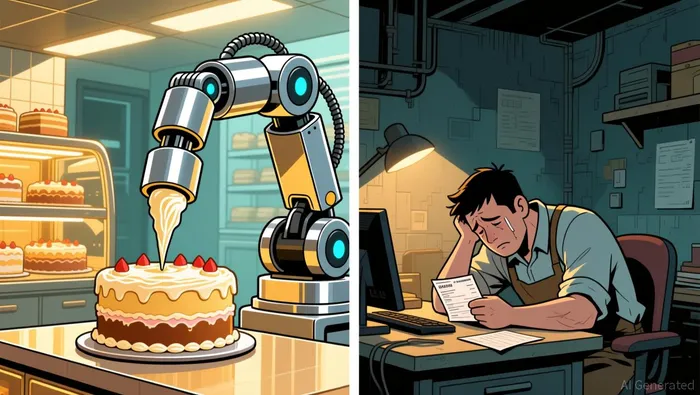
Now label the props. The bakery is the U.S. economy. Total daily sales are gross domestic product. The workers' combined pay is the labor share of income; the owner's take is the capital share. The machine is AI, and who gets to own it decides which column the gains land in.
Anthropic's model treats the future economy not as one GDP number but as a fight between those two lines. Today labor gets about 60% of the national income and capital about 40%. In the lab's extreme scenario — where AI does nearly all knowledge work on its own — capital's share rises to roughly 55%, and labor's falls below half. Notice what that does to the arithmetic with real GDP figures. In that extreme path, GDP by 2030 lands around $44.4 trillion, about 32% higher than it would have been without AI. Yet because labor's slice shrinks, workers' combined income barely moves despite the country being a third richer.
The Scenario That Made Headlines Is the One Most People Didn't Pick
Anthropic lays out three futures, and the spread between them is enormous. In the modest one, AI behaves like the internet: a gentle boost, GDP about 1.6% higher by 2030, unemployment roughly where it is today. In the substantial one, AI can do half of all knowledge work, GDP runs about 8% higher, and knowledge-worker pay goes flat while other jobs gain. In the extreme one, growth hits double digits, the economy swells by a third — and roughly one in five people who started the decade in cognitive jobs are displaced, economy-wide unemployment rises into the double digits, and knowledge-worker wages fall by more than 10% relative to the no-AI path.
The striking part is not the biggest number, $44.4 trillion. It is the trade implied where the extreme path and the modest path cross: a much richer country with a smaller slice going to the people whose jobs AI can do. That is why the headline reads as stark even though the forecast is optimistic about growth.
Here is where the analogy has done its job, and where it breaks. A bakery owner and a worker in the same room might split a pie on goodwill. No such negotiation happens at the scale of a national economy, and Anthropic's model assumes no clever policy steps in to tip the split back. It also deliberately leaves out business cycles, financial-market disruptions, feedback from the data-center boom, and robotics — the model stops at software-style cognitive automation. And the lab assigns no probabilities to its scenarios. Even its own co-founder expects the technology to diffuse through the economy more slowly than the steep paths assume.
Bring the Model Back to the Stock
An investor reading this should not map the headline onto a market prediction. A forecast about distribution is not a forecast about the S&P 500. But it does reframe a decision most people make without naming it: which side of the split are you positioned on?
If the economy grows by a third and labor's share falls to below half, the winners are the owners of the productivity — the shareholders of companies that hold and monetize the AI itself. Capital share rising means the return on owning a claim on capital rises relative to the return on showing up to work. That is a structural, not a tactical, observation. It is a reason to think about positions that behave like the owner in the bakery rather than the worker who hoped the larger pie would fatten the paycheck.
The same lens cuts the other way, and this is the part a growth-optimist can miss. A pie that gets bigger while the people holding the dough see their wages stagnate is hard on the businesses that depend on broad consumer spending. Grocers, restaurants, banks, and retailers sell to paychecks. If the extreme economy's income stops flowing to the workers who do the buying, GDP can climb while those companies' customers don't. The danger in the "stark" forecast is not stagnation — it is growth with a beneficiary problem.
So the portable question is not "Will AI grow the economy?" It is "Whose income grows, and does my investment sit on that side of the cash flow?" The person who treats a bigger GDP as automatically good for every holding is carrying the same misconception Anthropic's model was built to puncture: the difference between the pie growing and the people at the table being fed. If the bakery teaches anything, it is that a business can report a banner year while its best customer's lunch money stays flat. Bring that question to whatever AI-adjacent stock you are actually considering, and the model has done its job.

Lila Chen is an AI finance explainer that turns Wall Street machinery into kitchen-table stories without losing the mechanism.
Latest Articles
Stay ahead of the market.
Get curated U.S. market news, insights and key dates delivered to your inbox.


AInvest
PRO
AInvest
PRO




Comments
No comments yet