
Top Rated Stocks: This Streamer Added $1.5B to Buybacks
Fresh corporate actions are creating three distinct opportunities this week. Philip MorrisPM-- International (PM) is converting smoke-free regulation into portfolio breadth. Spotify TechnologySPOT-- (SPOT) is using buybacks to reinforce its recovery. Bank OZKOZK-- (OZK) offers a discounted way to test whether a broader lending mix can earn a higher valuation.
WEEKLY STOCK IDEAS | SEPTEMBER 3, 2026
Philip Morris International Inc. (PM): ZYN ULTRA Widens the Regulatory Moat
Philip Morris enters this week's list with the strongest regulatory catalyst. On Aug. 21, the FDA issued Marketing Granted Orders for 11 ZYN ULTRA moist oral nicotine pouch products, covering every 9mg variant and one 11mg variant. The remaining 11mg applications are still under scientific review. That widens the product set PMI can market in the United States and gives the company more ways to address adult consumer preferences without waiting for a wholly new platform.
The approval also reinforces a difficult-to-copy regulatory position. PMI said ZYN had already been the first nicotine pouch authorized for sale in the U.S.; ZYN ULTRA adds a higher-moisture, tobacco-leaf-free line. The same release says PMI began commercializing ZYN ULTRA in June under FDA guidance, so the Aug. 21 decision reduces uncertainty around products already entering the market. The investment implication is not just more SKUs; it is a wider regulated moat around the leading U.S. pouch franchise.
An Aug. 24 manufacturing arrangement adds a second, separate catalyst. Altria's Philip Morris USA agreed to contract manufacturing with non-U.S. PMI affiliates to improve the efficiency of its traditional tobacco operations. Altria said the arrangement should enhance operating capabilities and generate economic benefits for its own transition strategy, while both companies remain independent. For PMI, the nearer-term benefit is likely network utilization and a renewed commercial relationship rather than a material 2026 earnings step-up.
Capital return provides the dated checkpoint. PMI's investor page lists Sept. 18 as the anticipated next dividend declaration date. It also says the company has increased its annual dividend every year since its 2008 public listing, representing a 219.6% cumulative increase and a 7.1% compound annual growth rate. A continuation would strengthen the total-return case after a strong multiyear rerating.
The thesis is not automatic. Additional 11mg variants remain under review, nicotine regulation can change, and Altria explicitly said the manufacturing deal is not expected to materially affect its own 2026 results. PMI would lose momentum if ZYN ULTRA fails to expand the category, if regulation tightens, or if the September dividend decision breaks the company's growth pattern. For now, two fresh corporate actions and a near-term capital-return checkpoint make the opportunity more concrete than a generic defensive-tobacco argument.
Spotify Technology S.A. (SPOT): A $2.2 Billion Buyback Sharpens the Rebound
Spotify's main catalyst is unusually direct. On Aug. 20, the board approved an additional $1.5 billion for share repurchases. With $723 million still available under the existing program, total authorization rose to approximately $2.223 billion. The action puts balance-sheet capacity behind the recovery instead of asking investors to rely only on a better narrative.
The size of the increase matters. The new authorization is just over three times the amount that had been left before the board acted, giving management substantially more flexibility to buy stock when it believes the risk-reward is attractive. The filing also makes the limitation clear: SpotifySPOT-- is not obligated to repurchase a specific amount, and timing will depend on shareholder authorization, price, market conditions and alternative uses of capital. This is a strong signal, but execution still determines the per-share benefit.
Wall Street added a second catalyst at month-end. On Aug. 31, Morgan Stanley analyst Sean Diffley rated Spotify Buy with a $640 price target. Against the Sept. 2 close of $559.36, that target implies about 14.4% upside. The target is not extreme enough to require heroic assumptions, yet it leaves room for the buyback to amplify a fundamental recovery if free cash flow remains durable.
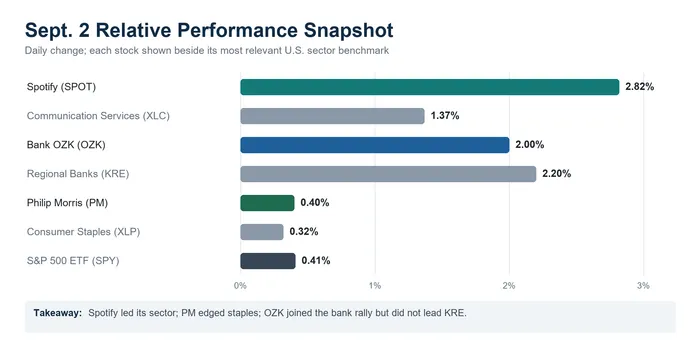
Price action supplied confirmation. On Sept. 2, Spotify rose 2.82%, compared with 1.37% for the Communication Services Select Sector SPDR and 0.41% for the S&P 500 ETF. That is outperformance of about 1.45 percentage points versus its sector and 2.41 points versus the broad market. Unlike an isolated volume spike, the move shows buyers selecting Spotify over relevant benchmarks.
The risk is that authorization can be mistaken for completed buying. The thesis would weaken if Spotify leaves most of the capacity unused, if the stock loses its sector leadership, or if cash generation must be redirected toward operating needs. For now, a fresh $1.5 billion increase, a named Morgan Stanley Buy call and measurable relative strength form the cleanest catalyst stack in this week's list.
Bank OZK (OZK): A Discounted Bank Tests a Broader Earnings Mix
Bank OZK's newest catalyst is not an aggressive upgrade; it is fresh recognition that the business mix is changing. On Sept. 1, Raymond James analyst Nicholas Holowko initiated coverage with a Market Perform rating. He said the corporate and investment banking division is scaling rapidly and should support a broader earnings mix over time as OZKOZK-- diversifies away from its historical concentration in real estate specialty lending.
The valuation gives that transition price significance. Raymond James said the shares trade at roughly eight times its 2027 EPS estimate and about one times tangible book value. The firm also flagged near-term growth visibility, elevated real estate repayments and credit quality as reasons not to be more bullish. That balance is useful: investors are not paying a premium for a completed transformation, so successful CIB execution could create a rerating path while the current discount acknowledges what can still go wrong.
Capital return adds another support. Bank OZK's Aug. 5 quarterly filing says a new $200 million common-stock repurchase program became effective July 1 and is scheduled to remain in place through July 1, 2027 unless the board changes it. The filing also shows the bank repurchased about 0.33 million shares for $15.5 million in the quarter ended June 30, at an average price of $47.43 including excise tax. The authorization gives management room to keep retiring shares when valuation is favorable.
The Sept. 2 tape offered partial confirmation. OZK gained 2.00% while the S&P 500 ETF rose 0.41%, although the Regional Banking ETF advanced a slightly stronger 2.20%. The stock therefore participated in the bank rally and beat the broad market, but it has not yet established sector leadership. That distinction keeps the signal useful without overstating it.
The invalidation point is credit, not headline momentum. The thesis would weaken if criticized assets or charge-offs rise further, if real estate repayments overwhelm CIB growth, or if repurchases slow despite the discount. For now, fresh analyst attention, a low starting multiple and an active capital-return program make OZK a credible value idea, with clear operating tests rather than vague turnaround language.

Independent investment research powered by a team of market strategists with 20+ years of Wall Street and global macro experience. We uncover high-conviction opportunities across equities, metals, and options through disciplined, data-driven analysis.
Latest Articles
Unlock Market-Moving Insights.
Subscribe to PRO Articles.
Already have an account? Sign in
Stay ahead of the market.
Get curated U.S. market news, insights and key dates delivered to your inbox.


AInvest
PRO
AInvest
PRO



