The number doing the work in this headline — "4% of global oil supply" — isn't a guess, and it isn't media panic. It is a measure of the one pipeline Saudi Arabia had left. Since the Strait of Hormuz effectively closed when the U.S.-Iran war began in late February, the kingdom has pushed as much as four to five million barrels a day of crude across the Arabian Peninsula on the East-West line, from Abqaiq to the Red Sea port of Yanbu, to keep its Asian buyers supplied. That much crude is roughly four percent of what the world consumes each day. When the line's pumping stations were hit on Sept. 10, Saudi shut the pipeline down "as a precautionary measure" and left exports hanging on whatever could still be moved and whatever remained in storage.
Why the pipeline can't be swapped out quickly
The reason four percent feels outsized is that the usual alternatives are unavailable. The Strait of Hormuz carried roughly 20 million barrels a day of oil and refined product before the war; that traffic has since fallen to a trickle, a disruption the International Energy Agency has called the largest supply shock on record. Yanbu's crude was the substitute for that loss, and Yanbu sits on the Red Sea — a body of water the Houthis now threaten to close at its southern outlet, the Bab el-Mandeb strait. Saudi could in principle reroute barrels north through Egypt's SUMED pipeline and the Suez Canal. But SUMED can move only about 2.5 million barrels a day, it is shared with other producers, and it empties into the Mediterranean rather than onto the tankers that carry Saudi crude to Asia. Fully loaded supertankers cannot transit the Suez Canal, so the practical journey for an Asian buyer stretches from roughly three weeks to six or seven, tying up a tanker fleet that is already tight.
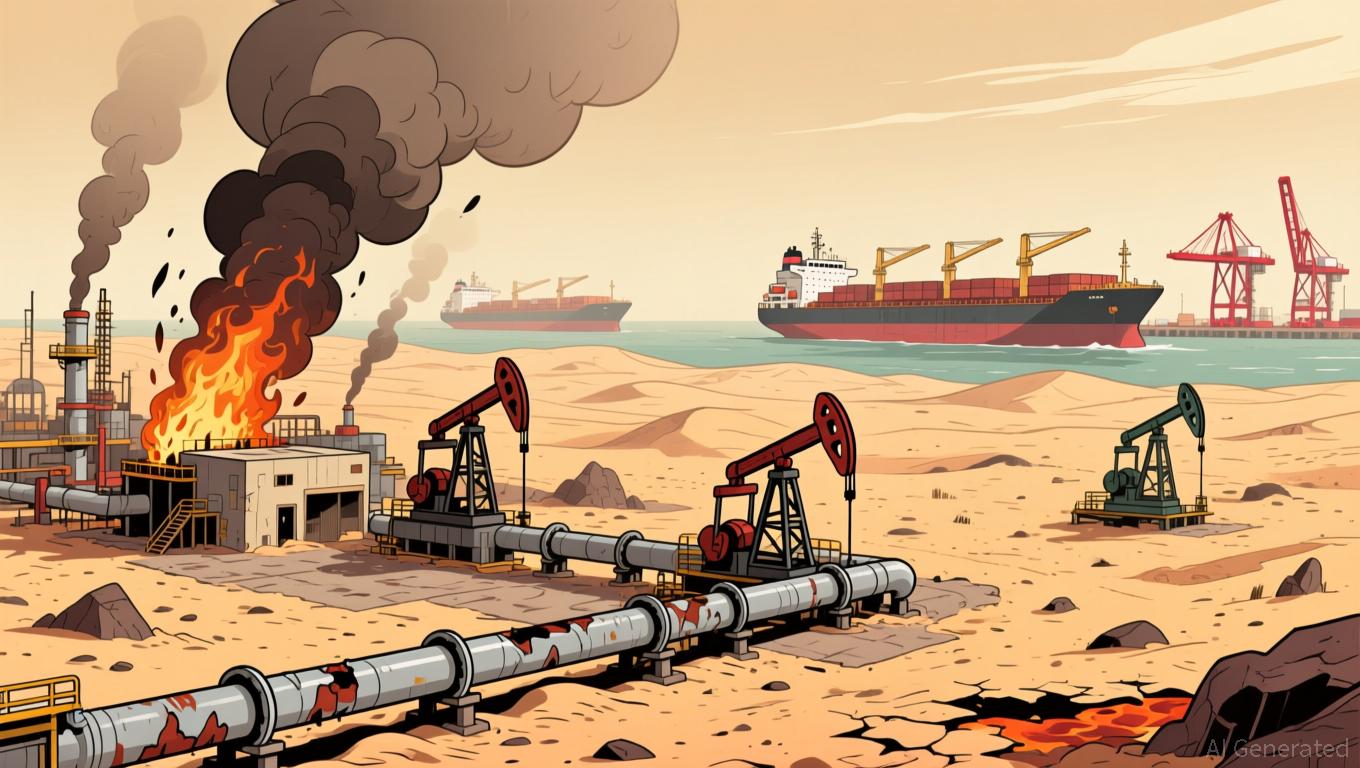
That is the physical setup, and pipes do not lay new track overnight. It is why the traders and buyers on the ground describe Saudi running out of export stocks "within days" if pumping does not restart.
Quick Backtesting Tool
Where the news reaches a stock's cash flow
For an equity investor, none of this matters until it reaches a company's cash flow, and the transmission is crude pricing. Global benchmark Brent surged back above $100 a barrel on the news and trades near $104 — it sat near $72 before the war, spiked above $119 at its March extreme, and has spent months oscillating in the $90s. For an upstream producer, every sustained dollar of realized crude is nearly pure cash flow: revenue rises with the barrel, while most of a producer's costs do not. That is the mechanism that turns a pipeline outage in one country into higher free cash flow, lower leverage, and more buyback or dividend capacity at a drilling company in Texas, the Permian, or the Gulf of Mexico.
But the same mechanism runs backward, and that is where the careful investor parts from the headline-chaser. Oil is a mean-reverting commodity, and the U.S. Energy Information Administration — whose job is to make exactly this forecast — already assumes Middle East flows stay constrained through the end of 2026 and then gradually normalize, with Brent averaging about $90 a barrel in the second half of this year, sliding to the mid-$70s by mid-2027 and into the mid-$60s later that year. A geopolitical premium that is real today is, on the EIA's own modeling, expected to fade within a few quarters of restored flow.
The margin-of-safety test
That brings the question back to where a cash-flow investor always lands: price versus durable value. It is not enough that producers benefit from the spike; the market has been paying for it for months. A representative low-cost U.S. producer, EOG Resources, is up about 40% year to date, and the pure-oil Permian producer Diamondback is up roughly 36%. By the time a headline like "4% of supply" reaches a phone, much of the easy re-rating has already happened.
That does not make the sector wrong or uninteresting — elevated supply risk that feels durable is genuinely favorable to producer cash flows. But it changes what you should buy it for. A name bought here has to earn its keep as a business at lower oil prices, not just as a trade on this month's premium. The honest check is the same one I run on any energy holding: does the cost position and balance sheet let the producer keep generating cash flow and covering its payout if Brent slips back toward the EIA's $70s forecast, rather than the $104 spot in the headlines? If the answer is "only if oil stays high," you are buying the spike. If the cash flow survives a return to normal crude, the outage is a tailwind you are being paid to wait for.
There is also an easy-to-miss wrinkle: not every "energy" stock that pops with the headline benefits the same way. Producers with benchmark-priced barrels collect the price gain directly. Refiners pay that gain as a cost on their feedstock. And fee-based midstream pipelines are largely insulated from the barrel price — their exposure here is physical volume, not price. So the outage is not a uniform "buy energy" signal; it is a reason to look company by company at whose cash flow actually changes and whether the share price already reflects it.
The Saudi line will likely restart — a similar attack in April took about three days to repair — and the point of this headline is not that the world is running out of oil, nor a refusal to look at energy. It is that the hard part of energy investing is not spotting the shock; it is deciding what the business is worth when the shock, as it eventually will, recedes. The outage makes the cash flows bigger for a while. It does not change the test.