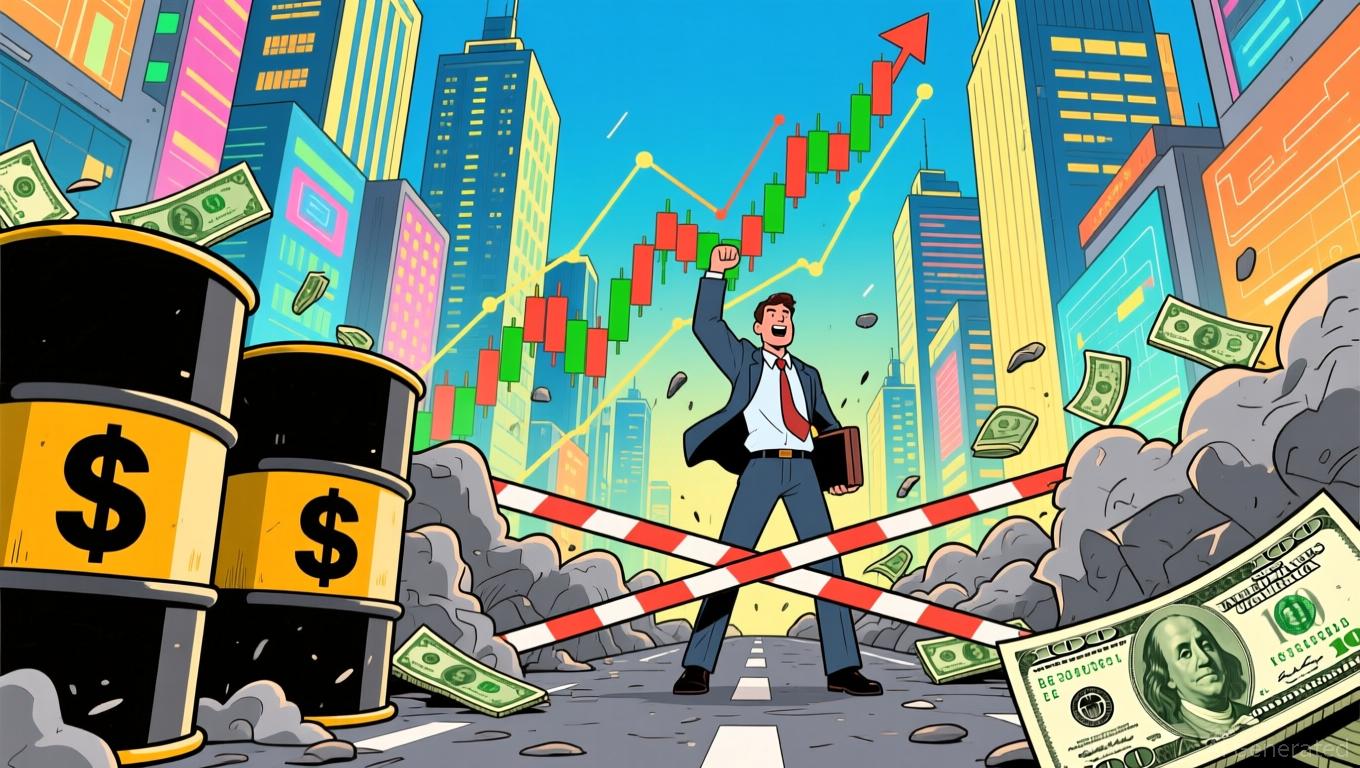
THE ANNOUNCEMENT that EnviriNVRI-- has concluded its engineered-to-order contracts with Deutsche Bahn and Network Rail sounds, on the surface, like a relief dividend for shareholders of the freshly spun-off industrial-services company. The contracts were money-losers, their drag widely acknowledged. Ending them removes the most obvious cloud over Harsco Rail, the company's rail-equipment arm. The real question is whether the market's enthusiasm is justified or merely a tidy narrative for a stock that has already run.
To understand the significance, the contracts need a brief history. Harsco Rail, once a standalone firm before being folded into the Enviri conglomerate, signed large fixed-price agreements with three European railway operators: Germany's Deutsche Bahn, Britain's Network Rail and Switzerland's SBB. The deals were signed before the pandemic, at a time when steel prices, labour costs and supply-chain frictions were benign. Inflation did the rest. Fixed prices met rising costs, and the contracts turned from revenue sources into cash drains. By the first quarter of 2026, Enviri had set aside $56.7 million in reserves for forward losses on these contracts alone.
The contracts were also the primary reason Harsco Rail could not be sold or spun off on its own in earlier years. They tied the rail business to a predictable path of losses, making it unattractive to buyers and a drag on the broader conglomerate. Management's 2026 guidance projected Harsco Rail to deliver adjusted EBITDA — a rough proxy for cash earnings before interest, taxes and non-cash items — of between -$26 million and -$19 million for the full year. That negative outlook was almost entirely a function of these three deals.
Quick Backtesting Tool
As of the end of the first quarter, the contracts were only partially done. SBB was 91% complete, Network Rail 68% and Deutsche Bahn 56%. Progress was measured in percentages of costs incurred, not milestones celebrated. Network Rail was reportedly the subject of early-exit negotiations; Deutsche Bahn had been renegotiated. The announcement that the Deutsche Bahn and Network Rail obligations have now been concluded — whether through settlement, early termination or formal completion — resolves the two largest uncertainties in the company's rail portfolio.
The timing matters because it follows the June 1st launch of "New Enviri", the entity that emerged after the parent company sold its Clean Earth environmental-waste business to Veolia for $3.04 billion and distributed $15 in cash per share to existing holders. New Enviri, which trades under the same NVRI ticker, is a much smaller enterprise: roughly $1.2 billion in annualised revenue and an expected adjusted EBITDA of $140 million. Of that, Harsco Environmental contributes an estimated $175 million, leaving Rail as a structural deficit. The $101.5 million backlog that remained on the three ETO contracts at the end of 2025 was both an asset and a liability: guaranteed revenue at prices the market no longer honoured.
Concluding the Deutsche Bahn and Network Rail contracts should, in theory, unmask the rail business's underlying economics. Management has pointed to a path where the segment returns to cash-flow break-even after 2026, with losses rolling off through 2027 and 2028. The SBB contract, already nearly finished, is the last remaining item. Once the ETO chapter closes, the segment can reduce headcount, refocus on its standard equipment and aftermarket-parts businesses and operate without the distortion of loss-making fixed-price work.
To be sure, the market has not been sitting still. New Enviri's stub shares — which reflected the value of the company after stripping out the Clean Earth proceeds and cash distribution — were trading at an implied multiple of roughly 4 to 5.5 times EBITDA before the spin-off, well below the 7 to 8 times that peer environmental-services firms command. The stock has since climbed from its post-launch base, closing at $22.41 on August 6th, up more than 25% year-to-date. Some of the relief from ETO resolution was clearly anticipated. The stock's recent move suggests investors were pricing in the mechanical tailwind of loss contracts rolling off.
The deeper problem is that "rolling off" is not the same as "turning round". Removing a drag is a necessary step, but it does not by itself create earnings power. Harsco Rail's standard equipment and aftermarket businesses have their own challenges: cyclical demand from railway operators, competition from firms such as Alstom and Wabtec, and a European infrastructure market that is buoyant but not growing fast enough to absorb a sudden surge in order books. The rail segment's pro forma 2026 operating loss of $29 million, even before the ETO losses, is a reminder that the business's fixed cost base is not trivial.
The structural incentive for management is clear. New Enviri's new chief executive, Mr Russell Hochman, has promised to "get Rail fixed" before considering any sale. That is a credible sequence: a loss-making division is difficult to sell, and a cleaned-up one could command a better price or justify higher multiples within the combined entity. But the timeline is the constraint. Shareholders who paid attention to the spin-off maths were offered a sum-of-the-parts pitch that assumed Rail's losses would taper. If they persist longer than expected, the multiple expansion already baked into the stock reverses.
AInvest's aggregate signal labels New Enviri a Buy, with a high fundamental score of 9.34 out of 10, reflecting the improving cost profile and the Clean Earth exit. Aggregate signals of this kind are useful as a cross-check but not as a thesis: they compress forward-moving improvements into a single grade without revealing which expectations, if disappointed, would break the case.
The investor implication follows from the mechanism. The conclusion of the Deutsche Bahn and Network Rail contracts is a genuine step forward. It removes uncertainty, frees working capital and clarifies the path to breakeven. But the stock's current level assumes more than relief. It assumes that the underlying rail business can grow its way to profitability once the losses are gone — a claim the earnings record has not yet proved.
The better test is not whether the old contracts are finished. It is whether the new ones are worth the paper they're written on. Investors should watch order books in the standard equipment and aftermarket lines, not just the headline that the loss contracts are done. A rail turnaround that depends on the absence of losses, rather than the presence of demand, is a fragile one.