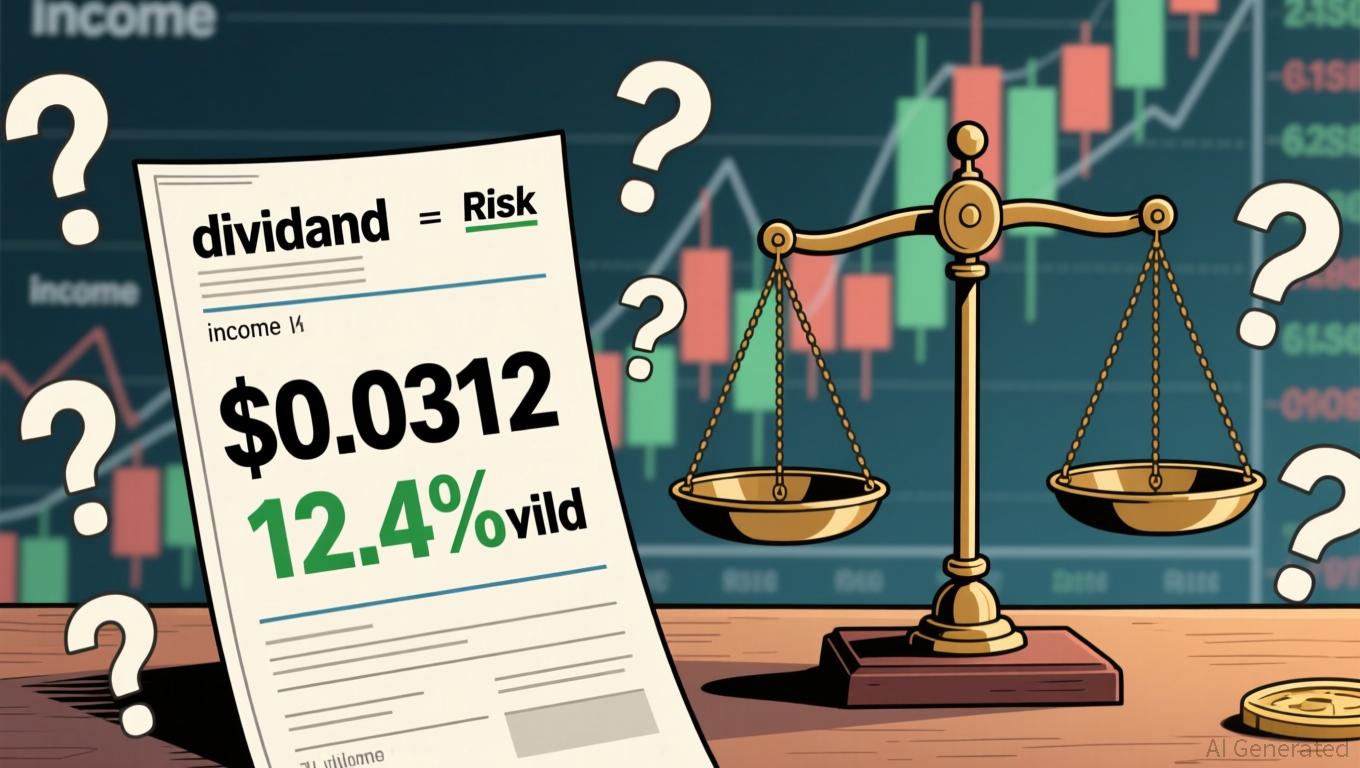
NRO's 12.4% Yield Pairs a Steady $0.0312 Payout With Real Questions
NRO looks like an income fund first and a growth story not at all.
The headline is straightforward: a 12.40% forward dividend yield on a distribution that has held at $0.0312 per share for many months. That kind of cash return draws attention, but the right expectation here is current income, not automatic compounding. The key question is whether management can keep that payout coming from income the portfolio can sustainably produce.
Quick Backtesting Tool
What matters most is the payout source
The fund itself frames the debate. Under its level distribution policy, it anticipates regular monthly distributions of $0.0312 subject to market conditions, and it says payouts may consist of net investment income, net realized capital gains and return of capital. In other words, a high yield is only as attractive as what is funding it.
The valuation adds another layer. Shares traded around $3.02 against a NAV of $3.32, a -8.21% discount. That can look like value, but it does not automatically offset a payout that is becoming less secure.
The payout looks steady, but leverage keeps the risk visible
The steady $0.0312 per share distribution is the draw, but stability is not the same as safety. The fund says there is no assurance that the Fund will always be able to pay a distribution of any particular amount, so the main watchpoint is the quality of the income behind the check.
NRO is built for income, not simplicity
NRO's primary objective is high current income. It is also a closed-end fund that can use leverage through preferred stock and debt. That structure can support distributions, but it also means fixed financing costs sit above the common payout.
Right now, NRO carries $70.000M in debt and 25.14% effective leverage. That means a meaningful part of the portfolio is financed with borrowed money. In a stable environment, that can help. If portfolio income softens, though, the cushion for common shareholders gets thinner.
What bulls and bears are actually weighing
What bulls see - The current $0.0312 per share of common stock distribution remains in place. - The fund is still structured around high current income. - The shares trade at a discount to NAV, which can make the yield more attractive if the payout holds.
What bears see - Management says there is no assurance that the Fund will always be able to pay a distribution of any particular amount. - Distributions may consist of net investment income, net realized capital gains and return of capital. - The fund uses leverage through preferred stock and debt, and its ability to maintain the payout depends on the amount and cost of leverage.
Taken together, that argues for a watchful approach. NRO looks more like a monitor-and-collect income position than a set-it-and-forget-it vehicle.
What to watch before treating this as a buy, hold, or avoid
The practical question is simple: what would make the current setup worth owning over the next few distribution notices?
Three signals matter most
First, whether the $0.0312 per share of common stock distribution stays intact. Continued payments at that level would suggest management still sees enough flexibility to maintain the policy.
Second, how the fund describes what the payment is made from. The announcement says future distributions may consist of net investment income, net realized capital gains and return of capital, so the source matters as much as the amount.
Third, the market valuation. Shares are at $3.02 versus a NAV of $3.32, a -8.21% discount. If the payout looks durable, that gap can narrow. If the payout quality weakens, a discount alone is not much protection.
How investors are most likely to use this
This looks most interesting if the next few distributions remain at $0.0312 and the fund continues to emphasize income stability, because its ability to maintain the current rate depends on the amount and cost of leverage as well as investment income and expenses.
If the payment stays steady and the discount remains, the setup can work for income-focused investors. If management starts leaning more on capital gains or return of capital, or if leverage becomes a larger part of the story, the appeal weakens quickly.