At first glance LululemonLULU-- looks like the opportunity the market keeps handing to contrarians. The stock sits near $99, a level it has not traded around in eight years, down roughly 52% year to date. It carries a forward P/E in the neighborhood of 8 to 10 times — a single-digit multiple on one of retail's best-known premium brands, with a roughly 56% gross margin and no net debt. Cheap, unloved, famous. What more do investors want?
The answer, tucked inside the September 3 quarterly report, is that this is the rare cheap stock where the multiple is cheap for the wrong reason. The classic contrarian setup — a forward P/E collapsing toward the market's while the business keeps growing — assumes the "E" holds up. Lululemon's "E" is shrinking, and it keeps shrinking faster with every guidance update. That inverts the setup rather than confirming it.
The numbers are still getting worse
Second-quarter revenue fell 4% to $2.42 billion, a miss against the roughly $2.46 billion consensus, and comparable sales sank 9%. Management did not frame this as a soft patch; it cut full-year revenue by about $650 million to $10.35–10.50 billion, a decline of 5% to 7% for the year versus a prior call for flat-to-down-1%. Full-year earnings guidance was slashed to $9.48–9.73 a share from $10.95–11.15 — the second full-year cut in three months.
Quick Backtesting Tool
The trajectory is the dangerous part. For the current quarter management guided revenue down 10% to 11% year over year and earnings to $0.93–0.98 a share, against $2.59 a year ago. That is the shape of a story getting worse, not a base forming a bottom. Lululemon's biggest market, the Americas, fell 8% with comparable sales down 12%.
Why the cheapness is partly deserved
Two details separate real damage from a market that simply overreacted. First, the reported numbers flatter the underlying business. Reported second-quarter EPS of $2.92 included roughly $0.86 a share in one-time tariff refunds; the adjusted figure that strips those out was about $2.06. The headline trailing multiple is partly a product of an accounting boost that will not repeat, meaning real earnings power is lower than the P/E suggests.
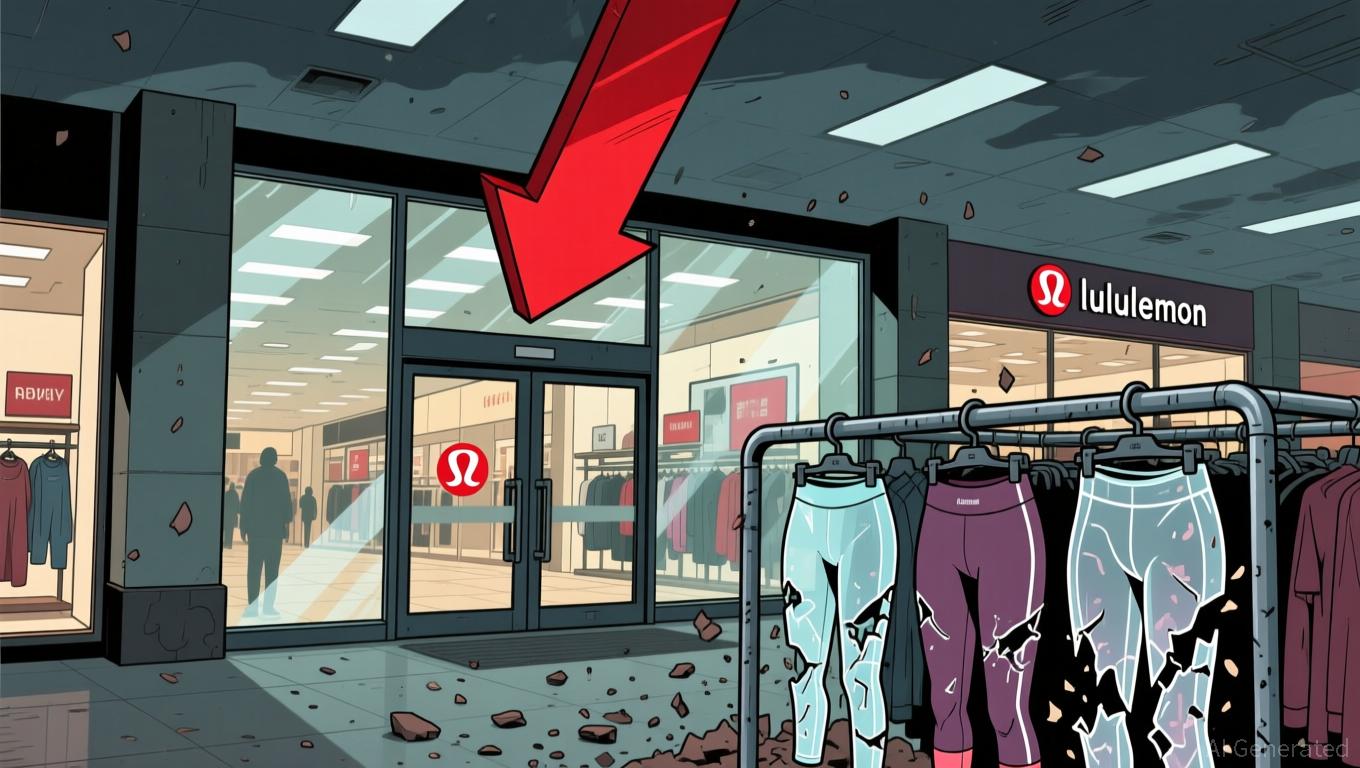
Second, the moat is showing specific, measurable cracks. Lululemon's athleisure market share fell about 10 percentage points to 43.9% over the past year. Its flagship leggings category declined roughly 20% as shoppers shifted toward looser, "away-from-body" silhouettes that rivals such as Alo and Vuori had already moved into. Interim co-CEO Meghan Frank attributed part of the slowdown to negative social-media commentary — a marketing problem she called a "bounded half-life" — but she gave the core-category slowdown a heavier label: a product-level issue. Leggings are the brand's proposition; when the central product sheds a fifth of its sales, that is not just sentiment. Toss in the Texas attorney general's probe into "forever chemicals" in its clothing and securities class-action investigations, and the discount is carrying more baggage than a reputation hiccup.
A real buy waits on the numbers, not the name
The genuinely intact pillars are worth naming, because they are the difference between a broken business and a beaten-down one. Gross margin near 56%, roughly $1.4 billion of cash, and more than $1.3 billion of trailing free cash flow give Lululemon room to survive a long rebuild, and China is still guided to high-single-digit growth. There is also a catalyst the stock is now discounting: Heidi O'Neill, the former Nike executive who helped grow that company's women's business into a far larger one, took over as CEO on September 8, replacing an interim team that has had to walk back guidance twice.
But a new CEO is a reason to watch, not a reason to catch a falling knife. Consensus has largely retreated to Hold as conviction has drained out of the name, and BMO Capital's bearish Underperform call carries a $70 target — a reminder that the sell-side floor can still drop. The burden of proof sits with the bulls here, and it is a mechanical, observable burden: whether third-quarter results come in less bad than the 10%–11% decline guide, whether the leggings decline flattens as new silhouettes arrive, and whether the Americas comp stops falling. Until those move, the single-digit P/E is a markdown that keeps getting marked down, not a bargain with a floor.
I do not see a clean contrarian buy yet. The market has not priced in a doom scenario the numbers contradict; it has priced in a deterioration the numbers confirm. Lululemon is cheap — but inexpensive alone is not a setup, and it is the underlying business, not merely the stock, that needs to stop breaking first.