Date of Call: Aug 6, 2026
Financials Results
- Revenue: $668 million, up 6.2% on a continuing operations basis, up 9.3% for the Etsy marketplace standalone
- Gross Margin: Healthy low 70s% number, with a little bit of compression year-to-year (not from compute costs)
- Operating Margin: Adjusted EBITDA margin of 29.2%
Guidance:
- Q3 Etsy marketplace GMS expected between $2.53B-$2.58B, representing year-over-year growth of approximately 4%-6%.
- Q3 take rate expected to be approximately 26%.
- Q3 adjusted EBITDA margin expected within a range of 28%-30%.
- Full year 2026 GMS growth at Etsy anticipated to be in the mid-single digit range.
- Full year take rate expected roughly equal to first half of the year.
- Full year adjusted EBITDA margin outlook tightens upward to 29%-30%, incorporating expected benefit from restructuring.
Quick Backtesting Tool
Business Commentary:
Marketplace Growth and Strategic Focus:
- Etsy's
GMSfor the Etsy marketplace grew to$2.6 billion, up7.5%year-over-year, marking the third consecutive quarter of growth. - This growth was driven by strategic priorities in discovery, matching, and personalization, which are reinforcing each other to improve marketplace health and performance.
Improved Financial Metrics and Profitability:
- The company reported
revenueof$668 million, with atake rateof25.9%, and anadjusted EBITDAof$195 million, or a29.2%adjusted EBITDA margin. - The improved profitability was due to strong execution against strategic priorities and discipline in operating expenses, allowing nearly half of the revenue growth to flow through to adjusted EBITDA.
Enhanced Buyer Engagement and Mobile Growth:
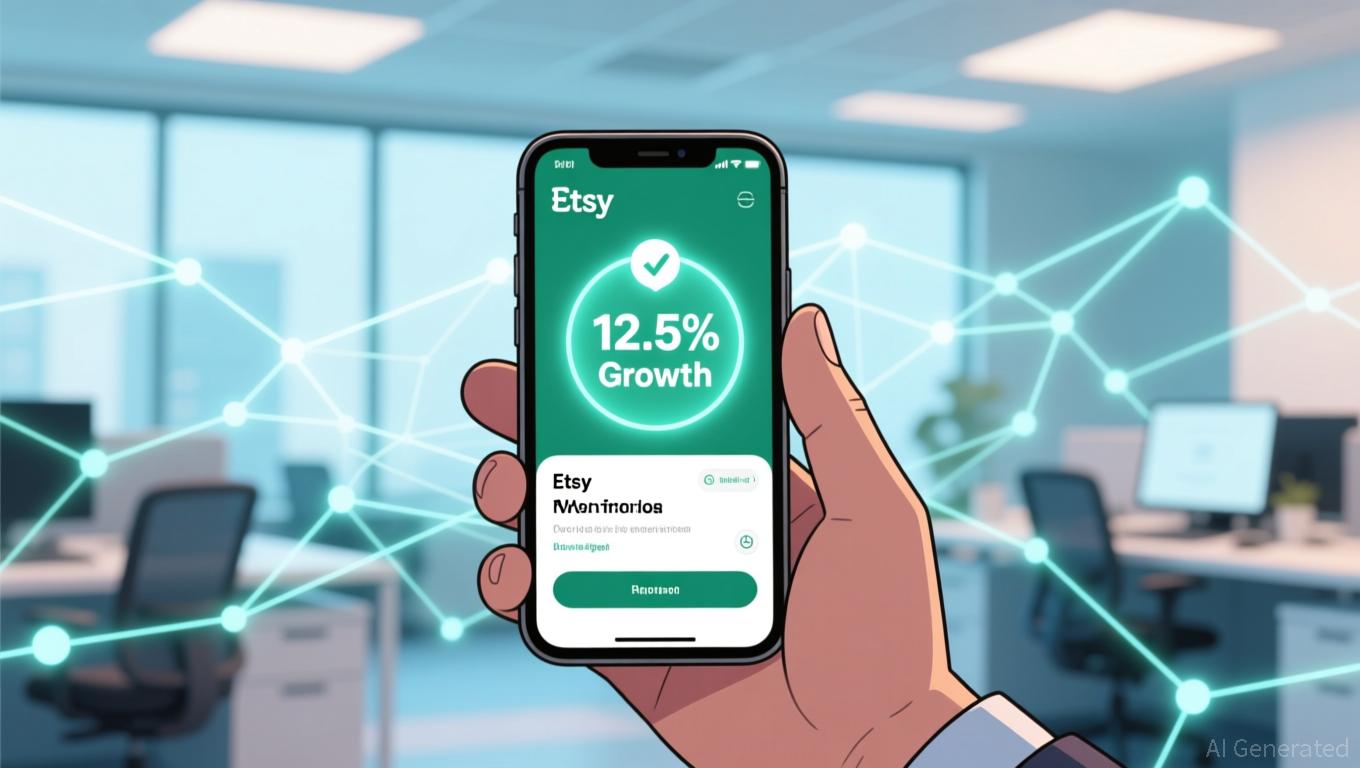
- Etsy's mobile app GMS growth accelerated to
12.5%year-over-year, withactive buyersincreasing by350,000sequentially to approximately87 million. - This was attributed to better discovery and matching, richer buyer profiles, and a more personalized experience, which drove stronger engagement and retention.
Restructuring for Future Growth:
- Etsy announced a restructuring plan reducing its workforce by approximately
12%, focusing on product and engineering groups. - The move aims to create a more focused organization with fewer silos to accelerate execution and invest more deeply in strategically critical areas like machine learning.
Capital Allocation and Share Repurchase:
- Etsy received
$1.4 billionin cash proceeds from the sale of Depop and has a new$2 billionshare repurchase authorization. - The increased share repurchase is a result of the company's growing confidence in strategic execution and the need to return excess capital to shareholders.
Sentiment Analysis:
Overall Tone: Positive
- CEO stated: "Our second quarter results reinforce our conviction that this focus is translating into stronger marketplace fundamentals, accelerating growth." CFO noted: "We’ve gained leverage across marketing, product development, and G&A." Management announced a new $2 billion share repurchase authorization, citing "growing confidence in strategic execution."
Q&A:
- Question from Rick Patel (Raymond James): Can you dig deeper on what you think are the most effective drivers of strong and improved GMS growth in Q2? What’s working and where do you see the most opportunity for improvement? Second, can you provide additional color on the initiative to improve discovery among young buyers?
Response: Growth driven by strong execution against strategic priorities: efficient marketing (especially own channels and PLA performance), product improvements (discovery, matching, personalization), and a better app experience. For younger buyers, focus is on shifting marketing investment to social/OTT channels, using influencer partnerships (e.g., Olivia Rodrigo), and creating relevant content, leading to increased reach on YouTube and TikTok.
- Question from Nathan Feather (Morgan Stanley): In some of the AOV gains that you’ve seen here, historically we’ve seen more limited uptake from sellers. How sustainable do you think that can be if trade changes normalize? On the buyer splits, really encouraging to see repeat individual buyers take a step forward here. How can we think through what have been the key elements that have allowed that to stabilize and, what’s the run rate to start to get that to grow?
Response: AOV increases driven by seller price adjustments, foreign currency tailwinds, and, more recently, improvements in relevance/quality surfacing higher-priced items. Expect price increases to be durable. Repeat buyer growth is an early signal that strategy is working; efforts include personalization, rewards, and reaching buyers where they are, alongside accelerated new buyer additions.
- Question from Ken Gawronski (Wells Fargo): Could you talk about the opportunity in live commerce, and your take on new models of distribution and emerging use cases in e-commerce, like Whatnot, and how they may or may not fit with Etsy and the platform?
Response: Live commerce is gaining traction beyond collectibles; sees potential for Etsy sellers with strong stories, but currently has no plans to launch live shopping features.
- Question from Marvin Fong (BTIG): Should we think about investing in new products as going deeper in the initiatives you’re already exploring, including AI? Are you exploring completely different products outside your existing strategy? Any impact from gas price fluctuations on buyer behavior?
Response: Investments will deepen focus on strategic priorities (discovery, matching, personalization) and build needed capabilities (e.g., machine learning). No discernible impact from gas price changes on consumer demand in Q2; growth seen across all income segments.
- Question from Maria Ripps (Canaccord): On workforce reduction largely across product and engineering, but you’re calling ML as kind of the core. Can you give more color on how smaller teams move the roadmap faster and what specifically are you choosing to stop doing?
Response: Restructuring simplifies organization by reducing overlap and reshapes talent mix to focus on capabilities critical for growth (discovery, matching, personalization, machine learning). It's an investment in execution speed and impact, not cost-cutting.
- Question from Anna Andreeva (Piper Sandler): Just wanted to follow up on some of the drivers by category. You had mentioned gifting and personalization is working well. Curious where you’re seeing in your bigger product verticals as well. Then just to follow up on gross margin, you’ve seen some compression on the higher compute costs. Should we expect that pressure to continue in 2026?
Response: Grew in every top category, outperforming peer benchmarks; strength is less category-specific and more about showing up for occasions. Gross margin compression not from compute costs; managed AI/infrastructure costs through usage shifts. No pressure expected from compute costs in 2026.
- Question from Bryan Smilek (JPMorgan): Can you talk about how you can translate this brand activation towards younger demographics into more international markets? Can you share more color on their LTV profile and conversion relative to legacy cohorts?
Response: Approach with younger buyers is globally applicable. Younger buyers have lower LTVs but higher growth potential due to life changes; pleased with beachhead established.
- Question from Nicholas Jones (BNP Paribas): On enhancing buyer profiles covering 65 million buyers, I think it’s 3x the data points. Can you speak to what the funnel looks like to aggregate these data points and what it would take to drive that 65 million buyer number higher?
Response: Buyer profiles can be built for all buyers; they get richer with engagement. The focus is on expanding coverage and using the data to personalize experience, recommendations, marketing, and search results.
- Question from Michael Morton (MoffettNathanson): Could you give examples of growing direct relationships with most active buyers by optimizing communication? On some of the cost savings from the reorganization, why not reinvest even more in marketing?
Response: Optimizing communication involves improving relevance, personalization, and freshness of content across email and push channels. Restructuring not intended to alter long-term margin profile; savings will be reinvested in engineering, product, customer ops, and R&D. Marketing efficiency is improving, allowing more effective spending; no frontier being hit.
- Question from Shweta Khajuria (Wolfe Research): Could you please talk to what specifically has changed in your marketing spend and strategy, where you’re seeing best returns, and how much runway do you have left? Second, talk to mobile app users and where you see runway for growth.
Response: Marketing improvements include better PLA segmentation, shifts to social and targeted streaming, and effective use of owned channels (email, push, app). App GMS growth driven by existing users purchasing more and new buyers; improvements in discovery, personalization, and feed freshness driving engagement.
- Question from Ygal Arounian (Wedbush): I wanted to dig into the tech investments, particularly around ML. What’s evolving here on that, and how does that tie into agent of commerce?
Response: ML investments focused on discovery, matching, and personalization to make Etsy more personal and improve inventory relevance. AI also used for off-Etsy discoverability and experimenting with AI-native shopping experiences (e.g., conversational interfaces like gifting assistant).
- Question from Youssef Squali (Truist): The 50% flow-through from incremental revenue to adjusted EBITDA in Q2 is pretty impressive. Maybe talk about the biggest drivers there and just the sustainability. Help us understand how you think about balancing increase in marketing spend with the $2 billion buyback.
Response: Flow-through driven by unexpected GMS growth from improved marketplace health. Incremental margins will move within historical ranges. Marketing efficiency gains allow continued investment; buyback uses proceeds from Depop sale to return capital to shareholders, complementary to marketing spend.
- Question from Oliver Lester (Arete Research): I wanted to know whether you expect to see any impact from the recent EU de minimis changes. My second question is just on Etsy Insider.
Response: No big impact expected from EU de minimis changes; Etsy helps sellers navigate. Insider is part of broader loyalty focus; testing more mechanics but no specific update.
Contradiction Point 1
Impact of AI/Agent Traffic on Conversion and User Behavior
It directly impacts expectations regarding the effectiveness of AI-driven traffic in converting to on-platform sales, influencing marketing strategy and user engagement metrics.
Ygal Arounian (Wedbush) - Ygal Arounian (Wedbush)
2026Q2: AI traffic from agentic experiences is still <1% of total but shows high intent and AOV. - Kruti Patel Goyal(CEO)
How are evolving tech/ML investments influencing your role as an agent of commerce? - Bryan Smilek (JPMorgan)
2026Q1: Etsy's app with OpenAI has not yet launched. The strategic shift reinforces the hypothesis that agentic shopping can become a meaningful discovery channel over time. Current trends show strong traffic growth and high-intent traffic. - Kruti Goyal(CEO)
Contradiction Point 2
Sustainability and Drivers of Average Order Value (AOV) Growth
It involves changes in the primary driver and durability of AOV increases, which is crucial for understanding future revenue sustainability.
Nathan Feather (Morgan Stanley) - Nathan Feather (Morgan Stanley)
2026Q2: Listing price increases (due to tariff changes, expiration of de minimis) are durable and flowing through to AOV. - Lanny Baker(CFO)
What factors are driving the sustainability of recent AOV gains and the stabilization of repeat buyer cohorts, and what is the current growth run rate for these cohorts? - Naved Khan (B. Riley Securities)
2026Q1: Stripping out FX and listing price changes, there is still growth in AOV from product optimizations. Changes to search algorithms... are contributing to AOV growth, though these factors are currently outweighed by the other, more significant contributors (listing price changes). - Charles Baker(CFO)
Contradiction Point 3
Strategy for Engaging Younger Buyers
It reflects a contradiction on the primary platform for reaching younger demographics, affecting marketing strategy and channel investment focus.
Rick Patel (Raymond James) - Rick Patel (Raymond James)
2026Q2: Shifted marketing investment to social channels (YouTube, TikTok), OTT, and relevant content. Partnerships like Olivia Rodrigo driving innovative engagement. Increased reach to Millennial/Gen Z audiences (5x visits in those channels in H1 2026). - Kruti Patel Goyal(CEO)
What are the most effective drivers of strong and improved GMS growth in Q2, and can you provide additional color on the initiative to improve discovery among young buyers? - Rakesh Patel (Raymond James & Associates, Inc.)
2025Q4: For younger buyers, the mobile app (where 90% of Depop GMS is mobile) and social channels are key. - Charles Baker(CFO)
Contradiction Point 4
OpenAI Partnership Financial Model and Strategic Rationale
It involves a contradiction on whether the partnership's fee is a strategic investment or directly tied to seller compensation, affecting financial modeling and strategic partnership perception.
Ygal Arounian (Wedbush) - Ygal Arounian (Wedbush)
2026Q2: AI also for off-Etsy discoverability (partnering with major AI platforms); traffic from agentic experiences still <1% of total but high intent/AOV. - Kruti Patel Goyal(CEO)
How are evolving technology and machine learning investments impacting the company's role as an agent of commerce? - Maria Ripps (Canaccord Genuity Corp.)
2025Q3: Etsy pays a success-based transaction fee (similar to affiliate/CPA) to OpenAI, which is not currently passed to sellers as part of an offsite ads program. The fee is seen as a strategic investment. - Joshua Silverman(CEO)
Contradiction Point 5
Nature of Exogenous Impact from Regulatory Changes (De Minimis)
It concerns the business impact of a key regulatory change, affecting financial stability expectations and seller support strategies.
Oliver Lester (Arete Research) - Oliver Lester (Arete Research)
2026Q2: No big impact expected; Etsy is helping sellers navigate regulatory changes with strong partner support. - Lanny Baker(CFO)
What is the expected impact from recent EU de minimis changes and any update on Etsy Insider? - Robert Coolbrith (Evercore ISI Institutional Equities)
2025Q3: A slight headwind from the de minimis exemption expiration (~a couple of weeks at quarter-end), but business stabilized quickly due to resilience in U.S. domestic inventory. - Charles Baker(CFO)