Bloom's numbers are accelerating, but the market still wants more proof
Bloom just put on a strong show. After a $1.7B AI deal with Nebius, it reported record Q2 revenue of $1.065B and raised its full-year revenue guidance. But the stock surged 11% before reversing and gave back most of those gains on the same session. That reaction suggests investors see real momentum, but not yet full conviction in the story.
Coeur, by contrast, is coming off results that are easier to verify. It reported 2025 adjusted EBITDA that more than tripled to $1B, and then posted Q1 2026 adjusted EBITDA of $475M after the New Gold transaction closed. If that run rate persists, annualized EBITDA could climb well above current market expectations. For investors who prefer assets, production, and cash flow they can trace directly to the balance sheet, that is a sturdier starting point.
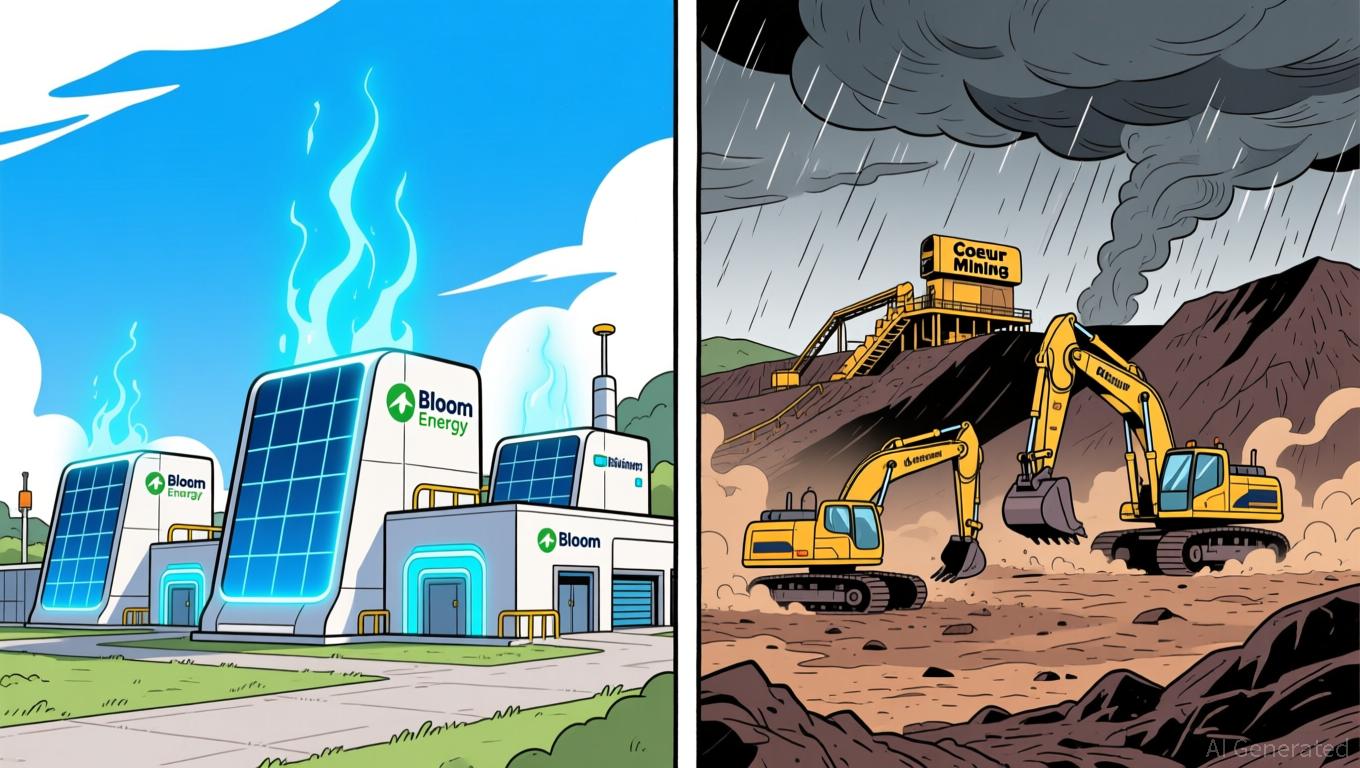
Bloom's growth is real, but monetization still has to keep improving
The bull case has substance
Bloom ended 2025 with record full-year revenues, 2.5x YoY product backlog growth, and a second straight year of positive cash flow from operations. The ramp continued into 2026. In Q1, revenue rose 130.4% year over year, product revenue increased 208.4%, and gross margin reached 30.0%. Q2 was even stronger, with record $1.065 billion in quarterly revenue, 215.4% product revenue growth, and gross margin of 33.4%. BloomBE-- also has major customers putting money behind the thesis, including Brookfield's $5 billion strategic partnership and a $1.7 billion AI deal with Nebius.
Quick Backtesting Tool
Those are not trivial signals. Backlog, improving product mix, expanding margins, and strategic capital commitments suggest real demand behind the AI infrastructure narrative.
What the market still wants to see
The open question is whether that demand keeps translating into clean earnings, not just bigger revenue lines and stronger headlines. Bears will argue that Bloom still has to prove contracts can be converted into repeatable monetization with enough consistency to justify a rich valuation. The stock's post-earnings move briefly surged 11% before reversing is a reminder that excitement alone is not enough.
The test is straightforward: - If Bloom keeps converting orders into shipments, margin expansion, and earnings, the premium multiple can be earned. - If not, the story can stall in the gaps between quarters.
Coeur's case rests on diversified assets, production, and visible cash flow
The operating base is broad enough to matter
This is not a one-mine dependency story. CoeurCDE-- says it operates seven wholly-owned operations across North America, from Nevada and Alaska to Canada and Mexico. That does not eliminate execution risk, but it does make the cash engine more durable if one site has a rough period. In 2025, strong output and pricing helped drive record full-year production and prices. In Q1 2026, production reached 96,503 ounces of gold and 4.4 million ounces of silver.
The cash flow is already in the numbers
Coeur's 2025 report showed $2.1B in revenue, $586M in net income, and $1.0B in adjusted EBITDA. The first quarter of 2026 added another strong data point, with $856M in revenue and record quarterly adjusted EBITDA of $475M. That is the advantage of this setup: investors do not need to imagine how the business turns activity into cash.
After closing the New Gold transaction, management updated its 2026 outlook to 680,000-815,000 ounces of gold, 18.7-21.9 million ounces of silver, and 50-65 million pounds of copper. Against 2025 production of 419,046 gold ounces and 17.9 million silver ounces, the upside case is easy to see: a broader asset base could support meaningfully more EBITDA if metal prices stay supportive.
Exploration could extend the upside
Coeur's $158 million investment in exploration programs in 2026 is its largest-ever exploration effort, and past exploration has already contributed to meaningful mine-life extension and reserves growth. Rainy River gained two years of additional mine life, which matters because discovery-driven extensions can add value without the company having to hunt far outside its existing footprint.
For 2026, Coeur still looks like the cleaner buy
Bloom may have the more exciting story, but investors are already paying up for it. Even with 215% product revenue growth, a $3.9B-$4.2B 2026 revenue guidance range, 2.5x year-over-year product backlog growth, and backing from Brookfield's $5 billion partnership and Nebius's $1.7 billion AI deal, the stock still surged 11% before reversing. That is less a rejection of the story than a sign that the market wants cleaner proof before paying even more for it.
Why Coeur gets the edge
Coeur is easier to own without asking too much of the future because so much of the upside is tied to assets and cash flow that can already be measured. The New Gold transaction closed, management is funding the largest-ever 2026 exploration program, Rainy River gained two years of additional mine life, and the company still benefits from higher silver and gold prices. That makes for a cleaner path to rerating if EBITDA keeps building from existing operations.
What would change the conclusion
Bloom would need to show that its raised 2026 guidance and marquee AI demand are producing steadier earnings conversion, not just bigger revenue headlines. If that happens, the stock becomes harder to dismiss as a high-flying growth premium. Until then, Coeur looks like the better balance of growth, visibility, and risk for 2026.