Boston Beer announced on September 8 that it has hired Allison Stransky as chief marketing officer, effective October 12. She comes from Samsung Electronics America, where she oversaw big data, AI-powered campaigns, and brand storytelling — a profile that reads like someone pulled from a tech playbook rather than a beverage one. Boston Beer's press release says she will "strengthen, modernize, and evolve" the company's marketing across its brands: Samuel Adams, Twisted Tea, Truly Hard Seltzer, Sun Cruiser, Dogfish Head, and Angry Orchard.
The appointment is worth reading, but not for the reason the headline suggests. A marketing hire does not rewrite an investment thesis. What the hire tells you is that Boston Beer's leadership sees a demand problem severe enough to bring in an outside profile with a data-and-AI toolkit. The question an investor should be asking is different: has the stock fallen enough that a turnaround — or even a managed decline — becomes interesting at this price?
The answer depends on separating the business's operating reality from the multiple the market is now offering.
Quick Backtesting Tool
What the volume data actually shows
Boston Beer's problem is not marketing. It is volume. Across its two most recent reported quarters, the company has posted consecutive declines in both depletions — the measure of beer actually sold to consumers through distributors — and shipments. In the second quarter ended June 27, depletions fell 6% and shipments fell 4.5%. Revenue declined 3.3% to $568.3 million. The first quarter was similarly weak: depletions down 4%, shipments down 6.9%, revenue down 4.4% to $433.9 million.
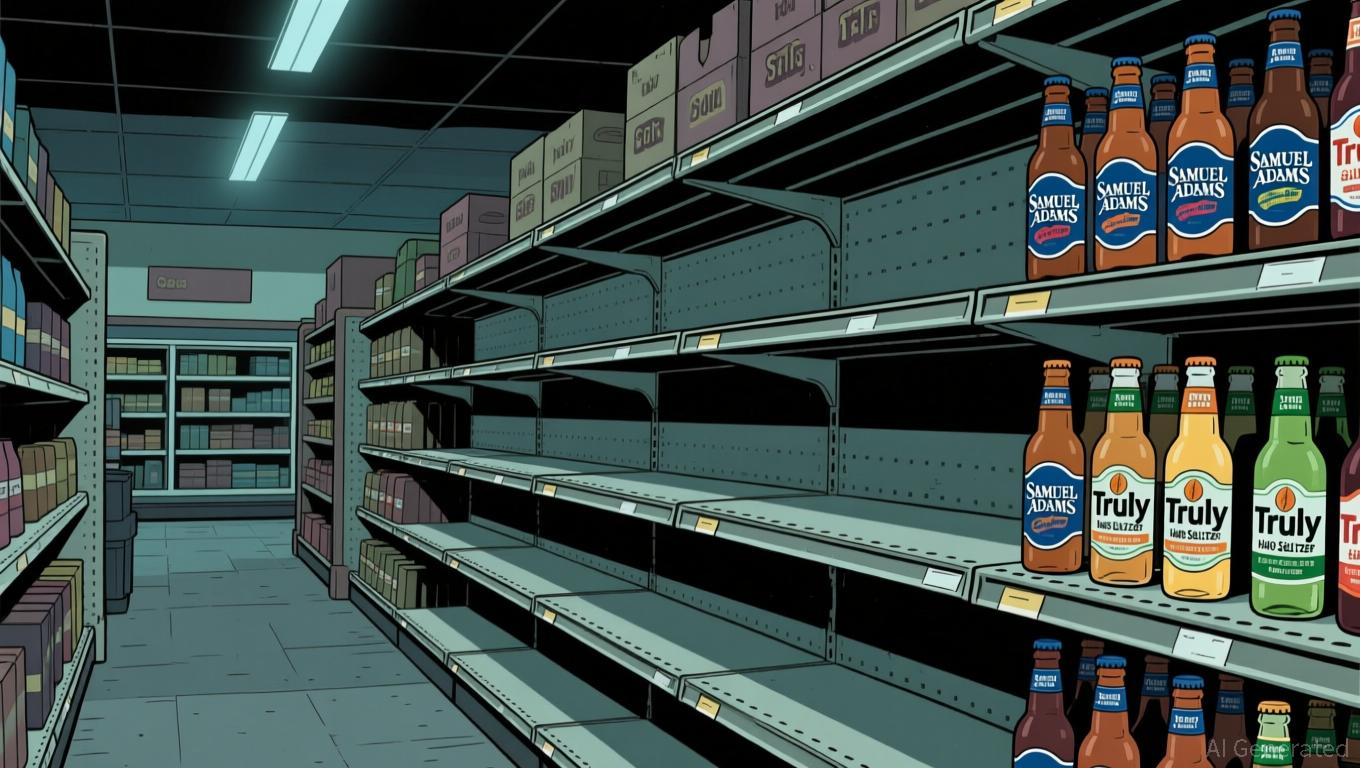
And this is not isolated to one brand. The declines hit across Samuel Adams, Twisted Tea, Truly Hard Seltzer, Hard Mountain Dew, and Dogfish Head. The only offsets have been Sun Cruiser — the company's ready-to-drink vodka — and Angry Orchard. Sun Cruiser is the one bright spot, but it's still a small player against the weight of the declining core brands.
For context, the broader craft beer industry shrank 4% in production during 2025, according to the Brewers Association. Beer dollar sales nationally fell 3.7% and volume dropped 5.2%. Boston BeerSAM-- is not uniquely broken, but neither is it outsizedly strong within a category that is losing steam.
Full-year 2026 guidance has been narrowed to reflect these trends. Management expects depletions and shipments to decline low-single digits to mid-single digits. Price increases of 1% to 2% are planned but not enough to bridge the volume gap. Non-GAAP EPS guidance sits at $8.50 to $10.50 for the full year.
The multiple has collapsed alongside the volume
Here is where the story becomes interesting for an investor. The stock has fallen roughly 23% over the past four months and sits about 35% below its 52-week high of $264.46. At the current price of around $172, Boston Beer trades at:
- 0.92x trailing sales
- 0.78x EV-to-sales
- A forward P/E of 10.5x
- A price-to-free-cash-flow of just 6.8x
These are not growth-company multiples. They are close to what you see at a mature consumer staple with no growth expectation. Boston Beer still has $1.96 billion in trailing revenue, generates roughly $206 million in free cash flow, holds $265.5 million in cash, and carries zero debt. The balance sheet is clean. The cash generation is real. But the market is pricing the stock as if the business is permanently impaired.
Part of that impairment concern is real. The company is dealing with a $175.5 million jury verdict from an aluminum can supplier dispute with Ardagh Metal Packaging, entered in early April 2026. Boston Beer has recorded the full amount in Q1, took a $19.4 million reduction in Q2 on interest adjustments, and says it intends to appeal. Post-judgment interest accrues at 3.79% until resolution. On top of that, tariffs are expected to cost $20 million to $30 million in 2026, and commodity costs for energy and aluminum remain elevated.
The litigation is a material overhang. But it's a one-time event, not a structural business deterioration. Management says the combination of cash on hand, operating cash flow, and a $150 million credit line is sufficient to cover operations and any eventual payment. That claim checks out arithmetically: $265.5 million in cash plus roughly $259 million in trailing operating cash flow gives meaningful cushion even before appeal outcomes.
The new CMO won't fix demand — but the valuation absorbs that risk
Allison Stransky's background at Samsung, Google, L'Oreal, Unilever, and Johnson & Johnson is impressive. She brings data-driven marketing experience at scale. The prior CMO, Lesya Lysyj, left in March after nearly seven years — longer than the industry average for such a role. Boston Beer's COO Phil Hodges ran marketing as interim during a search that took six months.
None of this changes the structural issue. You can optimize advertising spend and sharpen brand positioning, but a CMO does not create demand in a category where consumers are drinking less craft beer and where the post-pandemic hard seltzer surge has normalized. That was true when Truly was surging, and it's true now.
What the hire does signal is that management is not passive. They're investing in localized marketing and point-of-sale activations — advertising, promotional, and selling expenses rose 16.4% in Q2 alone. The company has also announced multiple $25 million share buyback programs, suggesting confidence that the current price is below intrinsic value. Roughly $174 million remains on the board's $1.6 billion buyback authorization.
The cheap-enough bridge
Here is the core calculation: if Boston Beer's volume problem persists through 2026 — low-to-mid single-digit declines, modest pricing, tariff costs — the business still generates meaningful cash flow from a $1.96 billion revenue base with nearly 49% gross margins. Operating margins are under pressure but the company guided to non-GAAP EPS of $8.50 to $10.50. At a forward P/E of 10.5x, the stock is priced for a company that is neither growing nor collapsing, but quietly churning cash and buying back its own shares.
The bear case is straightforward: volume continues to slide, the hard seltzer hangover lasts longer than expected, the Ardagh verdict ends up costing more than the current estimate, and new products like Sun Cruiser fail to reach scale. In that scenario, the stock is cheap for a reason — a slow-eroding business trading at what looks like a multiple that offers no margin of error if revenue drops further.
The case for attention, however, is that the multiple has already done the heavy lifting. The stock has fallen roughly 35% from its high. It trades below one times revenue. Free cash flow of $206 million on a $1.78 billion market cap implies a yield of nearly 12%, before any share count reduction from ongoing buybacks. That yield already assumes volume stays flat and margins hold. If the company manages a modest improvement — even just a stabilization of depletions — the multiple re-rates meaningfully upward from this level.
The third-quarter earnings report will come later this year, and it will tell us whether Q3 shipments follow management's expectation of a low-to-mid single-digit decline, or whether the post-summer slowdown accelerates the problem. Q4 is typically where Boston Beer shows its strongest margin expansion, so the full-year gross margin result — guided at 48.5% to 50% — will test whether supply chain efficiencies and pricing gains can offset the volume drag.
Where the thesis lands
Boston Beer is not a story about marketing renewal or AI-powered campaigns. It's a story about a brand portfolio that dominated a category during the craft beer boom, now navigating a market that has moved past it. The volume declines are real, the industry context is soft, and the litigation adds uncertainty.
But the stock is trading at a multiple that treats those problems as terminal rather than manageable. At below one times revenue with $265 million in cash, no debt, and $206 million in annual free cash flow, the valuation has already priced in a business that is worse than the latest quarter shows. A new CMO is not the catalyst. The catalyst, if one comes, will be a quarter where depletions stop falling and Sun Cruiser demonstrates it can carry some of the weight.
Until then, the investment case for Boston Beer is not about what management plans to do with data and marketing. It's about whether the market's current price reflects a company that's still generating meaningful cash from established brands — and whether that cash flow, at this multiple, is enough to absorb the risks the business now faces. The evidence so far suggests the price has moved further than the operating numbers justify, but only the next few quarters of volume data will confirm whether this is a mispricing or simply the market being right to look away.