Two of the largest chip stocks on the market just beat Wall Street on revenue and profit — and both fell.
AMD posted a record $11.5 billion quarter in late August, up 50% year over year, with data center revenue nearly doubling. It beat on the top and bottom lines. The stock dropped about 8% in the next session. Two weeks later, BroadcomAVGO-- reported $29.6 billion in quarterly revenue, up 86%, with adjusted earnings ahead of consensus — and the stock slid another 5% after the call, on a fourth-quarter guide that landed just under expectations.
The reflexive read is that the market is punishing good news. I would put it differently. Both companies delivered exactly what Wall Street was bracing for. What moved the stocks was not the quarter that was reported; it was the next quarter that was promised. These two businesses are running the same AI trade at two very different prices, and the difference in how the market treated each one tells you where the risk actually sits.
Quick Backtesting Tool
One number that explains the AMDAMD-- drop
AMD's beat is unambiguous. Data center revenue grew 107% to $6.7 billion, now 58% of the total (up from 42% a year ago). Non-GAAP gross margin is 56%, up more than 200 basis points, and non-GAAP earnings came in at $1.66 against roughly $1.62 of consensus. The data center unit swung from a $155 million loss a year earlier to $2.1 billion of operating income. That is not an ordinary beat.
So why did the stock fall? The honest answer is that the part of the story that matters most is not yet in the numbers. In the last two to three months, CEO Lisa Su has reframed the server CPU business around what she calls agentic AI — the workloads where AI systems reason and act rather than just generate text. Her claim is that these workloads change the balance inside a server. Historically a data center server ran something like four to eight GPUs for every CPU. As agentic workloads take over, the ratio drifts toward one-to-one, and CPUs become a much bigger share of the box. On that read, the server CPU market grows from roughly $120 billion toward $220 billion by 2030, expanding at over 50% a year, and AMD expects server CPU revenue to grow more than 70% in 2027 and its entire data center segment to more than double.
Now separate the claim from the result. The 2027 numbers are a roadmap, not revenue. AMD guided third-quarter revenue to about $13 billion with data center growth described as "strong double-digit" — a big step down from the 107% the segment just posted, and a tell that the current-quarter ramp is decelerating. The product that is supposed to carry the 2027 story — the Helios rack and MI450 accelerators — only begins shipping this quarter, and the meaningful deployments (Anthropic's first gigawatt of MI450, Microsoft running Helios at scale on Azure) are not scheduled until the first half of 2027. Meanwhile the stock is up about 143% this year and trades around 132 times trailing earnings.

That is the whole judgment. AMD is priced for the 2027 ramp to land on time, on schedule, and at the claimed rate. The beat did not surprise; it was expected. What the selloff was pricing in is the distance between a roadmap that management is confident about and a line item that has not yet hit the income statement. A road map only creates value if it can be manufactured, deployed, and supported on schedule — and AMD's biggest growth engine does not meaningfully ship for the rest of the year. The market was not wrong about the demand. It was right to price in the execution risk on a company at this multiple. The question is not whether AMD grows; it is whether it is worth owning at 132x while the proof is still out on delivery.
The Broadcom discount that the multiple is hiding
Broadcom is the other side of the same coin, and the numbers say a different story. Revenue is up 86% to $29.6 billion, and the AI-specific part of the business — the custom chips it designs for a handful of the biggest technology companies — is now $16.7 billion, up 221% year over year and 54% in a single quarter. Operating margins run above 40%, free cash flow was $13.7 billion (46% of revenue), and the stock trades at about 45 times trailing earnings. AMD grows at 50% and trades at 132x. Broadcom grows at 86% and trades at 45x. On the scoreboard, Broadcom is the cheaper way to own the AI buildout.
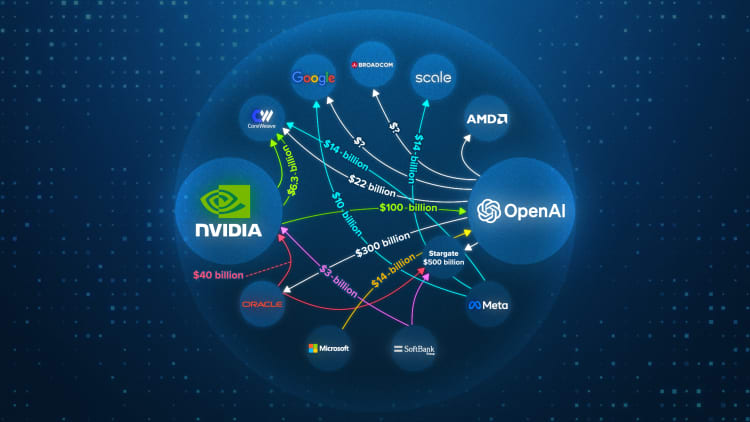
The reason the market is less enthusiastic is not a valuation problem. It is a concentration problem. Broadcom's AI revenue is concentrated in a small group of customers — Google, Meta, and increasingly OpenAI, whose custom "Jalapeno" chip it just highlighted. The CEO has said AI chip revenue will be "significantly in excess of $100 billion" in 2027, a figure that rests on long-term commitments from exactly this cluster of clients. The Q4 guide of about $34.8 billion, slightly under the roughly $35 billion Street was hoping for, read to some investors as the first hair in that concentration: one customer's deployment timing slips, and the number wobbles. That is a real and different risk from AMD's. Broadcom's risk is not whether the chips can be built — it is whether a few of the largest customers in the world keep adding capacity at the pace management is guiding. And a $100 billion AI business that depends on a handful of relationships is a different kind of asset than a diversified one, even at a far lower multiple.
Where I would put my money
I would not frame this as "Wall Street is wrong." The market's moves were both rational. AMD's selloff was the market insisting that a 132x multiple needs proof the roadmap is real, not just promising. Broadcom's selloff was the market asking what happens when the customers guiding that $100 billion are so few that a single scheduling change shows up in the guide.
What I would say is that the two are not the same position wearing two tickers, and a retail investor deciding between them should treat them as separate bets. AMD is a higher-variance bet that the agentic-AI CPU story and the Helios ramp arrive on time — you are paying a premium for a 2027 outcome that is mostly still a claim, so the return curve has to be back-half weighted for that to work. Broadcom is a lower-variance bet that the handful of hyperscalers keep spending, priced at a multiple that already discounts a meaningful amount of that risk. If I had to allocate across the two, I find the risk/reward on Broadcom more compelling today — the multiple leaves more room for the growth it has already delivered — while AMD is the trade for someone who believes the CPU shift lands in 2027 and is willing to carry a 132x multiple to get it.
The test is not an analyst target. It is a calendar. Broadcom reports its fourth-quarter results in December — the first hard number on whether that guide was a blip or a pattern. AMD follows in early November with the first full Helios quarter and the first sign of whether the "double-digit" data center growth is the floor, not the ceiling. Those two dates are where the thesis either gets confirmed or the multiple has to come down. Until then, the honest read is this: both companies proved the demand is real. The market is no longer paying for the demand. It is paying — or not paying — for the execution.