China's DUV milestone exposed the real policy risk for memory makers
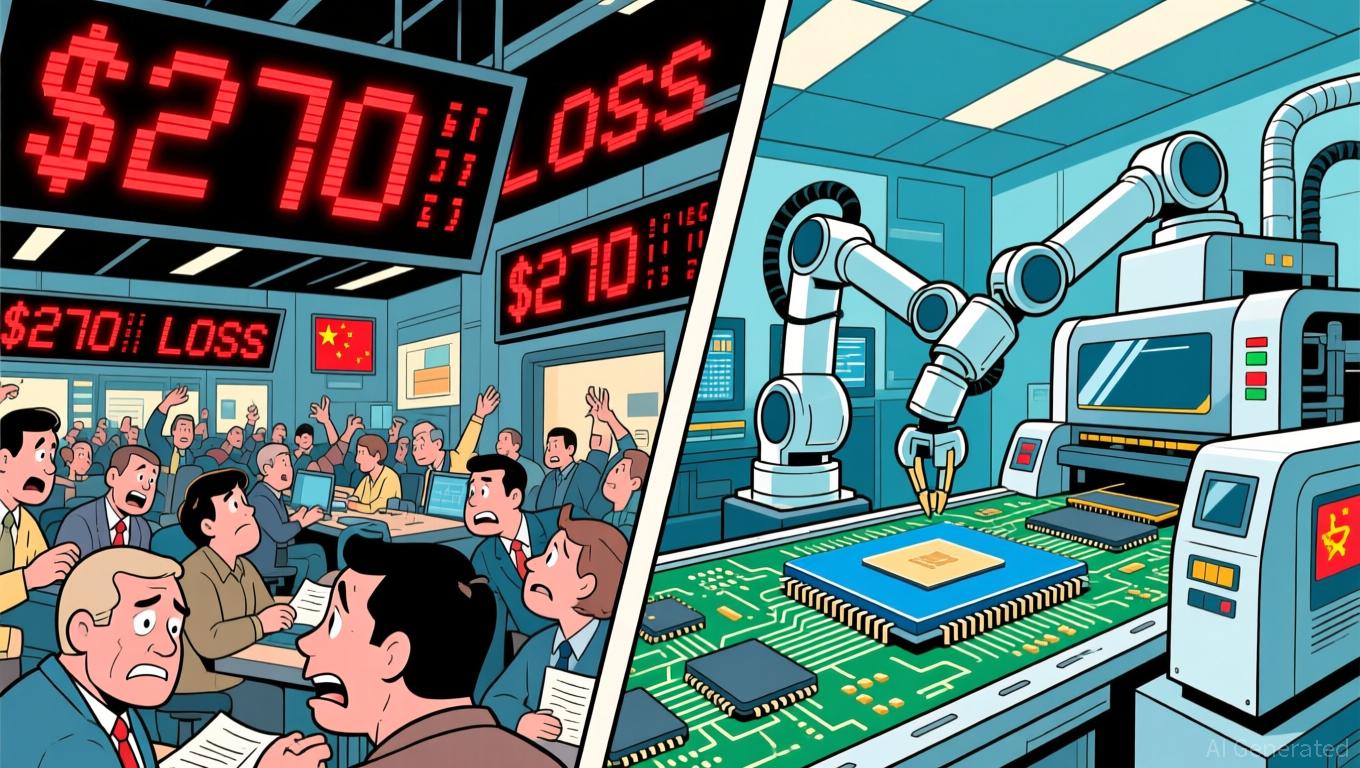
This week's selloff wiped out about $270 billion in a single day.
Why the market reacted so sharply
Earlier this month, investors learned that a state-backed Shanghai firm delivered the first domestically produced immersion DUV lithography machines to Chinese chipmakers. The event did not just make headlines; it challenged a core assumption behind Western export controls. South Korean stocks lost approximately ₩396 trillion, or about $270 billion, in one session, and the market's reaction showed how quickly investors are reassessing the idea that China's chip capabilities can be permanently capped.
The permission system is now the risk
The issue is no longer only "more restrictions someday." It is now a case-by-case approval process. Reuters reported that Washington granted Samsung and SK HynixSKHY-- an annual licence to bring in chip manufacturing equipment to their facilities in China for 2026. That replaced broader exemptions with a system that requires fresh approval for the next year. If each shipment or upgrade becomes negotiable, servicing, spare parts, and expansion in China become harder to plan around.
Testing Chinese equipment is insurance, not a strategy switch
That helps explain why Reuters says Samsung and SK Hynix are evaluating chipmaking equipment from China's Advanced Micro-Fabrication Equipment at their China plants. The key point is that this is still contingency planning. The trials are meant to reduce disruption risk if U.S. curbs tighten, and they are not a commitment to deploy Chinese tools at scale. Even so, the fact that foreign-owned fabs are running these tests matters. If a process step validates, Chinese equipment suppliers would gain uncommon exposure inside global memory manufacturing.
The hedge is about fab resilience, not a full swap to Chinese tools
After a day that erased roughly $270 billion and under a system that now depends on an annual licence for 2026, the real question is operational: how does a fab stay productive if Washington changes the rules again?
Why backup-tool testing makes sense
Samsung and SK Hynix have not suddenly pivoted. Reuters says the firms began testing AMEC etching equipment about two years ago as uncertainty grew over whether Washington would keep allowing tool imports into China. This looks less like a panic reaction and more like slow, practical risk management inside the factory.
The logic is straightforward. Memory fabs consist of many tool steps. If a key piece of equipment faces servicing pressure or approval delays, a validated backup supplier can help keep the line moving. This is not about replacing the whole toolbase overnight. It is about preserving throughput and flexibility if permits get tighter.
What testing does not mean
Investors should not confuse evaluation with adoption. Reuters has said the trials have yet to result in decisions on wider deployment, which means this remains a hedge rather than a full transition to Chinese equipment. Fab qualification still comes down to yield, uptime, and cost per chip, and those standards do not change just because the geopolitical backdrop gets more stressful.
Where the near-term opportunity is most credible
The immediate opening is not across every tool in the fab. It is more likely to show up in selected process steps where Chinese equipment can prove reliability. That helps explain why the first real debate is about qualification progress rather than sweeping market-share headlines. For investors, the point is to watch which tools move from testing toward narrower, repeatable use-not just which companies make the news.
The bottleneck remains lithography, where the latest report concerns the first domestically produced immersion deep ultraviolet (DUV) lithography machines entering service. For now, the more directly supported takeaway is that foreign-owned fabs are looking for operational resilience, and that creates a credible opening for Chinese tool suppliers in selected areas.
What would move the story from pilot phase to commercial relevance?
The debate from here is operational. Bulls argue that testing inside foreign-owned fabs is how adoption starts: backup source first, second source next, revenue later. Bears argue that testing is only low-cost optionality, and evaluations have yet to result in decisions on wider deployment. That makes the approval process central. With Washington using an annual licence system, even partial qualification could matter more than the market currently assigns to it.
Signals to watch for AMEC and other Chinese tool suppliers
- A shift from evaluation to narrow, documented use in a specific process step.
- Clearer progress on service support, qualification milestones, and uptime evidence.
- Validation that spreads beyond one pilot line or one factory.
Signals to watch for Samsung and SK Hynix
- Continued license approvals under the annual licence system.
- Stable servicing for existing Western tools.
- Evidence that backup testing is reducing operational risk rather than replacing high-performing equipment under pressure.
What would weaken the thesis
The story cools if approvals become less predictable, if Western-tool servicing remains disrupted without a credible fallback, or if trials stay in evaluation mode for a long time. In that case, the geopolitical narrative would still exist, but the commercial conversion would look less immediate.
For now, the clearest signals are qualification progress and permit renewals. Those are the markers that would show whether this hedge is becoming a real operating strategy rather than just a contingency plan.