Lead
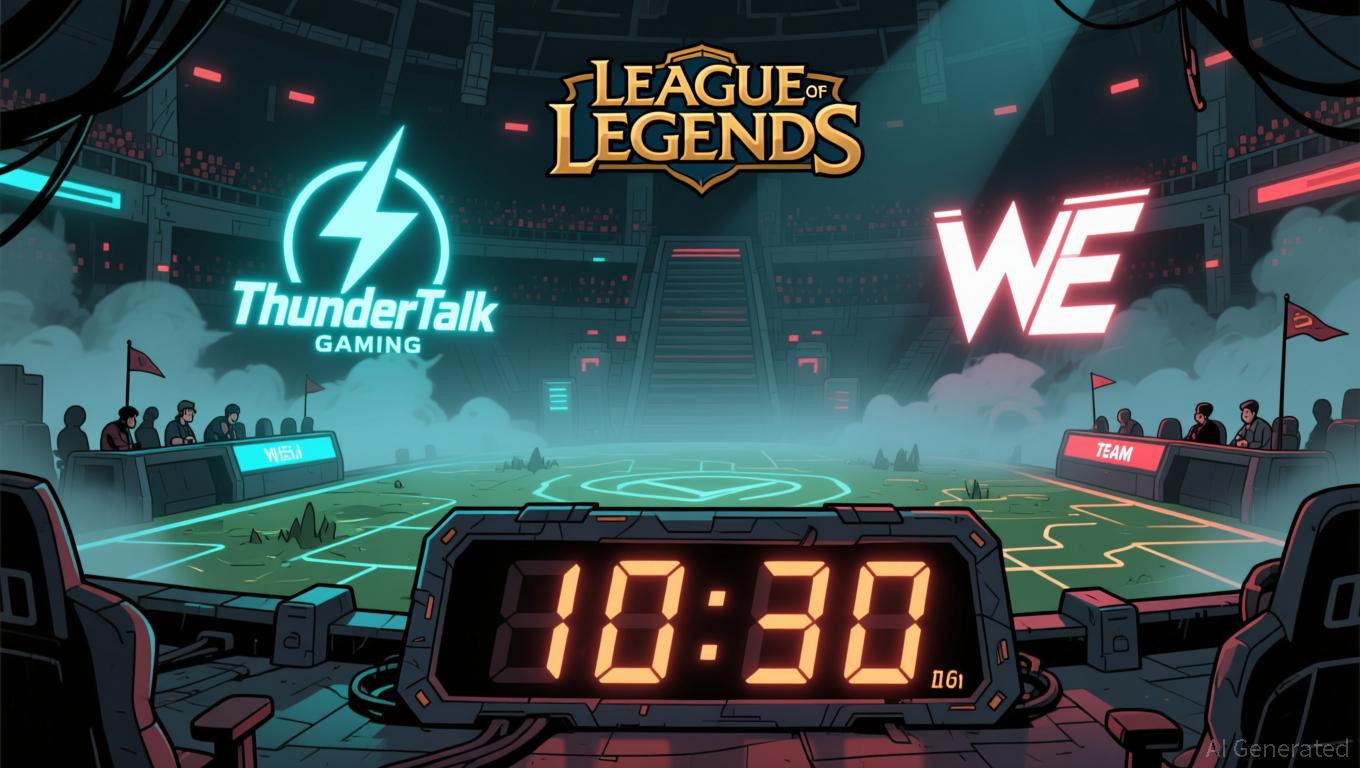
Polymarket traders have placed a heavy consensus on ThunderTalk Gaming defeating Team WE, with the main match market pricing a win probability near 30%. Yet this apparent conviction masks a volatile 24-hour repricing event and a structural rule risk that could force a 50-50 settlement regardless of on-stage performance. This analysis dissects the divergence between the market’s directional bet and the resolution framework, arguing that current prices may embed a mispriced forfeiture tail risk that few participants are discounting.
Event Definition
The market asks whether ThunderTalk Gaming or Team WE will win a best-of-three League of Legends match in the LPL Group Ascend stage. The contract settles based on the official result published by gol.gg, with a scheduled start time of 2026-08-02T13:00:00Z. The core disagreement is not about one team’s dominance, but whether the market’s lopsided pricing accurately reflects the probability of a clean, completed match versus a disruptive pre-match forfeit that would trigger a 50-50 resolution.
Latest News & Information Increments
LG Display’s Q2 2026 earnings report, while unrelated to esports, has been the most prominent corporate narrative in the display sector during this period. The company posted revenue of KRW 5.6 trillion and achieved its first half-year profit in five years excluding restructuring costs, driven by OLED products representing 57% of revenue. Management guided for mid-single-digit area shipment growth and high-teen percentage pricing improvements in Q3, reflecting stronger mobile OLED demand. However, these operational improvements are overshadowed by a significant competitive loss: Apple will exclusively source OLED touch panels for its upcoming MacBook Pro models from Samsung Display, excluding LG Display due to yield issues. Samsung Display simultaneously reinforced its technological lead by establishing a new brightness standard with VESA DisplayHDR True Black 1400 Tandem OLED technology. For the Polymarket contract on ThunderTalk Gaming versus Team WE, this news environment is effectively a low-information regime. The absence of roster changes, scrim leaks, or meta shifts means the market is operating on stale priors, making the current price more a reflection of positioning inertia than of any fresh catalyst.
Market Resolution Rules Analysis
The contract settles on the official match winner as recorded by gol.gg. If the match is forfeited or a walkover is declared before it begins, the market resolves to a 50-50 split regardless of which team is credited with the win in tournament standings. If the match is canceled or delayed by more than seven days without a winner being determined, it also resolves 50-50. Name discrepancies are resolved by real-world team identity, not by superficial branding changes. The critical distinction is temporal: a forfeit that occurs after the match has started resolves to the team that was leading or credited with the win, while a forfeit before the start triggers the binary 50-50 outcome.
Rule Risk Points & Disputed Scenarios
The primary risk is a pre-match forfeit. If either team fails to field a roster or withdraws minutes before the scheduled start, the contract does not award the win to the opposing team—it splits the outcome. This creates a scenario where a heavily favored team could be denied a payout even if their opponent concedes. A secondary risk exists if gol.gg fails to publish results within two hours of the match conclusion; in that case, a consensus of alternative sources may be used, introducing source ambiguity. These edge cases mean that a bet on the favorite is not purely a bet on skill differential, but also a bet that the match will physically begin.
Market Overview
The primary match market shows a mid-price of 0.295, implying that the market assigns roughly a 29.5% probability to one side winning. This is not a balanced 50-50 uncertainty; the market has already formed a strong directional view. The associated game handicap market rests at 0.395, reinforcing the skew. Neither market hovers near the 0.5 equilibrium, which may indicate that participants have reached a consensus on the likely result, or that liquidity is insufficient to support price discovery near the center. The primary market’s 24-hour volume exceeds $188,000, giving its price a degree of credibility, while the handicap market’s sub-$32,000 volume makes its price more susceptible to noise.
Market Dynamics (Volatility & Volume)
The primary market has experienced a one-week price decline of 0.19 and a one-day decline of 0.05, indicating that bearish sentiment has accelerated recently. The handicap market shows a divergent pattern: a one-week decline of 0.09 but a one-day increase of 0.03. This short-term divergence suggests that while the broader weekly trend has been negative for both, immediate intraday dynamics are pushing the handicap price upward even as the main outcome price remains under downward pressure. The 24-hour volume surge exceeding $150,000 in the primary market confirms that the recent repricing is backed by genuine trading activity, not merely a thin order book drift. However, the handicap market’s lower volume means its price movements should be treated with caution; they may reflect a single large order rather than a broad sentiment shift.
Trading Judgment & Follow-up Observation Points
The current price embeds a strong directional bet, but the resolution rules introduce a forfeiture tail risk that is not obviously priced in. A pre-match walkover would force a 50-50 settlement, making extreme positions vulnerable to a binary rule trigger that has nothing to do with in-game performance. The most important variables to track are: any official roster or delay announcements from the LPL in the hours before the scheduled start; the gol.gg publication status immediately after the match; and whether the handicap market’s volume picks up enough to validate its divergent price signal. The low-information news environment means that any sudden catalyst—such as a substitution or technical issue—could cause a sharper repricing than in a market with a steady flow of incremental updates.