The chip sell-off erased trillions, but not enough to guarantee an immediate S&P 500 rebound
A $1.3 trillion hit to market value is enough to make investors question the story, but it is not enough by itself to prove the simplest follow-up conclusion: that the S&P 500 must stage an immediate rescue rally. $1.3 trillion in stock market value vanished as 20 of the world's most valuable chip stocks sold off, including steep losses at NvidiaNVDA--, SK HynixSKHY--, Samsung, MicronMU--, AMDAMD--, and TSMCTSM--. That matters because this was not some niche corner of the market. It was the core of the AI trade.
What the sell-off likely signals
The more immediate signal appears to be psychological. This move followed a two-month 80% rally in semiconductor stocks that added roughly half a trillion dollars in market cap to the Nasdaq 100. After gains that steep, investors often shift from underwriting fundamentals to protecting paper profits. That can turn a sharp valuation reset into something that feels far more dramatic than the underlying fundamentals at that moment.
The volatility data points in a similar direction. The VIX made its biggest single-day jump since March, while S&P 500 index options reached a record 7.8 million contracts on Friday. That reads less like a calm recession diagnosis and more like a fast-paced sentiment unwind.
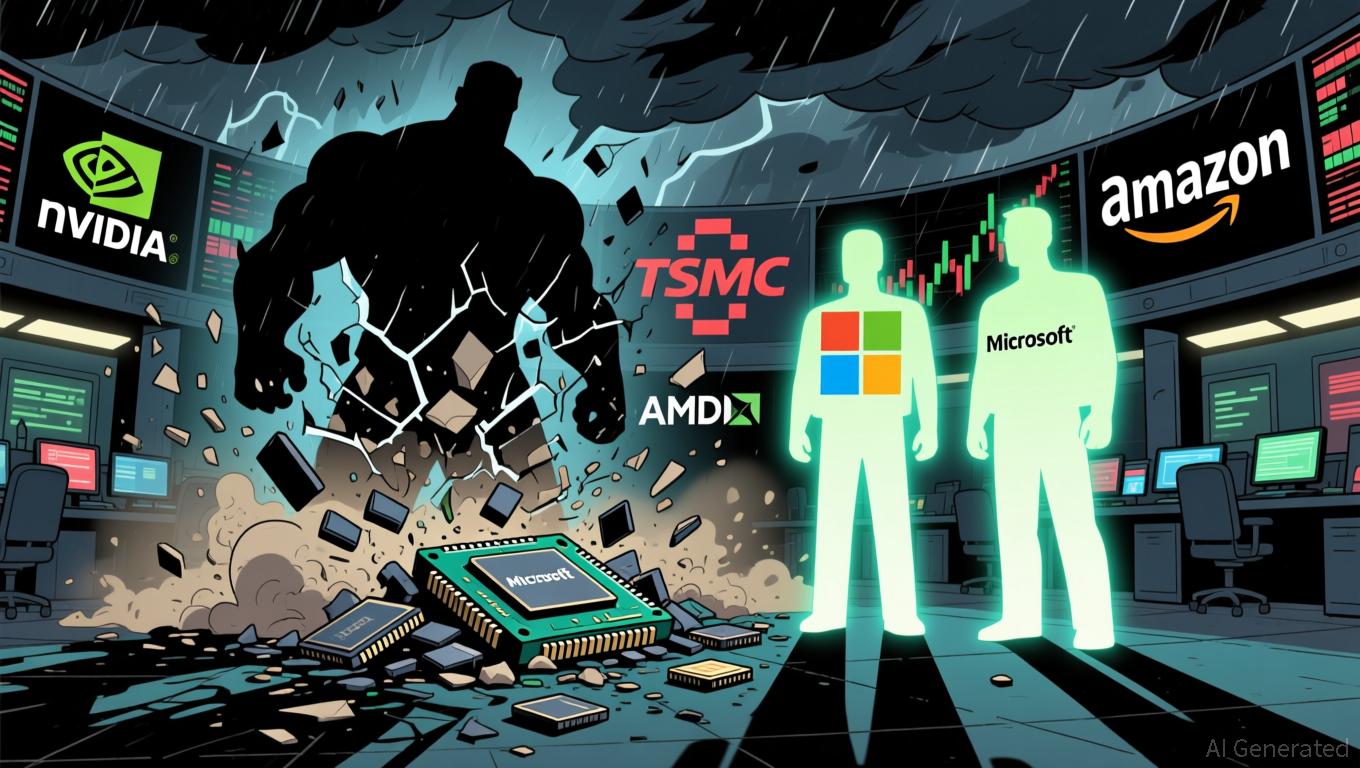
The broader tape also did not break in a uniform way. Microsoft and Amazon save the day, which argues against a simplistic "sell everything" read. The bigger risk now may be overreacting to the chip wobble-either by panicking at the wrong moment or by waiting for a rescue narrative that may never arrive.
Why confusing a sentiment unwind with a lasting top can be the bigger mistake
The mistake would be to treat this episode as a final verdict on the trade.
The selloff looked crowded, but the evidence for a full cycle turn was still thin
The Nasdaq-100 briefly entered correction territory, and several chip, memory, and storage names fell roughly 10% or more, including Dell, Sandisk, Western Digital, Seagate, Micron, and AMD. But those price moves do not yet prove the AI cycle has peaked.
The broader market was also mixed rather than uniformly bearish. In one earlier session tied to the same chip turbulence, Amazon.com (AMZN.O) and Microsoft (MSFT.O) were on the rise even as megacap and growth stocks were otherwise uneven. That gap between ugly sector optics and a still-supportive broader setup is where behavioral traps usually appear.
Once investors have lived through a violent move, loss aversion takes hold. The market begins to punish future uncertainty more harshly than the current damage justifies. Add recency bias, and a sharp reset after a two-month 80% rally in semiconductor stocks can start to feel like the end of the story. It often is not.
Quick Backtesting Tool
What investors should watch next
The bear case deserves respect. Investors are increasingly asking whether heavy data-center spending will translate into profits quickly enough to justify current valuations, and that debate is likely to intensify as more major tech companies report results. But the cleaner watchpoint is not whether chip stocks bounce next week. It is whether upcoming earnings confirm demand durability or finally give the bear case firmer proof.
Until that evidence arrives, the bigger mistake may be to read this chip rout as a clear signal that the S&P 500 is due for an instant rescue-or that the whole market should be sold as if the cycle has already turned.