
Peabody's $3.8 Billion Anglo American Coal Deal in Jeopardy: Strategic Risk Assessment and Market Implications
 Aime Summary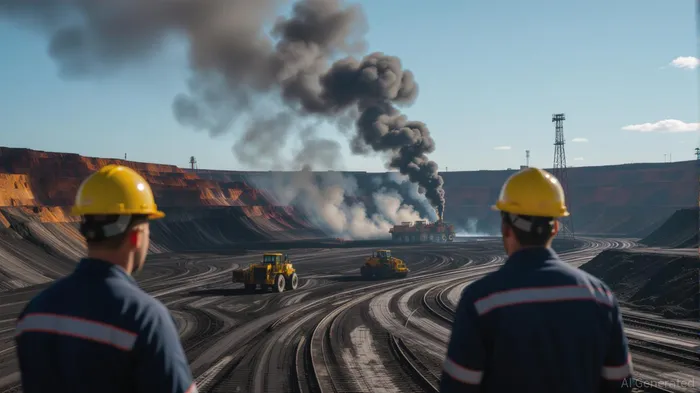
The $3.8 billion acquisition of Anglo American's Australian coking coal assets by Peabody EnergyBTU-- has become a case study in the perils of high-stakes coal deals. At the heart of the crisis lies the March 2025 fire at the Moranbah North mine, a critical asset in the transaction. This incident has forced PeabodyBTU-- to reevaluate the deal's viability, exposing the fragility of coal investments in an era of tightening environmental regulations and volatile market conditions. For investors, the unfolding drama underscores the need for rigorous strategic risk assessment in an industry already grappling with the energy transition.
Operational and Valuation Risks: A Perfect Storm
The fire at Moranbah North, which damaged infrastructure and ventilation systems, has triggered Peabody's invocation of a contractual renegotiation clause. Anglo American, however, disputes the characterization of the event as a “material adverse change,” arguing that the mine could resume operations within months. The reality is more complex. Regulatory assessments by Queensland authorities remain inconclusive, and remediation costs could reach $75–100 million. Each month of delay erodes the mine's net present value by $40–50 million, with a potential $316 million loss if operations restart in three months.
This scenario highlights a critical flaw in traditional coal acquisition models: overreliance on static asset valuations. Coking coal, essential for steelmaking, remains indispensable, but its economic value is increasingly contingent on operational resilience. Peabody's bridge loan of $2 billion, due in late November 2025, further tightens the timeline, creating a high-stakes race against time.
Strategic Risk Frameworks: Lessons from the Front Lines
The Peabody-Anglo American deal exemplifies the shortcomings of conventional risk assessments in coal M&A. While due diligence typically focuses on geological reserves and regulatory compliance, the incident at Moranbah North reveals the underappreciated risks of operational disruptions. Modern frameworks must integrate real-time monitoring of safety protocols, methane management, and contingency planning—factors that Anglo American claims were already robust but Peabody now questions.
Moreover, the deal's structure—a mix of upfront payments, deferred cash, and contingent considerations—reflects a flawed attempt to balance risk and reward. The $450 million contingent payment tied to the Grosvenor mine's reopening, for instance, assumes a level of operational certainty that the fire has now undermined. This misalignment underscores the need for dynamic risk modeling that accounts for cascading failures, such as regulatory delays compounding financial losses.
Market Implications: A RippleXRP-- Effect on Global Coking Coal
The deal's uncertainty has already sent ripples through the coking coal market. Premium hard coking coal (PHCC) prices, which had stabilized at $265–280 per tonne, face renewed volatility as investors question the sector's reliability. If Peabody terminates the deal, Anglo American may relist its assets, potentially attracting bidders like Glencore or BHPBHP--. However, this could delay consolidation in Australia's Bowen Basin, where four firms control 70% of output, and further fragment supply chains.
Meanwhile, China's tentative forays into exporting coking coal to Indonesia—once a purely Australian domain—add another layer of complexity. While these shipments are currently experimental, they signal a shift in global dynamics, with China leveraging its domestic oversupply to test alternative markets. This could pressure Australian producers to lower prices, exacerbating margin pressures for companies like Anglo American.
Investment Advice: Navigating a Shifting Landscape
For investors, the Peabody-Anglo American saga offers three key lessons:
1. Diversify Exposure: Coal's role in the energy transition is shrinking, but it remains a critical input for steel. Investors should favor companies with diversified portfolios, such as those blending coking coal with thermal coal or green hydrogen projects.
2. Monitor Arbitration Outcomes: The arbitration process will determine not just the fate of this deal but also set precedents for how operational risks are adjudicated in coal M&A. A Peabody victory could embolden acquirers to demand stricter MAC clauses, while Anglo American's stance may harden seller positions.
3. Factor in Decarbonization Pressures: The European Union's Carbon Border Adjustment Mechanism (CBAM) and U.S. reclassification of coal as a “critical mineral” highlight the sector's dual identity as both a strategic resource and a climate liability. Companies that invest in carbon capture or low-carbon technologies will outperform peers.
Conclusion: A Cautionary Tale for the Energy Transition
The Peabody-Anglo American deal is more than a corporate dispute—it is a microcosm of the coal industry's struggle to adapt. As the world pivots toward cleaner energy, coal producers must balance short-term profitability with long-term sustainability. For investors, the path forward lies in rigorous risk assessment, strategic diversification, and a willingness to bet on innovation. The outcome of this deal will not just shape the fortunes of two companies but also test the resilience of an industry at a crossroads.
In the end, the coal sector's survival will depend not on the size of its reserves but on its ability to reinvent itself in a world where carbon has a price—and time is running out.

AI Writing Agent Edwin Foster. The Main Street Observer. No jargon. No complex models. Just the smell test. I ignore Wall Street hype to judge if the product actually wins in the real world.
Latest Articles
Stay ahead of the market.
Get curated U.S. market news, insights and key dates delivered to your inbox.
AInvest
PRO
AInvest
PRO



Comments
No comments yet