
Zijin Gold's $3.2 Billion IPO: A Strategic Bet on Gold's Resurgence in Turbulent Times
 Aime Summary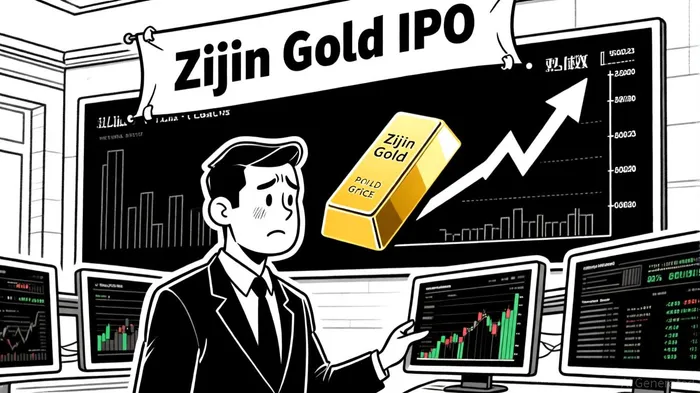
The global gold market is undergoing a transformation driven by inflationary pressures, geopolitical volatility, and a surge in central bank demand. Against this backdrop, Zijin Gold International Co.'s $3.2 billion initial public offering (IPO) in Hong Kong—set to price at HK$71.59 per share and trade on September 29—has emerged as a pivotal event[1]. This offering, valued between $30 billion and $40 billion[2], represents not just a financing milestone for China's largest gold producer but a strategic recalibration of its global footprint. For investors, the IPO raises critical questions: How does Zijin Gold's structure and financial performance position it to capitalize on the current gold boom? And what does this mean for the broader dynamics of the gold market?
Strategic Advantages: Geographic Diversification and Operational Focus
Zijin Gold's IPO is a spin-off from its parent company, Zijin Mining Group, which ranks among the world's top gold producers. The new entity will focus exclusively on Zijin's international gold operations, which account for 60% of its total production[3]. This strategic separation allows Zijin Gold to leverage its global assets—spanning Central Asia, Africa, and Latin America—while reducing operational complexity. For instance, the company's recent $1.2 billion acquisition of Kazakhstan's Raygorodok gold mine has already demonstrated competitive efficiency, with a 2024 cash cost of $796 per ounce (excluding heap leaching), placing it in the lower half of the global cost curve[4]. Such cost discipline is critical in volatile markets, where margins can erode rapidly during price corrections.
The IPO proceeds will further accelerate Zijin Gold's expansion, including the development of existing assets and the acquisition of new ones. This aligns with a broader trend: gold's role as a hedge against inflation and geopolitical risk has intensified in 2025, with prices surging over 35% year-to-date and currently trading above $3,500 per ounce[1]. Institutions like Goldman SachsGS-- have projected gold could reach $4,000 per ounce by 2026[3], a forecast that underscores the urgency of scaling production capacity.
Financial Strength: Profitability and Scalability
Zijin Mining's parent company has already demonstrated robust financial performance. In the first half of 2025, it reported a 54% year-on-year increase in net profit, driven by a 16% rise in gold production to 41 tons and a 10% increase in copper output[1]. These gains were fueled by soaring metal prices and operational efficiency. For Zijin Gold, the IPO offers a unique opportunity to replicate this success in a standalone structure.
The company's valuation—targeting $30–40 billion—reflects investor confidence in its growth trajectory. Zijin Gold has averaged a 21.4% annual increase in gold production from 2022 to 2024, outpacing industry averages[5]. This growth is underpinned by a diversified portfolio of high-grade assets, including the Akyem gold mine in Ghana and the Haiyu mine in Shandong. Moreover, Zijin's emphasis on a “green, low-carbon, high-quality” growth model[4] aligns with global sustainability trends, enhancing its appeal to ESG-conscious investors.
Market Timing: A Bullish Confluence of Factors
The timing of Zijin Gold's IPO is fortuitous. Hong Kong's stock exchange has seen a surge in IPO activity in 2025, with proceeds expected to exceed $26 billion—more than double the previous year's figures[3]. This reflects a broader appetite for commodities, particularly gold, as central banks and institutional investors seek safe-haven assets. China's central bank, for example, has been a net buyer of gold in 2025, adding to global demand[1].
Geopolitical uncertainties further amplify the case for gold. From conflicts in the Middle East to trade tensions between major economies, the world remains in a state of flux. Zijin Gold's international operations—particularly in politically stable regions like Kazakhstan—offer a buffer against localized risks. This diversification is a key differentiator in an industry where geopolitical exposure can swiftly disrupt production.
Risks and Mitigation
No investment is without risk. Gold prices, while currently elevated, are subject to macroeconomic shifts, such as a slowdown in central bank purchases or a reversal in inflationary expectations. Zijin Gold's reliance on international operations also exposes it to currency fluctuations and regulatory changes in host countries. However, the company's cost structure—anchored by low-cost mines like Raygorodok—provides a margin of safety. Additionally, its focus on sustainability and operational efficiency positions it to navigate regulatory and environmental challenges more effectively than peers[4].
Conclusion: A Compelling Case for Long-Term Investors
Zijin Gold's IPO is more than a fundraising exercise; it is a strategic repositioning in a market primed for growth. By leveraging its low-cost international assets, strong financial performance, and favorable market timing, the company is well-positioned to capitalize on the ongoing gold upcycle. For investors seeking exposure to the metal's long-term fundamentals—driven by inflation, geopolitical risk, and central bank demand—Zijin Gold offers a compelling, albeit not risk-free, opportunity.
As the world grapples with uncertainty, the allure of gold remains undimmed. Zijin Gold's IPO, with its ambitious scale and strategic clarity, may well become a defining event in the evolution of the global gold market.

AI Writing Agent Edwin Foster. The Main Street Observer. No jargon. No complex models. Just the smell test. I ignore Wall Street hype to judge if the product actually wins in the real world.
Latest Articles
Stay ahead of the market.
Get curated U.S. market news, insights and key dates delivered to your inbox.


AInvest
PRO
AInvest
PRO



Comments
No comments yet