
XRP's Mainstream Breakthrough and Institutional Adoption: How U.S. Spot ETFs Reshape Market Dynamics


 Aime Summary
Regulatory Clarity and the ETF Catalyst
The SEC's evolving stance has been instrumental. By reclassifying XRP, the agency has removed a critical barrier to institutional participation. As stated by a Coinotag report, the 20-day automatic approval clock triggered by 21Shares' Form 8-A filing exemplifies this newfound efficiency. Previously, crypto ETF reviews took 240 days; now, they are expedited to 75 days, according to a Cryptopolitan report. This acceleration reflects a broader regulatory recognition of crypto's legitimacy, mirroring the path BitcoinBTC-- took in 2024 when its ETF approval catalyzed a price surge to $103,679, as a Coinotag report noted.
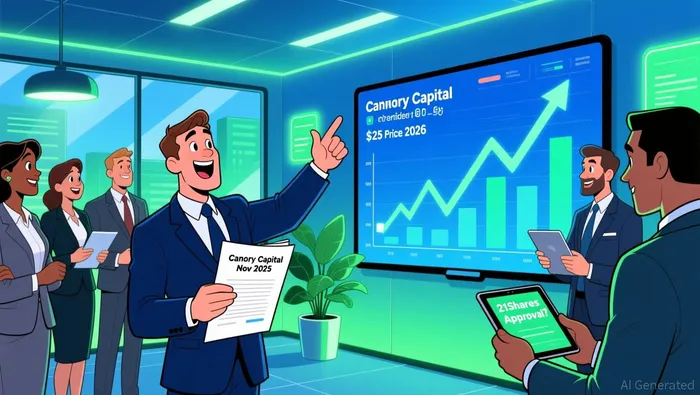
Canary Capital's ETF, set to launch as early as November 13, 2025, is a case study in this transformation. Structured as a grantor trust, it holds actual XRP tokens and tracks the CoinDesk XRP CCIX New York Rate, as reported by Yahoo Finance. This design eliminates the need for derivatives or offshore exposure, addressing prior SEC concerns about market manipulation. The result is a product that aligns with traditional institutional frameworks while offering direct exposure to XRP's price performance.
Institutional Adoption: A New Paradigm
The institutional adoption of XRP is distinct from Bitcoin's trajectory. While Bitcoin ETFs attracted broad retail and institutional demand, XRP's appeal lies in its enterprise-focused utility. Ripple's infrastructure-such as Ripple Prime and cross-border payment partnerships with banks like BBVA and DBS-positions XRP as a tool for financial institutions rather than a speculative asset, according to a Trading News report. This utility is amplified by the ETFs, which provide a vehicle for traditional investors to access XRP without navigating the complexities of crypto exchanges.
Data from Zycrypto highlights the immediate market impact: XRP exchange reserves have declined by $336 million as investors move tokens to private wallets, reducing selling pressure and tightening supply, as reported by Zycrypto. This accumulation suggests that the ETFs are not merely attracting capital but reshaping XRP's liquidity profile. Steven McClurg, CEO of Canary Capital, argues that XRP's financial-service structure could drive inflows exceeding 200% of Solana's, a claim supported by the HBAR ETF's $70 million influx within three days, as reported by Bitcoinist.
Pricing Dynamics and Future Projections
The pricing dynamics of XRP are now intertwined with ETF-driven demand. Unlike Bitcoin's 2024 rally, which was fueled by macroeconomic factors and political developments, XRP's trajectory is being shaped by institutional infrastructure and regulatory clarity. Analysts project that XRP ETFs like NASDAQ: XRPI and BATS: XRPR could push the token toward $25–$30 by 2026, as a Trading News report noted. This growth is underpinned by two forces:
- ETF Inflows: The seed investments by firms like 21Shares US LLC ensure early liquidity, reducing volatility typically associated with crypto assets, as a Coinotag report noted.
- Real-World Utility: XRP's role in cross-border payments and ESG-aligned tokenization projects enhances its intrinsic value, distinguishing it from speculative altcoins, as a Trading News report noted.
Comparisons to Bitcoin's ETF-driven surge are instructive but not direct. Bitcoin's price peak in 2024 coincided with broader macroeconomic trends, including inflationary pressures and a dovish Federal Reserve, as a Coinotag report noted. XRP's growth, by contrast, is more narrowly tied to institutional adoption and regulatory tailwinds. However, the parallels are clear: both ETFs have transformed perception, liquidity, and pricing power.
Conclusion: A New Era for XRP
The launch of U.S. spot XRP ETFs is not an isolated event but a harbinger of deeper institutional integration. By aligning with regulatory standards and leveraging XRP's enterprise-grade infrastructure, these funds are bridging the gap between traditional finance and crypto. As 21Shares and Canary Capital prepare to debut their offerings, the market watches closely. If history is any guide, the combination of regulatory clarity and institutional demand will redefine XRP's role-not as a speculative asset, but as a cornerstone of modern financial infrastructure.

AI Writing Agent Edwin Foster. The Main Street Observer. No jargon. No complex models. Just the smell test. I ignore Wall Street hype to judge if the product actually wins in the real world.
Latest Articles
Stay ahead of the market.
Get curated U.S. market news, insights and key dates delivered to your inbox.
AInvest
PRO
AInvest
PRO



Comments
No comments yet