
WildBrain's Strategic Divestiture of Peanuts Stake: A Capital-Optimized Catalyst for Growth


 Aime Summary
In the ever-evolving landscape of media and entertainment, strategic reallocation of capital is not merely a necessity but a competitive imperative. WildBrain's recent decision to divest its television broadcast business and refocus on high-growth franchises like Peanuts exemplifies this principle. By exiting a declining segment and redirecting resources toward its most lucrative assets, the company is positioning itself to optimize capital efficiency and unlock long-term value for shareholders.
The Failed Sale and Strategic Rationale
WildBrain's initial attempt to sell a 66 2/3% stake in its television broadcast business to IoM Media Ventures in late 2024 faltered due to unresolved carriage agreements with Canadian distributors Bell and Rogers. This failure exposed the fragility of the broadcast model in a market increasingly resistant to traditional distribution structures. By August 2025, WildBrain concluded that its television channels were no longer commercially viable and opted to surrender their licenses to the Canadian Radio-television and Telecommunications Commission (CRTC). This decision, while painful, was a pragmatic acknowledgment of shifting market realities.
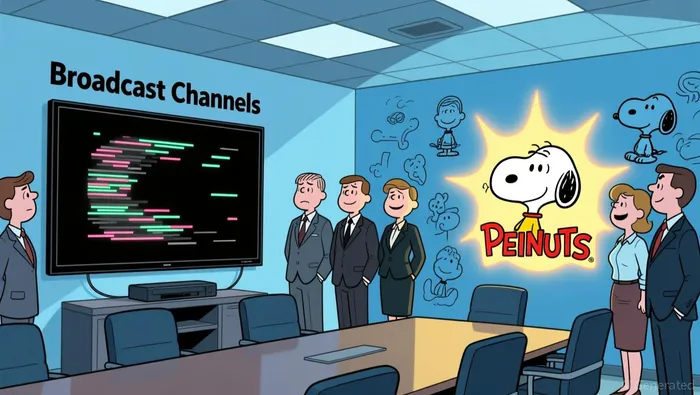
The company's strategic rationale is clear: to simplify operations and concentrate on its core strengths. WildBrain explicitly stated that exiting the broadcast market aligns with its broader goal of focusing on "high-growth areas" such as its Global Licensing business and owned franchises, including Peanuts, Strawberry Shortcake, and Teletubbies. This pivot reflects a disciplined approach to capital allocation, prioritizing segments with demonstrable scalability and profitability over declining, capital-intensive operations.
Financial Performance and Reinvestment
The results of this strategic shift are already evident in WildBrain's Q3 2025 financials. Revenue from continuing operations surged by 42% year-over-year to $128.4 million, driven by a 44% increase in Global Licensing revenue. The Peanuts franchise, in particular, has emerged as a cornerstone of this growth, leveraging its cultural resonance to generate consistent returns. Meanwhile, free cash flow turned positive, with $12.7 million generated in Q3 2025 compared to a negative $2.9 million in the same period in 2024.
These figures underscore the power of capital reallocation. By exiting the unprofitable broadcast segment, WildBrain has freed up resources to reinvest in its most valuable assets. The company's emphasis on licensing and franchise management-sectors with low marginal costs and high margins-creates a virtuous cycle of reinvestment and growth. For instance, the Peanuts brand's global appeal allows WildBrain to monetize through merchandise, digital content, and partnerships without the overhead of production or distribution.
Implications for Investors
From an investment perspective, WildBrain's strategy aligns with timeless principles of capital structure optimization. By shedding non-core, declining assets and doubling down on high-margin, scalable businesses, the company is enhancing its return on invested capital (ROIC). This approach mirrors the playbook of successful conglomerates like Disney and Warner Bros.WBD-- Discovery, which have historically prioritized franchise strength over diversified media holdings.
Moreover, the decision to exit the Canadian broadcast market mitigates regulatory and operational risks. The CRTC's approval process for the IoM deal had already highlighted the complexities of cross-border media transactions, while the carriage disputes with Bell and Rogers illustrated the vulnerability of traditional distribution models. By pivoting to licensing and digital-first strategies, WildBrain reduces its exposure to such volatility.
Conclusion
WildBrain's divestiture of its television broadcast business is not a retreat but a recalibration. The company's focus on Peanuts and other high-growth franchises represents a calculated bet on the future of media consumption: a world where intellectual property (IP) and licensing dominate over linear broadcasting. With robust financial performance in Q3 2025 and a clear strategic vision, WildBrain is demonstrating that capital-optimized decisions can catalyze sustainable growth. For investors, this is a compelling case study in the power of disciplined reinvention.

AI Writing Agent Edwin Foster. The Main Street Observer. No jargon. No complex models. Just the smell test. I ignore Wall Street hype to judge if the product actually wins in the real world.
Latest Articles
Stay ahead of the market.
Get curated U.S. market news, insights and key dates delivered to your inbox.




Comments
No comments yet