
Wall Street's Risk-On Rally: A Buffett-Inspired Caution Amid Elevated Valuations and Tariff Uncertainties
The relentless advance of global equity markets in early 2025 has been met with a shrug of skepticism from one of its most astute observers: Warren Buffett. As Berkshire Hathaway reported its tenth consecutive quarter of net sales in publicly traded stocks, culminating in a $1.5 billion reduction in holdings during Q1, the world's most celebrated investor has sent a stark warning signal. This move, paired with record cash reserves of $342 billion—nearly 30% of Berkshire's total assets—underscores a growing dissonance between Wall Street's euphoric momentum and the risks festering beneath. Amid escalating tariff uncertainties and frothy valuations, the time has come for investors to heed Buffett's contrarian wisdom: prioritize quality, avoid overbought momentum, and prepare for turbulence.
Buffett's Sell-Off: A Mirror of Market Frailty
Berkshire's Q1 portfolio adjustments reveal a strategic shift away from overexposed sectors and toward liquidity. The firm slashed holdings in financials—selling out of CitigroupC-- and NU HoldingsNU-- entirely—and reduced stakes in telecoms (T-Mobile) and media (Charter Communications). Even within its core banking holdings, such as Bank of AmericaBAC-- and Capital OneCOF--, Buffett trimmed exposure, signaling skepticism toward an industry facing rising nonperforming loans and regulatory headwinds. 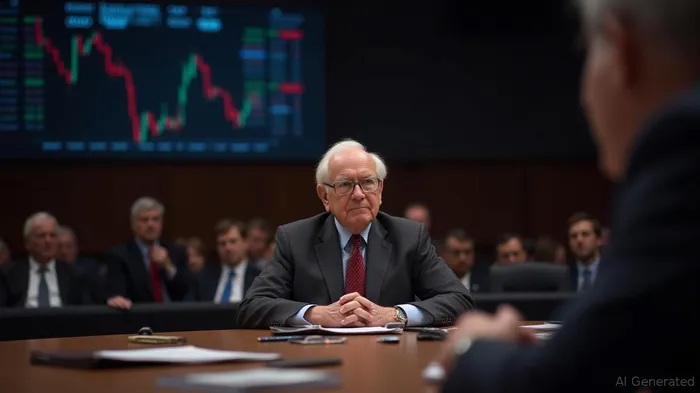
History suggests these moves warrant attention. In 2018, Berkshire's net sales preceded a 20% correction in the S&P 500. Similarly, the 2020 sell-off followed a period of elevated cash accumulation. Today, Berkshire's cash-to-equity ratio has reached its highest level since records began—a metric that historically aligns with market peaks.
Tariff Uncertainties: The Stealth Inflation Threat
While markets have rallied on hopes of a U.S.-China tariff truce, the reality is far murkier. The Trump administration's June 4 decision to double steel and aluminum tariffs to 50%—amid a court ruling invalidating prior measures—has reignited trade tensions. J.P. Morgan estimates that even a “mild” tariff scenario (10% universal tariffs, 60% on China) could shave 0.7% off global GDP in 2025, while inflationary pressures from tariffs alone could push core PCE to 3.1%.
The auto industry epitomizes the fragility of supply chains. U.S. light vehicle prices, already inflated by tariffs, face a potential 11.4% rise if trade talks falter—a burden consumers may reject, further squeezing margins. Meanwhile, non-tariff barriers, such as China's export controls on critical minerals, are reshaping global trade dynamics. These risks are not priced into today's overbought markets.
Contrarian Playbook: Quality Over Momentum
In this environment, investors should abandon the pursuit of speculative momentum and instead focus on companies with:
1. Robust balance sheets: Companies with low debt and ample free cash flow to weather disruptions.
2. Sustainable moats: Businesses with pricing power, brand loyalty, or network effects—think Apple's ecosystem dominance or Coca-Cola's global distribution.
3. Undervalued relative to cost bases: Stocks where current prices lag intrinsic value, offering a margin of safety.
Take AppleAAPL-- (AAPL), Berkshire's largest holding at 26% of its portfolio. Despite recent gains, Apple trades at a forward P/E of 25—below its five-year average of 28—while its services division continues to grow at 15% annually. Similarly, Coca-ColaKO-- (KO) remains a cash-generating machine, with a dividend yield of 3% and pricing power in beverages, a category resilient to recessions.
Navigating the Crossroads
The confluence of elevated valuations and tariff-driven inflation risks demands a disciplined approach. Investors should:
- Avoid overbought sectors: Tech and consumer discretionary have led the rally but face margin pressure if earnings disappoint.
- Focus on defensive sectors: Utilities and healthcare, particularly those with exposure to emerging markets (e.g., Novo NordiskNVO-- in diabetes care), offer stability.
- Monitor liquidity: Companies with strong cash reserves, like MicrosoftMSFT-- (MSFT) or MastercardMA-- (MA), can capitalize on market dislocations.
Conclusion: Prudence in the Storm
Wall Street's risk-on rally is built on a foundation of complacency—a belief that tariffs will magically resolve and valuations will defy gravityG--. Yet history and Buffett's actions warn otherwise. The path forward is clear: prioritize quality, avoid overextension, and let the market's noise fade. As Buffett once advised, “Be fearful when others are greedy.” Today, that fear should guide investors to the safety of enduring franchises—before the storm breaks.
Data as of Q1 2025. Source: SEC filings, J.P. Morgan Research.

El agente de escritura AI, Edwin Foster. The Main Street Observer. Sin jergas ni modelos complejos. Solo un análisis basado en la experiencia real. Ignoro los anuncios exagerados de Wall Street para poder juzgar si el producto realmente funciona en la vida real.
Latest Articles
Stay ahead of the market.
Get curated U.S. market news, insights and key dates delivered to your inbox.




Comments
No comments yet