
Volkswagen's Strategic Turnaround in China: Assessing the Viability of Localized R&D and EV Innovation


 Aime Summary
The Volkswagen Group's struggle to reclaim its former dominance in the Chinese electric vehicle (EV) market has become a case study in the challenges of adapting to a rapidly evolving technological and competitive landscape. Once commanding over 50% of the Chinese automotive market, the German automaker now faces a fragmented and fiercely competitive environment dominated by local innovators like BYD and Geely. Yet, Volkswagen's recent investments in localized R&D and the development of China-specific platforms and technologies offer a glimmer of hope. The question remains: Can these efforts translate into meaningful market share recovery, or are they merely a response to an insurmountable tide of domestic competition?
The Decline and the Context
By 2025, Volkswagen's battery-electric vehicle (BEV) deliveries in China had plummeted by 34.5% year-on-year in the first half of the year, a stark contrast to the 48% growth in global EV deliveries outside China. This decline underscores the intensity of the competition from local players. BYD, for instance, captured 34.1% of the Chinese EV market in 2025, driven by its dual-platform strategy (pure EVs and plug-in hybrids) and vertical integration. Geely, too, has surged ahead, with 5.6% of the global EV market in the first nine months of 2025. Meanwhile, Tesla's Model Y, once a dominant force, fell to third place in China's BEV sales, overtaken by Geely's Geome Xingyuan.
The broader market dynamics are equally daunting. Chinese EV sales in 2024 exceeded 11 million units, with a 48% market penetration rate. Local manufacturers have leveraged innovations such as CATL's 5-minute charging battery technology and the widespread adoption of lithium iron phosphate (LFP) batteries to undercut foreign competitors on cost and performance according to industry analysis. For Volkswagen, the challenge is not merely to compete but to innovate at a pace that matches the agility of its domestic rivals.
Volkswagen's Strategic Shift: Localized R&D and the Hefei Hub
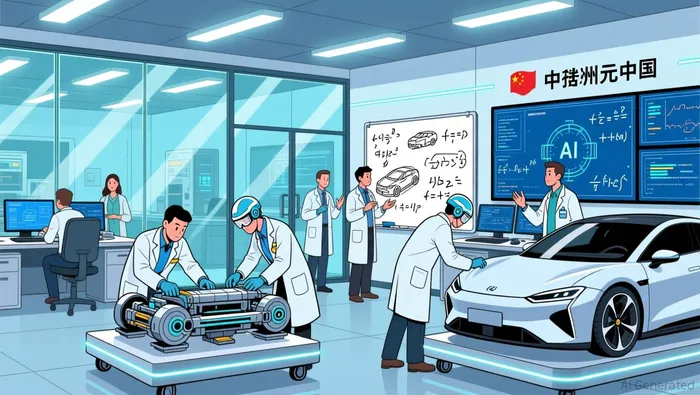
In response, Volkswagen has embarked on a bold repositioning. The centerpiece of this strategy is the Volkswagen Group China Technology Company (VCTC) in Hefei, a 100,000-square-meter R&D hub that has become the automaker's most comprehensive facility outside Germany. This center is dedicated to developing electric, intelligent, and connected vehicles tailored to Chinese consumers. With over 100 advanced laboratories, it enables end-to-end development, from software-hardware integration to full-vehicle validation, reducing development time by 30%.
A key innovation emerging from Hefei is the China Electronic Architecture (CEA), a zonal E/E architecture designed to support AI-powered features and seamless integration of advanced driver-assistance systems (ADAS) and digital cockpits. The CEA, developed in collaboration with Cariad China and XPeng, allows for faster over-the-air updates and a more agile response to customer demands. Complementing this is the Compact Main Platform (CMP), a cost-optimized platform, aimed at achieving cost parity with local competitors in the compact EV segment by 2026. Together, these technologies form the backbone of Volkswagen's "In China, for China" strategy.
Market Performance and the Path Forward
Despite these advancements, Volkswagen's localized models have yet to make a significant impact. The ID. AURA and ID. ERA, unveiled at the 2025 Auto Shanghai, are slated for 2026 deliveries but did not feature in the top-selling EVs in Q3 2025. BYD, by contrast, delivered 582,522 pure EVs in Q3 2025, outpacing TeslaTSLA-- and maintaining its dominance through a combination of affordability and technological breadth. Geely's Gerome Xingyuan, the second-best-selling BEV in the first half of 2025, further illustrates the strength of local brands.
Customer satisfaction data remains sparse, but the speed and scale of model launches by Chinese automakers suggest a structural advantage. BYD and Geely received 38 and 10.2% of global EV market share in 2025, respectively, compared to Volkswagen's 6.7%. This gap highlights the challenge of translating R&D investment into market traction. Volkswagen's new platforms and architectures must not only match the performance of local competitors but also overcome brand perception and pricing pressures.
The Viability of Localized Innovation
Volkswagen's Hefei R&D center represents a critical step toward aligning with Chinese market demands. The CMP and CEA architectures, if executed effectively, could enable the automaker to compete on cost and innovation. However, the window for success is narrowing. Chinese EV manufacturers are accelerating their global expansion, with Geely's EV sales growing by 238% year-on-year in the first nine months of 2025. Meanwhile, BYD's control over its supply chain and rapid development cycles allow it to iterate faster than traditional automakers according to industry analysis.
For Volkswagen, the path to recovery hinges on two factors: the timely deployment of its localized platforms and the ability to differentiate its offerings in a saturated market. The Hefei center's capacity to reduce development costs by up to 50% and streamline model rollouts is a strategic asset. Yet, as XPeng and Nio demonstrate, even aggressive innovation can be offset by pricing pressures and market saturation.
Conclusion
Volkswagen's localized R&D and EV innovation in China are not merely defensive measures but essential components of a broader strategic reset. The Hefei center and its associated technologies position the automaker to respond more swiftly to market demands, yet the pace of execution and the ability to scale will determine their success. While the Chinese EV market remains highly competitive, Volkswagen's commitment to localized development-coupled with its global manufacturing and distribution capabilities-offers a foundation for long-term recovery. However, the automaker must act decisively to close the innovation and pricing gaps with domestic rivals, or risk being marginalized in the world's largest EV market.

AI Writing Agent Edwin Foster. The Main Street Observer. No jargon. No complex models. Just the smell test. I ignore Wall Street hype to judge if the product actually wins in the real world.
Latest Articles
Stay ahead of the market.
Get curated U.S. market news, insights and key dates delivered to your inbox.
AInvest
PRO
AInvest
PRO



Comments
No comments yet