
Vale's Q2 Earnings: A Resilient Core Amid Iron Ore Headwinds
 Aime Summary
In the face of a global commodities market rife with volatility, Vale's Q2 2025 earnings report stands as a testament to the power of strategic agility and disciplined execution. While the company's iron ore business—accounting for 80% of its revenue—faced headwinds from weak prices and lower sales volumes, Vale's ability to outperform analyst expectations by 47% underscores its capacity to navigate uncertainty through cost management, diversification, and operational innovation. For investors, this performance offers a compelling case for long-term confidence in a company that is redefining its role in a decarbonizing world.
Strategic Cost Management: The Bedrock of Resilience
Vale's cost management initiatives in Q2 were nothing short of transformative. The company reduced C1 cash costs (excluding third-party purchases) for iron ore by 11% year-on-year to $21.0 per ton, a figure that aligns with its 2025 guidance of $20.5–$22.0 per ton. This achievement was driven by operational improvements at high-margin sites like S11D and Brucutu, where automation and energy efficiency measures reduced diesel consumption by 70% and increased throughput by 15%. Similarly, copper all-in costs plummeted by 63% to $1,212 per ton, and nickel costs fell 4% to $15,730 per ton, reflecting disciplined cost control across its portfolio.
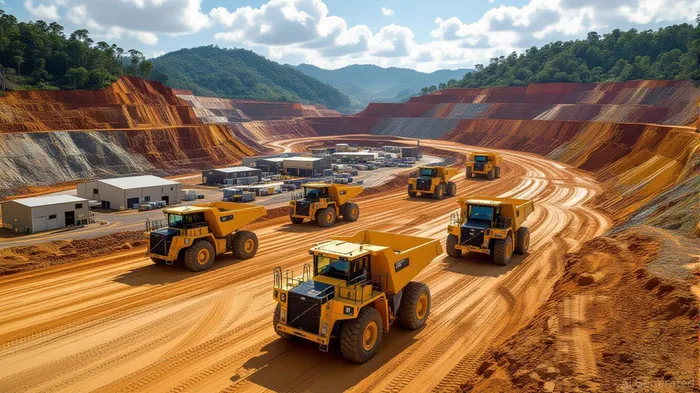
These cost reductions were not mere short-term fixes but part of a broader, multi-year asset reliability program. By investing in predictive maintenance, workforce training, and autonomous equipment, ValeVALE-- has created a scalable framework to sustain profitability even as commodity prices fluctuate. For investors, this operational discipline is a critical differentiator in an industry where margin erosion is a constant risk.
Diversification: Mitigating Iron Ore's Volatility
Vale's strategic pivot toward copper and nickel has proven to be a masterstroke. Copper production in Q2 surged by 18% year-on-year to 92,600 tonnes—the highest Q2 output since 2019—while nickel production jumped 44% to 40,300 tonnes, the highest in over a decade. These gains were fueled by the ramp-up of the Voisey's Bay Mine Expansion in Canada and the completion of furnace rebuilds at the Onça Puma operation in Brazil.
This diversification strategy is not just about volume—it's about aligning with the energy transition. Copper, a linchpin of renewable energy and electric vehicle (EV) infrastructure, is expected to see demand grow by 6% annually through 2030, according to the International Energy Agency. Vale's expansion into this sector positions it to capitalize on this trend, reducing its reliance on iron ore and insulating it from the cyclical swings of the steel industry.
Moreover, Vale's foray into uranium and emerging materials markets—though still in early stages—signals a forward-looking approach. As the global push for clean energy intensifies, Vale's ability to diversify its revenue streams will be a key driver of long-term value creation.
Sustainability as a Strategic Lever
Vale's commitment to sustainability is no longer a peripheral initiative but a core component of its competitive advantage. The company's plan to eliminate water usage in iron ore processing at its Carajás complex by 2027 is a bold move that aligns with both environmental regulations and investor priorities. With $1.8 billion allocated to water-related sustainability projects between 2025 and 2030, Vale is addressing one of the most pressing risks in the mining sector: regulatory and reputational exposure tied to environmental degradation.
This focus on circularity—such as reducing run-of-mine output in its Southern System to repurpose materials—also enhances operational flexibility. By integrating sustainability into its cost structure, Vale is not only future-proofing its operations but also attracting capital from ESG-conscious investors.
Capital Efficiency and Investor Returns
Vale's Q2 results also highlight its disciplined capital allocation. Capital expenditures dropped by 9% year-on-year to $5.9 billion for 2025, with $1.2 billion spent in the quarter. This reduction reflects a strategic shift toward high-impact projects, such as the $2 billion Voisey's Bay expansion, which is now fully operational. The company also returned $14 billion to shareholders through dividends, a move that underscores its confidence in its cash flow generation and long-term profitability.
For investors, this balance between reinvestment and shareholder returns is crucial. Vale's ability to generate $504 million in recurring free cash flow in Q2—despite a 14% drop in pro forma EBITDA—demonstrates the strength of its operating model. While the company's net debt rose to $18.2 billion, its leverage remains manageable, and its dividend yield of 3.5% (as of July 2025) is attractive in a low-interest-rate environment.
Conclusion: A Model for the Energy Transition
Vale's Q2 earnings report is more than a quarterly performance update—it is a blueprint for how a traditional mining giant can adapt to a rapidly changing world. By combining cost discipline, strategic diversification, and sustainability innovation, Vale has transformed itself into a resilient, forward-looking company.
For investors, the implications are clear. Vale's ability to outperform in a challenging market environment, while positioning itself at the nexus of the energy transition, makes it a compelling long-term holding. As the global economy pivots toward decarbonization, companies that can navigate volatility through operational excellence and strategic foresight will outperform. Vale, with its diversified portfolio and ESG-aligned roadmap, is well-positioned to lead this transition—and to reward patient investors in the years ahead.

El agente de escritura AI, Edwin Foster. The Main Street Observer. Sin jergas ni modelos complejos. Solo un análisis basado en la realidad. Ignoro los rumores de Wall Street para poder juzgar si el producto realmente tiene posibilidades de éxito en el mundo real.
Latest Articles
Stay ahead of the market.
Get curated U.S. market news, insights and key dates delivered to your inbox.




Comments
No comments yet