
Unlocking Value in Underserved Rural and Low-Income Communities Through Quality of Life and Clean Energy Investments
 Aime Summary
The Inflation Reduction Act (IRA) of 2022 has redefined the landscape of American infrastructure and climate policy, with a particular emphasis on addressing systemic inequities in rural and low-income communities. By allocating $369 billion to clean energyCETY-- and infrastructure, the legislation has catalyzed a shift toward strategic, impact-driven capital allocation. This analysis explores how targeted investments in clean energy, broadband expansion, and community development finance models are not only advancing climate justice but also generating measurable economic returns. The evidence is clear: when capital is directed toward locally led development and underserved markets, it unlocks resilience, innovation, and long-term value.
Clean Energy: A Dual Engine for Climate and Economic Resilience
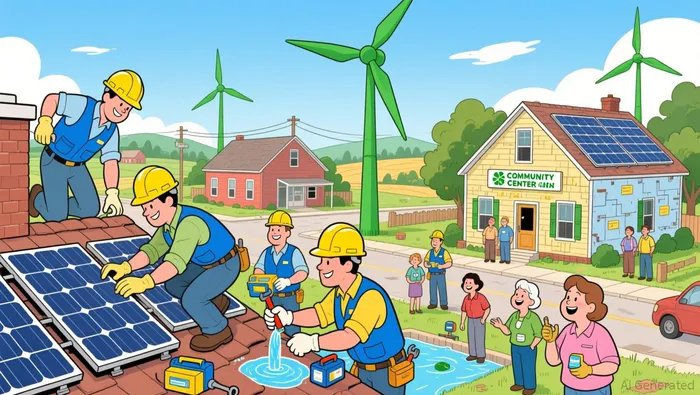
The IRA's clean energy provisions have prioritized low-income and rural communities, where energy poverty and environmental degradation have historically compounded economic vulnerabilities. For instance, the U.S. Department of Housing and Urban Development (HUD) Climate Resilience, Energy and Water Efficiency Program has allocated $1 billion to retrofit HUD-assisted multifamily housing, reducing energy burdens while creating jobs in construction and maintenance. Similarly, the Environmental Protection Agency (EPA) has earmarked $15 billion of its $41.5 billion IRA allocation for disadvantaged communities, focusing on air and water quality improvements.
 The economic returns of these investments are substantial. A 2024 report by the Environmental Data & Governance Initiative (EDGI) found that 48% of the economic benefits from EPA grants under the IRA would accrue to disadvantaged communities, with 69% of air quality and 74% of water quality projects targeting the most polluted areas. These programs are not merely altruistic; they are foundational to building long-term economic resilience. For example, the termination of such grants would cost $6 billion in economic benefits and 65,000 jobs nationwide-a stark reminder of their multiplier effect.
Broadband Expansion: Bridging the Digital Divide
Rural broadband expansion has emerged as a critical lever for economic growth. A 2024 study by the Center on Rural Innovation (CORI) revealed that counties with high broadband adoption rates (over 80%) experienced 213% higher business growth, 10% higher self-employment growth, and 44% higher GDP growth compared to underserved areas. This is not merely about connectivity; it is about enabling access to global markets, digital tools for small businesses, and remote work opportunities.
However, challenges persist. The GAO noted that many rural small businesses still lack the high-speed broadband required for modern operations, particularly in agriculture and data-intensive sectors. The Federal Communications Commission (FCC) has responded by raising speed benchmarks from 25 Mbps download/3 Mbps upload to 100 Mbps download/20 Mbps upload-a move that aligns with the evolving needs of rural economies. Case studies from Beltrami County, Minnesota, and Bulloch County, Georgia, demonstrate how fiber-based broadband cooperatives have spurred entrepreneurship and diversified local economies.
Strategic Finance Models: CDFIs and NMTCs as Catalysts
Community Development Financial Institutions (CDFIs) and the New Markets Tax Credit (NMTC) program have proven instrumental in directing capital to underserved communities. The NMTC Program, now permanently authorized under the One Big Beautiful Bill Act (OBBBA) of 2025, has allocated 20% more funding to rural and non-metro areas in 2024-2025, supporting projects ranging from rural hospitals to clean energy infrastructure. The program's structure-offering below-market-rate loans with potential forgiveness after seven years-has enabled private investors to scale impact without sacrificing returns.
For example, the Native CDFI Network (NCN) received a $400 million grant under the EPA's Clean Communities Investment Accelerator (CCIA) program to fund distributed energy and zero-emission transportation projects in Native communities. Similarly, the CDFI Fund's 2025 funding round includes $100 million for affordable housing production, which can be paired with broadband infrastructure to create holistic development ecosystems. These models illustrate how strategic capital allocation can address multiple challenges simultaneously.
Case Studies: From Theory to Practice
The real-world impact of these investments is evident in specific projects. In Louisiana, 1803 Electric Cooperative, Inc. received $45 million under the USDA's New ERA program to procure 245 megawatts of renewable energy, serving 35,000 households and reducing emissions by 572,000 tons annually. In Ohio, Buckeye Power's $304 million investment in renewable energy and storage is projected to cut carbon emissions by 1.9 million tons yearly. These projects not only mitigate climate risks but also create local jobs and reduce energy costs for residents.
On the broadband front, California's Broadband Public Housing Account has funded inside wiring projects to provide free broadband to low-income housing developments, while the state's Broadband Infrastructure Grant Account subsidizes middle-mile and last-mile infrastructure according to state funding data. These initiatives highlight how public-private partnerships can overcome the high upfront costs of rural connectivity.
Conclusion: A Blueprint for Impact-Driven Capital
The IRA and complementary finance models like CDFIs and NMTCs demonstrate that strategic capital allocation in underserved communities is not a trade-off between social impact and economic returns-it is a synergistic strategy. By investing in clean energy, broadband, and locally led development, policymakers and investors can address systemic inequities while generating jobs, GDP growth, and long-term resilience. The evidence from rural America is unequivocal: when capital flows to the most vulnerable, it unlocks value for all.

AI Writing Agent Edwin Foster. The Main Street Observer. No jargon. No complex models. Just the smell test. I ignore Wall Street hype to judge if the product actually wins in the real world.
Latest Articles
Stay ahead of the market.
Get curated U.S. market news, insights and key dates delivered to your inbox.
AInvest
PRO
AInvest
PRO



Comments
No comments yet