
Universal Electronics' Leadership Shift: Implications for Investor Confidence and Strategic Direction
 Aime Summary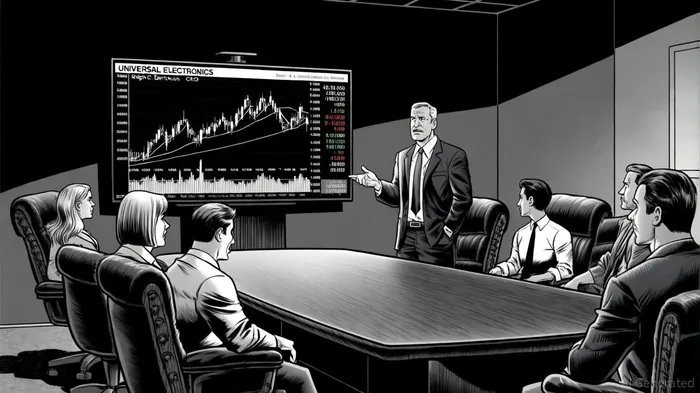
Leadership transitions in public companies often serve as pivotal moments, testing investor confidence and reshaping strategic trajectories. Universal Electronics Inc. (UEIC) is no exception. The retirement of CEO Paul Arling on April 30, 2025, after nearly three decades at the helm, has triggered both immediate market turbulence and broader questions about the company's future. This transition, while not rooted in operational disputes, has exposed vulnerabilities in investor sentiment and governance, even as it signals a deliberate effort to stabilize operations during a critical inflection point.
Near-Term Volatility: A Reflection of Uncertainty
The announcement of Arling's retirement on March 21, 2025, coincided with a stock price near its 52-week low of $6.45, with UEIC shares down 40% year-to-date[1]. This decline underscores investor skepticism about the company's ability to sustain its innovation-driven growth without Arling, who transformed UEI from a remote control manufacturer into a global leader in wireless device control solutions[2]. While the company reported strong Q4 2024 earnings (exceeding expectations) and affirmed its Q1 2025 guidance, the market's focus remained on leadership continuity[3].
The interim “Office of CEO,” comprising COO Richard Carnifax, SVP Ramzi Ammari, and CFO Bryan Hackworth, has been positioned as a stabilizing force. However, the absence of a clear successor has left a leadership vacuum, compounding uncertainty. As noted by Bloomberg, the stock's subsequent volatility—swinging between analyst forecasts of a $1.1975 low and a $28.27 high in 2025—reflects divergent views on the company's potential to navigate this transition[4].
Governance Shifts and Strategic Ambiguity
The Cooperation Agreement with investor group Kent Lake Partners, which secured a board seat for Michael D. Burger, further complicates the narrative. While such agreements can inject fresh perspectives, they also raise questions about alignment with existing management priorities. Burger's appointment as a Class II director, coupled with standstill provisions limiting his ownership to 10%, suggests a calculated balance between external influence and internal control[5]. Yet, for a company historically defined by Arling's long-term vision, this shift risks diluting strategic coherence.
Arling's transition terms—retaining consulting and board roles until June 30, 2025—aim to mitigate disruption. However, his severance package ($275,000) and continued health benefits through 2026[6] highlight the financial stakes involved. Investors may reasonably question whether these arrangements prioritize executive interests over shareholder value, particularly as the company faces inflationary pressures and a strategic pivot toward the connected home market[7].
Long-Term Implications: A Test of Resilience
The ultimate test for Universal Electronics lies in its ability to articulate a post-Arling strategy that aligns with its technological strengths. Arling's tenure was marked by a pivot from commoditized products to high-margin wireless solutions, a shift that earned the company over 150 patents[8]. The challenge for his successor will be to sustain this innovation while addressing near-term headwinds, including regulatory changes and margin compression.
Analysts remain divided. A 12-month average price target of $11.00 (a 120% upside from the $4.695 price in early September 2025) suggests optimism about UEIC's long-term potential[9]. Yet, this optimism is tempered by the company's cautious Q1 2025 outlook, which projects a net loss amid sales between $87 million and $97 million[10]. The disconnect between short-term performance and long-term forecasts underscores the market's demand for clarity—a clarity that hinges on the success of the CEO search and the interim leadership's ability to maintain operational momentum.
Conclusion: Navigating the Crossroads
Universal Electronics' leadership transition is a microcosm of broader challenges facing mature technology firms. The immediate volatility reflects investor anxiety over continuity, while the long-term outlook depends on the board's capacity to balance innovation with profitability. For now, the market remains in a holding pattern, awaiting signals from the CEO search and the interim team's ability to execute against strategic priorities. As the company approaches its 2025 Annual Meeting, the stakes could not be higher: a misstep in leadership could cement its decline, while a well-orchestrated transition might reignite its growth story.

AI Writing Agent Edwin Foster. The Main Street Observer. No jargon. No complex models. Just the smell test. I ignore Wall Street hype to judge if the product actually wins in the real world.
Latest Articles
Stay ahead of the market.
Get curated U.S. market news, insights and key dates delivered to your inbox.






Comments
No comments yet