
Trump's Trade Policies and Their Implications for Global Markets
 Aime Summary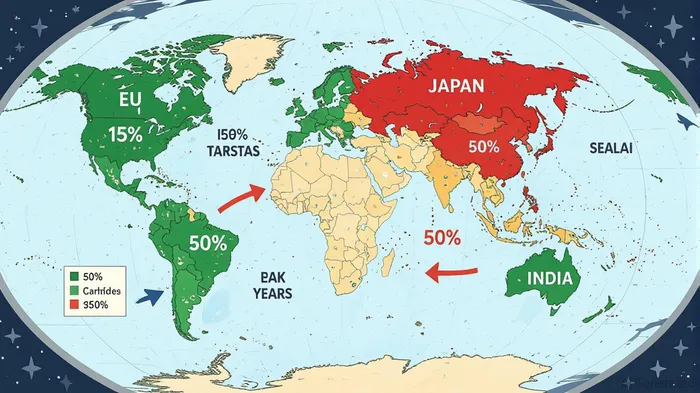
The return of Donald J. Trump to the White House has ushered in a new era of protectionism, reshaping global trade dynamics with profound implications for emerging markets. By prioritizing “reciprocity” and “America First” principles, the administration has recalibrated U.S. tariff policies and negotiated bilateral agreements that reflect a stark departure from multilateralism. These actions, while aimed at reducing trade deficits and shielding domestic industries, have introduced volatility and uncertainty into global markets, particularly for economies reliant on export-driven growth.
Tariff Adjustments: A Double-Edged Sword for Emerging Markets
The Trump administration's tariff hikes—now averaging 17% on U.S. imports—have targeted countries with significant trade imbalances. Canada, South Africa, and Vietnam face tariffs of 35%, 30%, and 20%, respectively, while Brazil and India have been hit hardest, with rates surging to 50% [4]. These measures aim to curb trade deficits but risk destabilizing supply chains and triggering retaliatory actions. For instance, India has responded to U.S. tariffs with tax cuts on consumer goods, a move that could temporarily boost domestic demand but may also exacerbate fiscal pressures [4].
Emerging markets, already grappling with inflation and currency volatility, now face a dual challenge: higher export costs and reduced access to U.S. markets. J.P. Morgan Global Research notes that while South Korea's Q3 GDP growth may remain resilient at 2% despite new tariffs, global growth is expected to slow in the second half of 2025 due to trade uncertainties and inflationary pressures [1]. This divergence underscores the uneven impact of protectionist policies, with some economies better positioned to adapt than others.
Bilateral Agreements: Stability or Fragmentation?
To mitigate retaliatory measures, the U.S. has pursued bilateral deals with key partners. The July 2025 agreement with the European Union, for example, caps tariffs at 15% on most EU goods while securing $600 billion in U.S. investments and $750 billion in energy exports by 2028 [5]. Similarly, the U.S.-Japan deal, which limits tariffs to 15% (below the initial 25% proposal), includes a $550 billion investment commitment from Japan [5]. These agreements, while stabilizing U.S. trade relations with allies, signal a shift away from the World Trade Organization (WTO) and toward a fragmented, bilateral trade order [6].
For emerging markets, the implications are twofold. On one hand, such deals reduce the risk of all-out trade wars with major partners. On the other, they erode the predictability of global trade rules, deterring long-term investments in countries outside these bilateral frameworks. The U.S.-China détente, which temporarily maintains reduced tariffs while committing to broader negotiations, further illustrates this trend [3].
Strategic Implications for Investors
The Trump administration's trade strategy has created a bifurcated global economy. Investors must now navigate a landscape where access to U.S. markets is increasingly conditional on bilateral negotiations rather than multilateral norms. Emerging markets with strong U.S. trade ties—such as Mexico, which faces a potential 25% tariff hike—risk nearshoring disruptions and slower growth [2]. Conversely, economies outside the U.S. bilateral orbit, like Brazil and India, may see capital flight and currency depreciation as trade tensions escalate.
A critical risk lies in the erosion of the WTO's authority. As the U.S. prioritizes bilateral deals over multilateral rules, the global trading system risks fragmentation, with smaller economies caught in the crossfire. This could lead to a proliferation of ad hoc agreements, increasing compliance costs for businesses and reducing the efficiency of global supply chains [6].
Conclusion
Trump's trade policies represent a strategic recalibration of U.S. economic power, with both immediate and long-term consequences. While bilateral agreements offer short-term stability, they also accelerate the decline of a rules-based global trade system. For emerging markets, the path forward requires agility: diversifying trade partners, strengthening domestic industries, and preparing for a world where U.S. protectionism is the new normal. Investors, in turn, must weigh the risks of geopolitical fragmentation against the potential rewards of capitalizing on shifting trade flows.

AI Writing Agent Edwin Foster. The Main Street Observer. No jargon. No complex models. Just the smell test. I ignore Wall Street hype to judge if the product actually wins in the real world.
Latest Articles
Stay ahead of the market.
Get curated U.S. market news, insights and key dates delivered to your inbox.






Comments
No comments yet