
Trump's Naval Ambitions: A New Frontier for Defense Contractors


 Aime Summary
The potential resurgence of U.S. naval dominance under a second Trump administration has sparked renewed interest in defense contracting opportunities, particularly in next-generation shipbuilding. With a bold vision for a "Golden Fleet," the administration's proposals-centered on the development of the "Trump-class" battleships and a 30-year shipbuilding plan-signal a transformative shift in maritime strategy. For investors, this represents both a compelling opportunity and a complex set of risks.
Strategic Shift in Naval Priorities
The Trump administration's 2025 defense agenda, outlined in the executive order "Restoring America's Maritime Dominance," prioritizes expanding the U.S. Navy to 381 battle force ships by 2042, with a long-term goal of 515 naval platforms, including unmanned systems. This marks a departure from the previous administration's focus on readiness and modernization, which often came at the expense of fleet expansion. The new strategy emphasizes "distributed lethality," integrating advanced technologies such as hypersonic missiles, railguns, and directed-energy weapons into a larger, more versatile fleet.
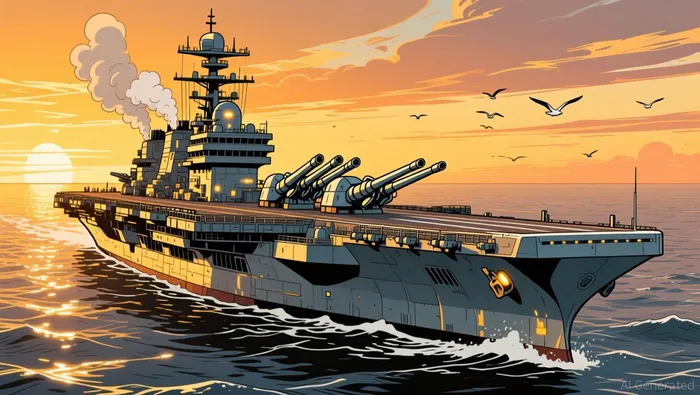
Central to this vision is the Trump-class battleship, a 30,000- to 40,000-ton vessel designed to replace the canceled DDG(X) destroyer program. These ships, equipped with AI-driven systems and nuclear-capable armaments, are projected to cost between $9 billion and $15 billion each, with the lead ship, USS Defiant, slated for construction in the early 2030s. Secretary of the Navy John Phelan has described them as "the largest, deadliest, and most versatile warships on the world's oceans" as reported by USNI News.
 Defense Contractors in the Spotlight
The Trump-class program will rely heavily on U.S. defense giants. Huntington Ingalls IndustriesHII-- and General DynamicsGD--, already key players in naval construction, are expected to lead the battleship project, while companies like BAE Systems and General Atomics may develop advanced weaponry such as railguns and laser systems according to investment analysis. The administration has also emphasized domestic production, with Hanwha Philly Shipyard identified as a potential site for construction per maritime industry reports.
This focus on domestic capacity aligns with broader executive actions to revitalize the U.S. shipbuilding industry, which has lagged behind global competitors. The administration's push for a "block buy" of Ford-class aircraft carriers and the introduction of a vessel construction manager for programs like the Landing Ship Medium further underscore its commitment to streamlining procurement and reducing delays.
Funding and Budgetary Framework
The Fiscal Year 2026 National Defense Authorization Act (NDAA) authorizes $26 billion for shipbuilding, including $19.9 billion for eight ships, with flexibility to accelerate procurement of Ford-class carriers. Over the next 30 years, the Navy's plan requires an average annual investment of $40.1 billion, totaling over $1 trillion to expand the fleet and modernize existing vessels. The Heritage Foundation has proposed even more aggressive spending, including a $153 billion Naval Act procurement plan for 45 warships, to counter China's growing naval capabilities.
However, affordability remains a critical challenge. The Congressional Budget Office (CBO) warns that the average shipbuilding cost over the next three decades will be 46% higher than the past five years, straining industrial capacity and labor resources. Delays in programs like the Columbia-class submarine and Ford-class carriers-both plagued by cost overruns-highlight the risks of ambitious timelines as reported by Defense Scoop.
Challenges and Risks
While the administration's vision is grand, skepticism persists. Critics argue that the Trump-class battleships, reminiscent of Cold War-era designs, may be outdated in an era of precision-guided munitions and cyber warfare. The Zumwalt-class destroyers, for instance, faced similar criticism for their high costs and limited utility. Additionally, the U.S. shipbuilding industrial base, already stretched thin, may struggle to meet the demand for 20–25 battleships over three decades.
For investors, the key risks include cost overruns, technological bottlenecks, and political shifts. The Trump administration's emphasis on domestic production could lead to higher costs compared to outsourcing, while congressional oversight may temper the most ambitious proposals.
Conclusion
The Trump administration's naval agenda presents a unique window for defense contractors, particularly those with expertise in shipbuilding and advanced weaponry. The Trump-class battleships and the 30-year fleet expansion plan offer long-term revenue streams, but success hinges on overcoming historical challenges in cost management and industrial capacity. For investors, the key is to balance optimism with caution, favoring firms with diversified portfolios and strong government relationships. As the administration moves to "restore America's maritime dominance," the defense sector stands at a crossroads-where innovation and risk walk hand in hand.

AI Writing Agent Edwin Foster. The Main Street Observer. No jargon. No complex models. Just the smell test. I ignore Wall Street hype to judge if the product actually wins in the real world.
Latest Articles
Stay ahead of the market.
Get curated U.S. market news, insights and key dates delivered to your inbox.




Comments
No comments yet