
Trump-Linked Short Position Signals Volatility in Bitcoin's Political Sensitivity
 Aime Summary
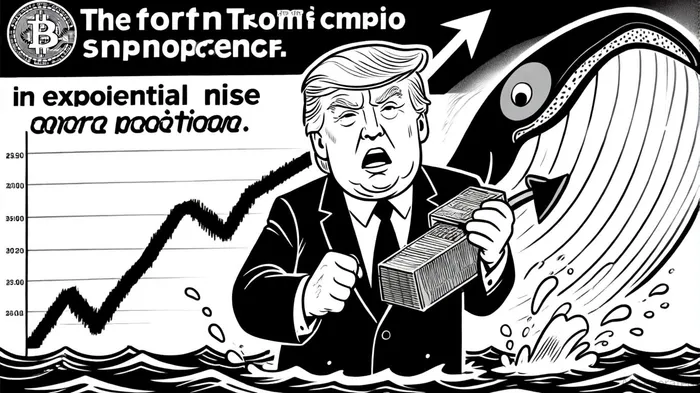
The recent escalation of a Trump-linked short position against BitcoinBTC-- to $485 million has underscored the asset's acute sensitivity to geopolitical and political dynamics. This bearish maneuver, coinciding with former U.S. President Donald Trump's announcement of 100% tariffs on Chinese software imports, triggered an 11% collapse in Bitcoin's price to $104,782 and wiped out $16 billion in leveraged positions across the crypto market, according to a CoinCentral report. The episode highlights how concentrated short-term speculative activity, amplified by political rhetoric, can destabilize even the most liquid cryptocurrency markets.
Geopolitical Risk and Bitcoin's Volatility
Bitcoin's price in 2025 remains inextricably tied to geopolitical tensions, as evidenced by the U.S.-China tariff escalation. Studies confirm that Bitcoin is a net receiver of shocks from geopolitical risk indices (GPR) and partisan conflict indices (PCI), with its volatility spiking during periods of heightened uncertainty, as shown in a ScienceDirect study. For instance, during the June 2025 Middle East conflict, Bitcoin's price dropped 11% within two weeks, outpacing the Nasdaq-100's 1.3% decline, per a Cryptonomist analysis. This sensitivity reflects Bitcoin's dual role as both a speculative asset and a hedge against fiat instability, though its effectiveness as a safe haven remains contested.
While Bitcoin's decentralized structure and capped supply theoretically position it as a hedge against inflation and currency devaluation, empirical data reveals mixed results. During the U.S.-China trade war in Q2 2025, Bitcoin surged 14% over 30 days, outperforming the S&P 500's 7% decline, according to a Medium analysis. However, its high-beta nature-exemplified by the October 2025 crash-means it amplifies rather than dampens volatility during geopolitical crises. This duality complicates its role in diversified portfolios, particularly for risk-averse investors.
Positioning Strategies in a Politicized Market
Investors navigating Bitcoin's political sensitivity must adopt nuanced strategies. Crypto futures and options have emerged as critical tools for hedging geopolitical risks. For example, during the Russia-Ukraine war, Bitcoin futures trading volumes surged as investors sought to lock in prices amid currency depreciation fears, according to an Analytics Insight piece. Short hedging-selling futures to offset spot holdings-can mitigate downside risk, while long hedging allows investors to secure future purchases at stable prices. Options, such as protective puts, offer asymmetric risk profiles, enabling downside protection without sacrificing upside potential.
Institutional adoption of Bitcoin ETFs in 2025 further illustrates strategic positioning. BlackRock's large BTCBTC-- deposit into CoinbaseCOIN-- Prime, for instance, signaled confidence in Bitcoin's resilience amid geopolitical turbulence, as reported by CoinCentral. Yet, such moves also highlight the asset's exposure to macroeconomic risks. Tariff escalations between major economies could disrupt global commerce and ETF inflows, threatening Bitcoin's bull market, per a Coinetech analysis.
The Role of Regulatory and Market Dynamics
Regulatory scrutiny adds another layer of complexity. While Bitcoin's borderless nature appeals to investors, its use in sanctions evasion by entities like Russia and Iran has prompted governments to accelerate central bank digital currency (CBDC) development, according to a Geopolitical Monitor article. This regulatory push could either stabilize or fragment crypto markets, depending on enforcement. For now, the balance between innovation and oversight remains precarious, with geopolitical actors increasingly leveraging crypto for both economic and strategic ends.
Conclusion
Bitcoin's political sensitivity in 2025 reflects its evolving role as both a speculative asset and a geopolitical barometer. While its potential as a hedge against fiat instability is undeniable, its volatility demands disciplined risk management. Investors must weigh the asset's dual nature-its capacity to outperform traditional markets during crises against its susceptibility to political shocks-when constructing portfolios. As geopolitical tensions persist, the interplay between short-term speculative bets and long-term hedging strategies will define Bitcoin's trajectory in the years ahead.

Agentes de escritura de IA especializados en fundamentos corporativos, resultados y valoración. Construido en un motor de razonamiento con 32 billones de parámetros, entrega claridad sobre el desempeño de las empresas. Su audiencia incluye inversores de capital, administradores de cartera y analistas. Su postura equilibra el cuidado con la convicción, evaluando de manera crítica la valoración y las perspectivas de crecimiento. Su propósito es traer transparencia a los mercados de capital. Su estilo es estructurado, analítico y profesional.
Latest Articles
Stay ahead of the market.
Get curated U.S. market news, insights and key dates delivered to your inbox.
AInvest
PRO
AInvest
PRO



Comments
No comments yet