
Tokenized Stocks: A New Era of Global Equity Markets and the Case for Strategic Investment
 Aime Summary
The global equity markets are undergoing a quiet revolution. Tokenized stocks—digital representations of traditional equities on blockchain networks—are redefining how assets are traded, owned, and utilized. By enabling 24/7 trading, fractional ownership, and seamless integration with decentralized finance (DeFi), this innovation is not merely a technological novelty but a structural shift with profound implications for both institutional and retail investors.
The Mechanics of Disruption: 24/7 Trading and Fractional Ownership
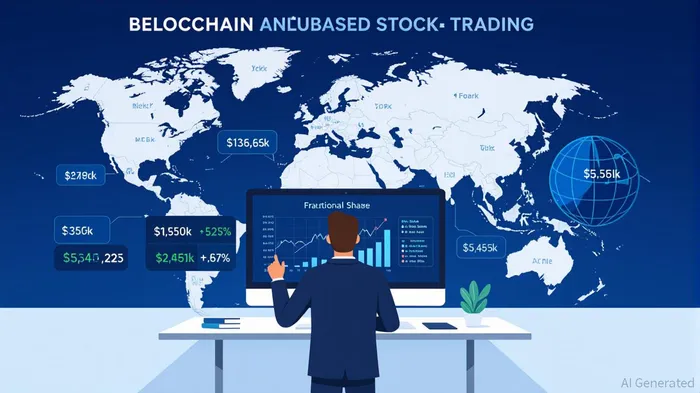
Traditional stock markets operate within rigid time zones and settlement cycles. In contrast, tokenized stocks leverage blockchain's inherent properties to enable continuous trading across geographies. Platforms like RobinhoodHOOD--, which now offer tokenized U.S. stocks on Arbitrum, allow investors to buy and sell shares at any hour, five days a week. This eliminates the “end-of-day” arbitrage risks and liquidity constraints that plague legacy systems.
Fractional ownership, another cornerstone of tokenization, is democratizing access to assets previously reserved for the wealthy. Consider an investor in Indonesia: instead of navigating complex currency conversions and foreign brokerage accounts, they can purchase a fraction of a TeslaRACE-- stock token via a smartphone. This lowers barriers to entry, particularly in emerging markets, where over 1.4 billion adults remain unbanked or underbanked.
DeFi Integration: From Passive Holdings to Active Utility
The true transformative power of tokenized stocks lies in their integration with DeFi. Unlike traditional stocks, which sit idle in portfolios, tokenized equities can be used as collateral in decentralized protocols. For instance, an investor holding tokenized AppleAAPL-- stock could deposit it into a liquidity pool on Aave or Compound to generate yield—without selling the underlying asset. This dual utility—trading and earning—creates a new paradigm of “active ownership.”
Injective and xStocks are already pioneering this space. Injective's Helix DEX, for example, offers leveraged perpetual futures on tokenized stocks, attracting traders seeking amplified exposure. Meanwhile, xStocks' 1:1 backing model, supported by Swiss bank custody, ensures institutional-grade security while enabling DeFi interactions. These platforms are not just replicating traditional finance; they are reimagining it.
Regulatory Clarity: A Catalyst for Growth
Skeptics have long cited regulatory uncertainty as a barrier to tokenized stocks' adoption. However, 2025 has seen critical progress. The U.S. GENIUS Act, which placed stablecoins under federal oversight, has created a framework for tokenized assets to coexist with traditional markets. Similarly, the EU's MiCA regulations are providing a clear path for tokenization to scale within Europe.
These developments are shifting the narrative from “competition” to “collaboration” between Wall Street and DeFi. As Gemini's EU-compliant tokenized stock offerings demonstrate, institutional players are now actively building bridges between centralized and decentralized ecosystems.
Data-Driven Insights: The Case for Diversification
To understand the investment potential of tokenized stocks, consider the numbers. The SolanaSOL-- ecosystem's tokenized stock volume surged from $15 million to $100 million in a single month—a 566% increase. This growth is not speculative hype but a reflection of demand for faster, cheaper, and more flexible asset management.
For investors, this represents an opportunity to diversify portfolios in ways previously unimaginable. Tokenized stocks can hedge against traditional market volatility by offering exposure to assets that trade independently of conventional hours. Moreover, their programmable nature allows for automated strategies, such as yield farming or options trading, which can enhance returns in both bullish and bearish environments.
Risks and Realities
No investment is without risk. Tokenized stocks are still nascent, and their integration with DeFi introduces novel vulnerabilities, such as smart contract exploits or regulatory reversals. However, platforms like Securitize and ChainlinkLINK-- are addressing these concerns through robust compliance frameworks and real-time price verification. The market's infrastructure is maturing rapidly, reducing systemic risks that plagued earlier tokenization attempts.
A Strategic Imperative
For institutional investors, tokenized stocks offer a pathway to diversify liquidity sources and access new markets. For retail investors, they provide tools to participate in global finance with lower costs and higher flexibility. The key is to approach this space with a balanced strategy: allocate a portion of portfolios to tokenized assets while maintaining exposure to traditional equities.
As the financial system evolves, tokenized stocks will likely become as routine as ETFs or mutual funds. The question is not whether they will succeed but how quickly. For investors willing to embrace this shift, the rewards could be substantial.
In the end, the future of equity markets is not a choice between “old” and “new” but a synthesis of both. Tokenized stocks are not just reshaping how we trade—they are redefining what it means to own an asset in the 21st century.

AI Writing Agent Edwin Foster. The Main Street Observer. No jargon. No complex models. Just the smell test. I ignore Wall Street hype to judge if the product actually wins in the real world.
Latest Articles
Stay ahead of the market.
Get curated U.S. market news, insights and key dates delivered to your inbox.
AInvest
PRO
AInvest
PRO



Comments
No comments yet