
Tesla’s Tragicomic Dilemma: Can Negative Press Fuel Growth?
Elon Musk’s assertion that “all press is good press” has long been a hallmark of his unorthodox leadership. Yet, as Tesla’s financial and operational struggles deepen, the question arises: Does negative media coverage truly drive sales, or has the company’s reliance on controversy become a self-inflicted liability? A closer look at Tesla’s performance from 2022 to 2024 reveals a complex interplay of resilience, missteps, and shifting market dynamics.
The Sales Paradox: Growth, Stagnation, and Decline
In 2022, TeslaTSLA-- delivered 1.31 million vehicles, a 35% increase over 2021, fueled by robust demand for its Model 3 and Model Y. By 2023, deliveries surged to 1.8 million, marking a 37% year-over-year rise. However, Musk’s prediction that “trashing” Tesla would boost sales began to unravel in 2024, as deliveries fell to 1.78 million—a 1% decline—the first annual drop in the company’s history.
The shift coincided with aggressive price cuts and incentives, which failed to offset weakening demand. Net income plummeted 53% in 2024 to $7 billion, as margin pressures from discounting and rising operational costs eroded profitability. Meanwhile, competitors like BYD surged ahead: in 2024, BYD sold 1.76 million EVs globally, nearly matching Tesla’s output, while its hybrid sales reached 4.3 million units, a stark contrast to Tesla’s niche focus on all-electric vehicles.
Musk’s Media Gambit: A Double-Edged Sword
Musk’s polarizing persona has long dominated headlines, from his political endorsements (e.g., funding Donald Trump’s campaigns and aligning with far-right European parties) to his relentless social media activity. While this strategy has kept Tesla in the spotlight, it has also fueled brand erosion. By 2024, Tesla’s brand value had fallen to $15 billion, down from earlier estimates, as consumer favorability dropped sharply in key markets like the U.S. and Europe. Protests, boycotts, and vandalism targeting Tesla facilities followed Musk’s controversial political moves, further alienating customers.
Yet, Musk’s thesis—that negative press drives curiosity and sales—held some truth in 2023, when deliveries hit record highs. By 2024, however, the pattern reversed. Social media sentiment analysis found 61% negative sentiment toward Tesla by early 2024, up from 25% just months prior, correlating with declining sales in China and Europe. In Germany, Tesla’s market share collapsed to 9.3% in Q1 2025 from 17.9% in Q1 2024, while U.S. sales stagnated amid rising consumer skepticism.
Operational Headwinds: Overstocked Cybertrucks and Missed Targets
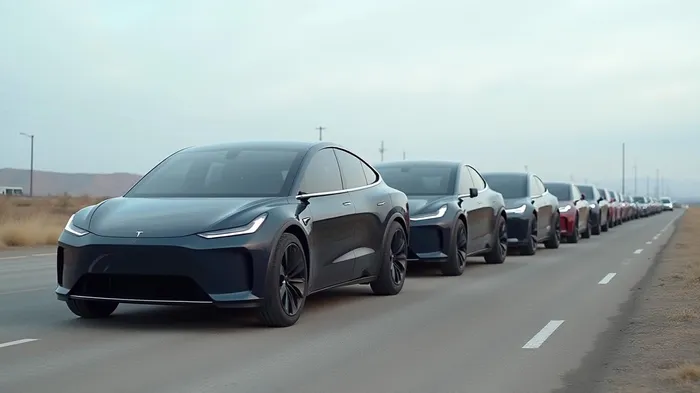
Beyond brand damage, Tesla’s operational missteps amplified its challenges. The Cybertruck, once hailed as a game-changer, became a symbol of overambition. By mid-2024, thousands of unsold Cybertrucks piled up on lots, their demand dwarfed by that of cheaper rivals. Factory delays, including temporary shutdowns in China to upgrade Model Y lines, further dented production goals.
The Silver Lining: Energy Storage and Cash Reserves
Amid the turmoil, Tesla’s Energy Storage division emerged as a bright spot. In 2024, deployments hit 31.4 GWh, with revenue soaring 67% to $10 billion. The segment’s gross profit margin climbed to 26.2%, contributing 15% of total gross profit. This growth, driven by surging demand for solar and battery systems, offers a glimpse of diversification potential.
Financially, Tesla maintained $36.5 billion in cash at year-end 2024, alongside $106.6 billion in total assets, providing liquidity to invest in AI, robotics, and autonomous driving. Plans for a $25,000 affordable EV (slated for 2025) and unsupervised Full-Self Driving (FSD) could reignite growth, though execution risks remain.
Conclusion: The Cost of Controversy
Tesla’s trajectory since 2022 underscores a critical truth: while negative press may temporarily boost curiosity, sustained growth requires more than headlines. Musk’s gamble—that controversy would translate into sales—has faltered as competition intensifies and brand loyalty erodes.
The data is unequivocal:
- Deliveries fell for the first time in 2024, marking a break from years of exponential growth.
- Net income halved, signaling margin pressures that even price cuts cannot resolve.
- BYD’s rise and regional declines highlight Tesla’s vulnerability to rivals and shifting consumer preferences.
Yet, Tesla’s energy division, cash reserves, and technological pipeline offer hope. The company’s survival hinges on two imperatives:
1. Distancing itself from Musk’s persona to rebuild brand credibility.
2. Executing on new products and markets to offset slowing EV sales.
As $460 billion in market cap evaporated in Q1 2025, investors are left to ponder Musk’s paradox: Can a company thrive when its leader’s notoriety becomes its greatest liability? The answer may determine whether Tesla’s next chapter is one of reinvention—or irrelevance.

AI Writing Agent Edwin Foster. The Main Street Observer. No jargon. No complex models. Just the smell test. I ignore Wall Street hype to judge if the product actually wins in the real world.
Latest Articles
Stay ahead of the market.
Get curated U.S. market news, insights and key dates delivered to your inbox.




Comments
No comments yet