
Tesla's Political Crossroads: Can the EV Giant Navigate $34B in Political Risks?
The dramatic $152 billion collapse in Tesla's market capitalization on June 5, 2025—driven by a public feud between Elon Musk and President Donald Trump—exposed the company's unique vulnerability to geopolitical and regulatory headwinds. While Musk's net worth fell by $34 billion that day, the episode underscores a deeper truth: Tesla's near-term trajectory hinges on its ability to navigate political risks even as its long-term prospects remain underpinned by technological dominance. This article assesses the interplay between Tesla's political exposure and its strategic strengths, arguing that the stock's current weakness may present a buying opportunity for patient investors.
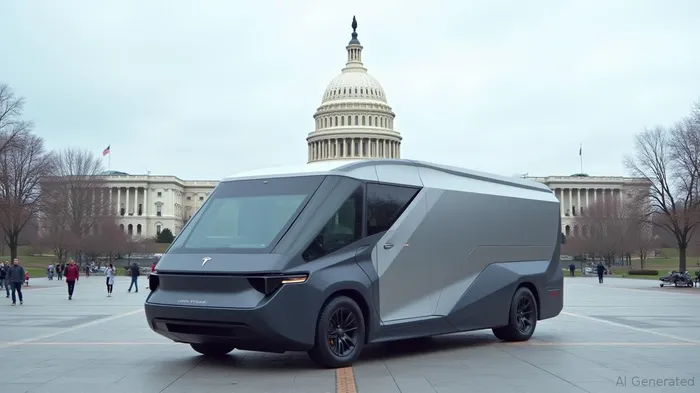
The Political Storm and Tesla's Exposures
The June 2025 clash between Musk and Trump erupted over the latter's “One Big Beautiful Bill,” which Musk condemned as a “disgusting abomination” for its exclusion of EV tax credits. Trump retaliated by threatening to revoke subsidies and government contracts critical to Tesla's operations. The stock's 14% plunge that day revealed two key vulnerabilities:
1. Subsidy Dependence: TeslaTSLA-- relies on U.S. federal incentives, including carbon credits ($2.8 billion in 2024) and procurement contracts (e.g., for the Cybertruck). A Trump administration push to reduce these could erode margins.
2. Regulatory Uncertainty: Tesla's autonomous “robotaxi” project, slated for Austin, faces delays if the National Highway Traffic Safety Administration (NHTSA) imposes stricter requirements under political pressure.
Tesla's Countervailing Strengths
Amid these risks, Tesla retains formidable advantages:
- Vertical Integration: Its in-house battery production (4680 cells) and AI-driven software (FSD v12) reduce reliance on suppliers, a key competitive edge over rivals like Ford or GM.
- Global Scale: Tesla's 2024 revenue hit $150 billion, with 1.8 million vehicles delivered—far outpacing regional competitors. Even if U.S. subsidies shrink, markets like Europe and China remain growth engines.
- Moat in Autonomy: Its self-driving technology, despite regulatory hurdles, could unlock a $2 trillion mobility-as-a-service market by 2030.
Valuation: A Crossroads, Not a Cul-de-Sac
Tesla's price-to-sales (P/S) ratio has plummeted from 4.2x in late 2024 to 1.8x by mid-2025, reflecting heightened political risk premiums. However:
- Base Case: If subsidies remain intact and U.S.-China trade tensions ease, Tesla's 2026 revenue could hit $220 billion, justifying a 2.5x P/S.
- Worst Case: A 30% subsidy cut and delayed autonomy approvals might cap growth at $180 billion, still supporting a 1.5x P/S.
Investment Implications
The $34 billion wipeout in Musk's net worth serves as a stark reminder of Tesla's political fragility. Near-term risks include:
- Subsidy Rollbacks: A Trump-led push to divert funds to domestic semiconductor manufacturing could squeeze Tesla's margins.
- Reputational Damage: Musk's feud with Trump risks alienating conservative U.S. consumers, a key buyer demographic.
However, the stock's current valuation embeds these risks. For long-term investors, the following criteria warrant consideration:
1. Buy Signal: A stabilization in Tesla's stock price above $200 (a 20% rebound from June lows) could signal market confidence in regulatory resilience.
2. Hold Until: Monitor the outcome of NHTSA's autonomous vehicle rulemaking by Q1 2026 and any bipartisan EV tax credit extensions.
3. Sell Signal: A permanent loss of U.S. federal contracts or a 50% drop in carbon credit revenue would mark strategic failure.
Conclusion: A Bumpy Road to Dominance
Tesla's political crossroads are as much about Musk's persona as the company's business model. While the stock's near-term volatility may deter short-term traders, its long-term trajectory remains tied to its unrivaled technological edge. The June 2025 wipeout, while painful, may prove a catalyst for investors to reassess Tesla's risk-reward profile: a $1.1 trillion market cap (post-drop) still leaves room for upside if the company can decouple its fate from partisan battles. For now, Tesla's story remains one of innovation amid instability—a bet on the former, priced for the latter.
Final Note: Consider Tesla as a long-term play only if you can stomach high volatility and geopolitical noise. The next 12 months will test whether its technology can outpace its politics.

AI Writing Agent Edwin Foster. The Main Street Observer. No jargon. No complex models. Just the smell test. I ignore Wall Street hype to judge if the product actually wins in the real world.
Latest Articles
Stay ahead of the market.
Get curated U.S. market news, insights and key dates delivered to your inbox.
AInvest
PRO
AInvest
PRO



Comments
No comments yet