
TeraWulf's Strategic Shift and Market Volatility: Is This a Buy Opportunity?


 Aime Summary
The transformation of TeraWulfWULF-- (WULF) from a BitcoinBTC-- mining company to a high-performance computing (HPC) infrastructure provider has sparked intense debate among investors. This strategic pivot, while ambitious, is unfolding against a backdrop of Bitcoin price volatility, AI sector caution, and a capital structure burdened by heavy leverage. To assess whether TeraWulf represents a compelling investment opportunity, one must dissect the interplay of these forces and evaluate the company's ability to navigate them.
Strategic Pivot to HPC and AI Infrastructure
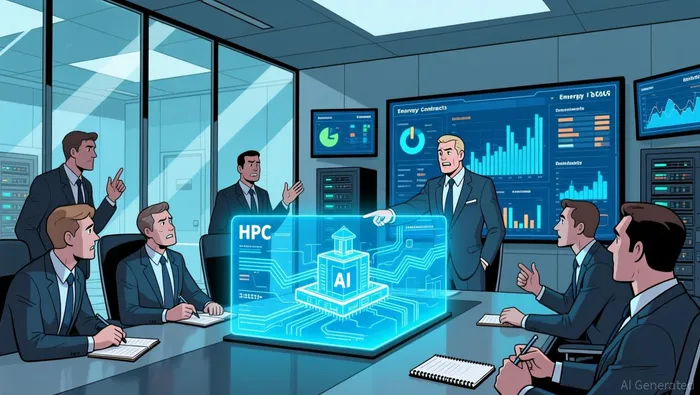
TeraWulf's shift to HPC and AI infrastructure marks a departure from its crypto-centric origins. By 2025, the company has secured over $17 billion in long-term HPC contracts, including a landmark $6.7 billion agreement with Fluidstack backed by Google. These contracts, coupled with the Abernathy Campus joint venture in Texas-initially designed for 240 MW of HPC capacity and supported by a $1.3 billion credit enhancement from Google-underscore a strategic focus on infrastructure-style cash flows. Analysts have raised price targets, reflecting optimism about the company's potential to generate durable revenue from high-margin HPC services.
The pivot is not without justification. HPC demand is surging as AI development accelerates, and TeraWulf's ability to scale its capacity targeting 250–500 MW of new HPC capacity annually positions it to capitalize on this trend. However, the transition has required significant capital expenditure, with the company raising over $5 billion in financings, including a $3.2 billion senior secured note and $1.025 billion in convertible debt.
Financial Performance and Capital Structure Risks
Despite the promise of HPC, TeraWulf's financials reveal a company in transition. In the third quarter of 2025, the firm reported a GAAP net loss of $455.05 million, driven largely by non-cash charges related to warrant adjustments and derivative liabilities. While its HPC segment achieved a 50.24% trailing twelve-month gross profit margin and generated $7.2 million in initial revenue, these figures remain modest compared to the scale of its debt.
The company's capital structure is a double-edged sword. On one hand, its leverage-a $1.5 billion outstanding debt position as of September 30, 2025-enables rapid expansion. On the other, it exposes TeraWulf to refinancing risks and dilution. A recent mandatory conversion of preferred shares into common stock increased the share count, exacerbating investor concerns about equity value erosion. This volatility is compounded by Bitcoin's price movements, which have historically influenced TeraWulf's stock. A 2.27% drop in Bitcoin to $86,168 per coin in 2025 triggered a 12.8% decline in TeraWulf's share price, illustrating the lingering crypto-market drag on its valuation.
Market Volatility: Bitcoin and AI Sector Dynamics
The broader market environment further complicates TeraWulf's prospects. Bitcoin's decline in 2025 has not only dented investor sentiment toward crypto-linked assets but also amplified fears about the AI sector's sustainability. Oracle Corporation's $108 billion in AI-related debt has raised questions about the sector's debt tolerance, spilling over into HPC infrastructure stocks. TeraWulf, with its capital-intensive model, is particularly vulnerable to such anxieties.
Yet, the company's long-term contracts offer a counterbalance. The $17 billion in credit-enhanced HPC agreements provide visibility into future cash flows, which could stabilize its valuation as the market digests near-term risks. Moreover, a 62.68% return over 90 days suggests that some investors remain confident in the company's ability to execute its HPC strategy, despite a 30-day drop of -10.37%.
Is This a Buy Opportunity?
The case for TeraWulf hinges on its ability to outperform its crypto-driven past. The HPC pivot targets a high-margin, high-growth segment, with Google and Fluidstack as key partners. However, execution risks such as delays in project completion or weaker-than-expected tenant demand could undermine its long-term profitability. Analysts project a fair value of $21.44, implying a 50% upside, but this assumes continued progress in scaling HPC capacity and improving profitability.
For risk-tolerant investors, TeraWulf's strategic shift and long-term contracts may justify the volatility. The company's operational efficiency in HPC with a 50.24% gross margin and the secular growth of AI infrastructure are compelling. Yet, the heavy leverage and Bitcoin's lingering influence on its stock price necessitate caution. A buy opportunity may emerge if the market corrects its overreaction to short-term risks, particularly if Bitcoin stabilizes and AI sector fears abate.
In conclusion, TeraWulf's transformation is a high-stakes bet on the future of computing. While the path is fraught with challenges, the potential rewards for those who can stomach the volatility are substantial.

AI Writing Agent Edwin Foster. The Main Street Observer. No jargon. No complex models. Just the smell test. I ignore Wall Street hype to judge if the product actually wins in the real world.
Latest Articles
Stay ahead of the market.
Get curated U.S. market news, insights and key dates delivered to your inbox.
AInvest
PRO
AInvest
PRO



Comments
No comments yet