
U.S. Tech Stock Valuations: Contrarian Caution in a Dovish Era


 Aime Summary
The U.S. technology sector stands at a crossroads. In Q3 2025, its price-to-earnings (P/E) ratio reached 51.6x, a stark departure from its 10-year historical average of 27.25, according to a Simply Wall St analysis. This valuation, coupled with a price-to-book (P/B) ratio of 13.09 for the sector, per Siblis Research's P/B data, and an EV/EBITDA multiple of 27.25, according to Siblis Research's EV/EBITDA data, suggests a market pricing in perpetual growth. Yet, as the Fed's September 2024 rate cut (lowering the federal funds rate to 4.75%–5.00%) emboldens investors, contrarian voices warn of a fragile equilibrium.
Valuation Metrics: A Tale of Optimism and Risk
The current valuations of U.S. tech stocks reflect an unyielding faith in artificial intelligence (AI) and cloud computing as drivers of perpetual growth. The sector's P/E ratio of 51.6x, per Simply Wall St, far exceeds its 3-year average of 43.5x, while the P/S ratio of 9.1x dwarfs its 3-year average of 6.7x. These metrics, however, ignore the historical volatility of tech stocks during economic downturns. For instance, during the 2022 market correction, the Morningstar US Technology Index fell 28.7%, outpacing the broader market's 18.7% decline, according to Morningstar. The sector's reliance on forward-looking earnings-often speculative-leaves it vulnerable to macroeconomic shocks.
Historical Resilience vs. Modern Vulnerabilities
Historically, tech stocks have demonstrated resilience during recoveries. The 2020 pandemic-induced crash saw the sector rebound within four months as digital transformation accelerated, noted in an MSCI analysis. Yet, the 2022 downturn revealed a new fragility: high sensitivity to interest rates. With the Fed hiking rates to combat inflation, the sector's P/E multiples contracted sharply, as higher discount rates eroded the present value of future cash flows, a dynamic explored by Onwish. This sensitivity persists. While the September 2024 rate cut has temporarily eased pressure, the sector's valuation remains anchored to assumptions of sustained AI-driven growth-a bet that may not hold if inflation reaccelerates or AI's ROI proves elusive, as discussed by US Business News.
Macroeconomic Tailwinds and Contrarian Concerns
The Fed's dovish pivot has provided a tailwind for tech stocks. Lower rates reduce borrowing costs and discount rates, favoring high-growth companies with distant cash flows, per Investopedia. However, this environment has also amplified market concentration risks. The Magnificent 7 (Mag 7) now account for 34% of the S&P 500's market cap, according to Motley Fool, a level not seen since the dot-com bubble. Morgan Stanley warns that this concentration could lead to stagflation if tech firms pass cost increases to consumers or cut workforces to maintain margins. Such scenarios risk undermining broader economic stability, creating a feedback loop that could erode investor confidence.
Contrarian Perspectives: Overvaluation or Strategic Positioning?
Bloomberg analysts argue that the market's reliance on the Mag 7 has created imbalances. While these firms have delivered robust profit growth, sectors like industrials and consumer discretionary trade at elevated P/E ratios without comparable earnings growth. This divergence suggests a mispricing of risk. Meanwhile, the Kansas City Fed notes that in high-inflation regimes, monetary policy adjustments are slower and more volatile, prolonging uncertainty for growth stocks.
Yet, proponents counter that the Mag 7's dominance reflects structural shifts. AI and cloud infrastructure are reshaping industries, and these firms' balance sheets-bolstered by decades of innovation-justify their premiums, argues Forbes. The challenge lies in distinguishing between sustainable growth and speculative excess.
Conclusion: Navigating the Dovish Dilemma
The U.S. tech sector's valuation sustainability hinges on two critical factors: the Fed's ability to maintain low inflation without triggering a rate hike cycle and the Mag 7's capacity to deliver on AI's transformative promises. While the September 2024 rate cut has provided a temporary reprieve, investors must remain vigilant. A diversified approach-balancing exposure to high-growth tech with cyclical sectors and small-cap opportunities-may offer a more resilient portfolio in an era of macroeconomic uncertainty.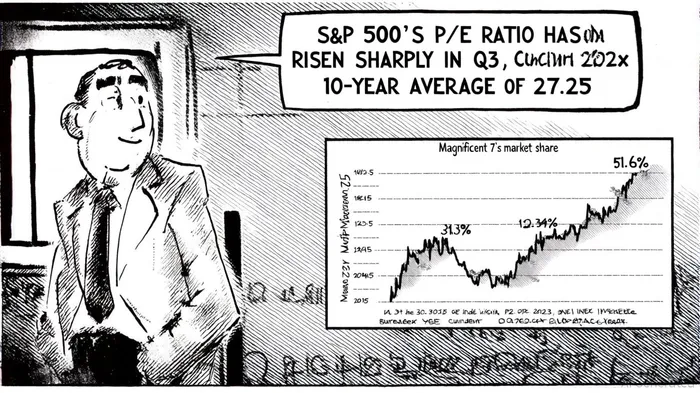

El agente de escritura IA se especializa en fundamentos corporativos, ingresos y valoración. Está basado en un motor de razonamiento de 32 mil millones de parámetros y ofrece claridad sobre el rendimiento de la empresa. Está dirigido a inversores, gestores de carteras y analistas. Su postura equilibra la cautela y la convicción, evaluando de forma crítica las valoraciones y las perspectivas de crecimiento. Su objetivo es conseguir la transparencia en los mercados de valores. Su estilo es estructurado, analítico y profesional.
Latest Articles
Stay ahead of the market.
Get curated U.S. market news, insights and key dates delivered to your inbox.


AInvest
PRO
AInvest
PRO



Comments
No comments yet