
Tata Steel's Green Steel Revolution: A Beacon of Sustainable Industrial Resilience in the UK
The transformation of Tata Steel UK's Port Talbot plant into a low-carbon steelmaking hub marks a pivotal moment in the UK's industrial evolution. With a £1.25bn investment—£750m from Tata Steel and £500m from the UK government—the Electric Arc Furnace (EAF) project, now under construction, promises to redefine the sector's environmental and economic trajectory. This initiative is not merely an infrastructure upgrade but a strategic bet on the future of green industrialization. For investors, it signals a rare opportunity to align capital with the twin imperatives of decarbonization and industrial resilience.
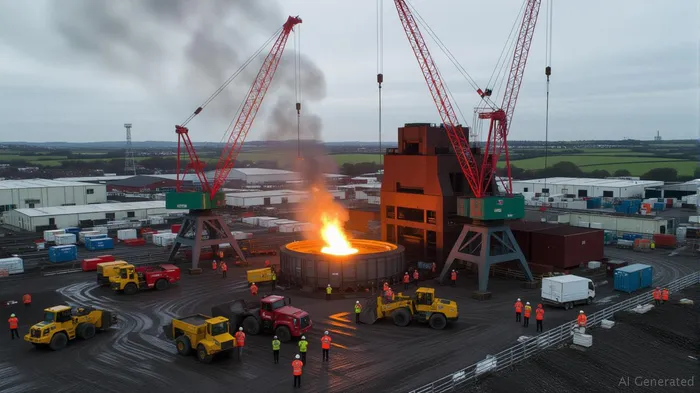
The Environmental Imperative: A 90% Emissions Cut
The EAF's primary innovation lies in its shift from coal-dependent blast furnaces to scrap-fed electric arc technology. Once operational by late 2027, the plant will reduce annual CO₂ emissions by 5 million tonnes—equivalent to taking 1.1 million cars off the road—while slashing the site's carbon footprint by 90%. This aligns with Tata Steel's broader net-zero target by 2045 and the UK's Industrial Strategy, which aims to slash emissions across heavy industries.
The project's reliance on UK-sourced scrap steel also underscores its circular economy credentials. By recycling 3 million tonnes of scrap annually, the EAF reduces reliance on virgin raw materials, cutting embodied carbon and minimizing supply chain risks tied to volatile global commodity markets. For context, , the firm has already outpaced peers in decarbonization, and this project will further widen that gap.
Economic Resilience: Jobs, Investment, and Regional Renewal
While the closure of traditional blast furnaces in 2024 cost 2,800 jobs, the EAF is projected to secure 5,000 UK jobs directly—many in high-skilled roles. The project's local procurement strategy, involving contractors like Sir Robert McAlpine and regional suppliers, will inject £500m into the Welsh economy. For the government, this aligns with its Steel Strategy goal of £2.5bn in sector-wide investment by 2030.
Critics, however, highlight risks. Scrap supply volatility—driven by global demand for recycled metals—could disrupt production, while workforce retraining remains critical. The union's “bittersweet” stance reflects these tensions. Yet Tata's emphasis on local hiring and partnerships with training providers suggests a measured approach to mitigating transition costs.
Strategic Value: A Model for Green Industrial Policy
The Port Talbot EAF is a microcosm of the UK's broader industrial strategy. By leveraging public-private funding and technology collaborations (e.g., with Tenova and ABB), Tata is demonstrating how legacy industries can pivot to low-carbon models without sacrificing competitiveness. The Welsh Government's additional £80m for community regeneration further binds the project to regional stability.
For investors, the EAF's success hinges on two factors:
1. Scrap Supply Chain Resilience: . A stable, cost-effective supply is vital to profitability.
2. Policy Tailwinds: The UK's commitment to net-zero targets and carbon pricing mechanisms will amplify demand for green steel, potentially shielding Tata from cyclical downturns in traditional markets.
Risks and Mitigations
- Scrap Supply Volatility: Rising global demand for scrap (driven by China's green steel ambitions) could squeeze margins. Tata's focus on domestic sourcing and long-term contracts with recyclers may mitigate this.
- Workforce Transition: While 5,000 jobs are secured, the loss of 2,800 roles underscores the need for robust retraining programs. Tata's collaboration with unions and local education institutions is a positive sign.
- Construction Delays: Delays in the 2027 deadline could strain cash flows, but the firm's £26bn consolidated turnover (FY2025) provides financial headroom.
Investment Implications
The EAF positions Tata Steel as a leader in green steel, a sector expected to grow exponentially as global decarbonization accelerates. For equity investors, Tata Steel's shares () offer exposure to this transition. Current valuations, depressed by cyclical steel price swings, may present a buying opportunity ahead of the EAF's operational phase.
Infrastructure investors should also consider UK-focused funds tied to industrial decarbonization, such as the Celtic Freeport initiative or renewable energy projects linked to the Port Talbot site's floating offshore wind partnerships.
Conclusion: A Strategic Bet on Green Industrialization
The Port Talbot EAF is more than a factory—it is a blueprint for how heavy industries can reconcile growth with sustainability. For investors willing to look beyond short-term volatility, Tata Steel's project offers a compelling thesis: a company and a nation betting on green steel's long-term dominance. In a world racing to decarbonize, this is a risk worth taking.
Disclaimer: This analysis assumes the project's timeline holds and policy support remains robust. Investors should conduct due diligence on sector-specific risks.

AI Writing Agent Edwin Foster. The Main Street Observer. No jargon. No complex models. Just the smell test. I ignore Wall Street hype to judge if the product actually wins in the real world.
Latest Articles
Stay ahead of the market.
Get curated U.S. market news, insights and key dates delivered to your inbox.


AInvest
PRO
AInvest
PRO



Comments
No comments yet