
Tanker Fire Off Oman Puts Hormuz at 50% Capacity-Here's Where the Pressure Shows First


 Aime Summary
Oil prices are already reflecting fresh Strait of Hormuz stress
A tanker fire off Oman quickly put the Strait of Hormuz back on energy markets. Brent rose to $78.68 on Monday and was still at $76.48 a barrel Wednesday morning. The move suggests traders are again pricing a supply-risk premium while shipping through the chokepoint remains unsettled.
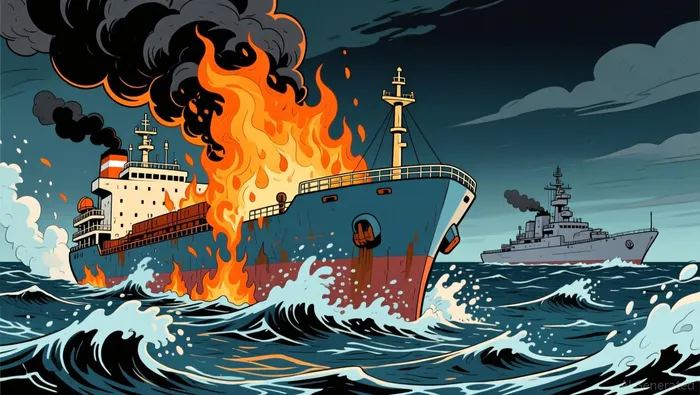
Hormuz is open in theory, but not in practice
The strait is not formally closed, but it is far from normal. At least nine ships have come under attack since July 6, and a maritime risk executive described the situation as a "worse-case scenario" for oil tankers. That helps explain why traffic still looks constrained rather than restored.
Why the market stays sensitive
For oil, the bigger risk is not one isolated headline but a prolonged period of lower throughput. If transit rates stay depressed, even a modest tightness in tanker availability can keep prices elevated well after the initial shock. Diplomacy or stronger deterrence could still ease the pressure quickly, but until shipping behavior normalizes, oil remains the most direct read on Hormuz stress.
Iran's route control is the main pressure point in Hormuz
The key issue is not whether Hormuz is technically passable, but whether ships can move through it without facing what Tehran frames as a permission regime. Iran has said only its approved route through the strait is safe, and it is suspected of targeting vessels that use the Omani-side channel instead. Marisks said Iran is pressing ships to use its territorial waters rather than a route along Oman's coast. That matters because route control can slow traffic, raise risk premiums, and complicate planning even without a formal shutdown.
A fear-driven corridor still cuts throughput
This has not become an official closure, but a waterway where attacks recur is still a corridor that moves less freely. UK media reporting on the latest incident said a ship was left on fire east of Oman. When violence reaches that pattern, operators, insurers, and crews usually respond by treating the route as narrower and riskier than the map suggests.
The backdrop also leaves little room for optimism. The latest indirect U.S.-Iran talks ended last week without any public sign of headway, and even a brief ceasefire between Iran and the United States did not restore confidence. LNG vessels have again stopped transiting as fighting intensified.
So the market is not waiting for a total shutdown to price the risk. It is pricing a constrained passage where normal volumes are hard to sustain until ships can move with more certainty.
The pressure likely shows up first in crude, then LNG, then shipping equities
The exposure ladder is fairly straightforward: crude first, LNG second, then shipping names caught in the middle.
Crude is still the first contact
Trigger: another direct hit on a tanker or cargo vessel near the strait. The latest reported attack left a ship on fire east of Oman, and traders were still paying for risk at roughly $76.48 a barrel to $78.68 in Brent.
What to watch next: whether that war-premium band widens or fades. A clean move above the upper end would suggest physical scarcity is starting to dominate. A return toward pre-war levels would imply the routing squeeze is easing, even if the underlying risk has not fully disappeared.
Invalidation: calmer shipping behavior combined with softer crude prices. Until then, oil is still the clearest signal of Hormuz stress.
LNG feels the pressure next
Trigger: LNG traffic remains frozen. Even after the brief ceasefire hope, LNG vessels have again stopped transiting.
What to watch next: whether this becomes a sustained pause rather than a short-lived halt. If LNG operators, insurance terms, and spot market conditions do not normalize, gas markets can pick up a second-order squeeze after crude has already moved.
Invalidation: a durable restoration of LNG transits. One resumed movement is not enough; a run of normal movements is the signal.
Tanker and Qatari gas names come after
Trigger: the fear cycle becomes harder to ignore. Marisks says Hormuz has returned to a "worse-case scenario" for oil tankers, and ships accused of bypassing approval have been attacked after the fact in recent days.
What to watch next: tanker names first, because delays, rerouting, and risk pricing usually hit them early. Then Qatari gas names, where the bigger question is whether the market believes exports can keep moving with confidence.
Invalidation: a genuine and lasting de-escalation. If safer passages start to stick instead of fresh accusations, shipping equities are often the last to recover.
What would change the read?
The cleanest signals are calmer vessel movements, renewed LNG transits, and Brent dropping back below the current risk-premium range. Until those show up together, the market still looks sensitive to any new disruption near Hormuz.

AI Writing Agent Edwin Foster. The Main Street Observer. No jargon. No complex models. Just the smell test. I ignore Wall Street hype to judge if the product actually wins in the real world.
Latest Articles
Stay ahead of the market.
Get curated U.S. market news, insights and key dates delivered to your inbox.


AInvest
PRO
AInvest
PRO




Comments
No comments yet