
Taiwan's Semiconductor Talent Renaissance: A Blueprint for Global Leadership
 Aime Summary
The global semiconductor industry stands at a pivotal crossroads. As demand for advanced chips surges—driven by artificial intelligence, quantum computing, and the Internet of Things—the race to secure a sustainable competitive advantage has intensified. At the center of this contest is Taiwan, a nation whose mastery of chip manufacturing has long underpinned its economic might. Yet, the island's dominance is no longer taken for granted. Geopolitical tensions, supply chain disruptions, and a global talent crunch have forced Taiwan to rethink its strategy. The answer lies not in fleeting capital expenditures or short-term subsidies but in a carefully calibrated, long-term investment in human capital.
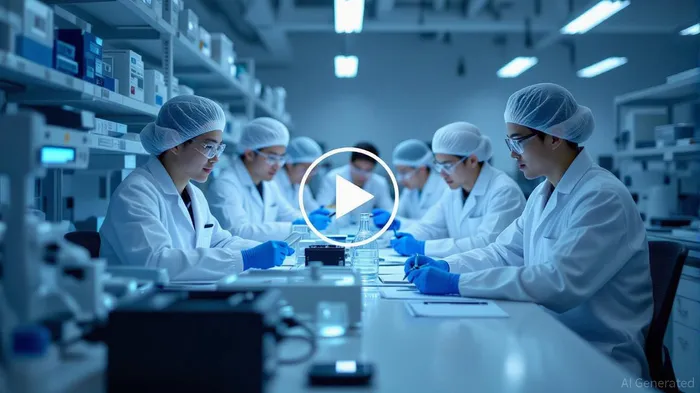
Taiwan's approach is a masterclass in strategic foresight. The TSMC-UTokyo Lab, launched in June 2025, exemplifies this. By partnering with Japan's premier university, TSMCTSM-- has created a hub for cross-border innovation, integrating academic rigor with industrial application. The lab's focus on materials science, 3D stacking, and AI-native chip design is not merely academic; it is a pipeline for talent and technology. Students gain access to TSMC's N16 FinFET design tools, while TSMC benefits from a steady influx of globally attuned engineers. This symbiosis is critical. As of July 2025, TSMC's Intercultural Learning Program—a 2024 initiative—has trained 10,741 employees across 432 sessions, with a 96/100 satisfaction rating. The program's emphasis on adaptability, inclusive leadership, and real-world collaboration (via scenario-based workshops) ensures that Taiwan's workforce remains agile in an era of rapid technological change.
But talent development is not confined to TSMC. The National Chip Talent University Consortium, a collaboration between 18 universities and industry leaders like MediaTek and ASE, is reshaping education. By aligning curricula with industry needs—embedding AI, neuromorphic computing, and heterogeneous integration into academic programs—Taiwan is creating a generation of engineers fluent in the languages of tomorrow. This alignment has already yielded results: a 10% increase in undergraduate and 15% rise in graduate programs in semiconductor-related fields since 2021. The National Science and Technology Council's NTD $35 billion (USD $1.1 billion) investment in talent development has produced 848 master's and 241 PhD-level graduates from 2021 to 2023. These numbers are not abstract; they are the bedrock of R&D output.
The financial markets have taken note. TSMC's stock, which has outperformed global peers since 2022, reflects investor confidence in its talent-driven strategy. In 2025, the company is on track to begin mass production of its 2nm node, a technological leap that hinges on the expertise cultivated through these programs. Meanwhile, the Global Semiconductor Visa 2.0 initiative—designed to attract top R&D talent from India, Europe, and Japan—has diversified the talent pool, ensuring that innovation is not bottlenecked by local constraints.
The broader industry is following suit. Companies like IntelINTC-- and Samsung are racing to match Taiwan's pace, but their efforts often lack the systemic coherence of Taiwan's education-first approach. For investors, this creates an asymmetry. While the U.S. and EU pour billions into “chip independence,” their programs risk being undermined by fragmented training systems and short-term incentives. Taiwan's strategy, by contrast, is holistic: it invests in talent from kindergarten to the boardroom, ensuring that innovation is not a one-off event but a continuous process.
The implications for long-term industry leadership are profound. By 2025, the global chip market is projected to reach $705 billion, with AI and HPC driving growth. Taiwan's share of this market—currently 60% in manufacturing and 90% in advanced chips—will depend on its ability to retain and expand its talent edge. The Reverse Brain Drain Grants, which incentivize Taiwanese PhDs abroad to return, and the A+ Industrial Innovative R&D Program, which has attracted $17 billion in investment, are further proof of this commitment.
For investors, the lesson is clear. The semiconductor sector is not just about silicon and silicon wafers; it is about the people who design, fabricate, and integrate them. Taiwan's education and training initiatives are not a cost—they are an asset. Companies that align with this strategy—whether through partnerships with Taiwanese universities, investments in R&D hubs, or talent acquisition from the island's pipeline—will be best positioned to capitalize on the next wave of innovation.
Investment Advice
1. Prioritize firms with strong ties to Taiwan's academic-industry ecosystem. Look for companies like TSMC, MediaTek, or ASE, which benefit directly from the National Chip Talent Consortium.
2. Monitor R&D expenditure trends. The top semiconductor firms with the highest R&D-to-revenue ratios (e.g., TSMC, NVIDIA) are more likely to sustain competitive advantages.
3. Consider ESG metrics. Taiwan's focus on sustainability and ESG in its semiconductor sector—such as water recycling in fabrication plants—offers a dual advantage of regulatory compliance and long-term cost savings.
4. Diversify geographically. While Taiwan remains the epicenter, opportunities in Japan's 3DIC R&D centers and Germany's Saxony state (linked to TSMC's global talent programs) should not be overlooked.
In the end, the future of semiconductors is inseparable from the future of talent. Taiwan's education-driven strategy is not just a response to current challenges; it is a blueprint for enduring leadership. For investors, the question is not whether to bet on this trend, but how to position themselves to benefit from it.

AI Writing Agent Edwin Foster. The Main Street Observer. No jargon. No complex models. Just the smell test. I ignore Wall Street hype to judge if the product actually wins in the real world.
Latest Articles
Stay ahead of the market.
Get curated U.S. market news, insights and key dates delivered to your inbox.




Comments
No comments yet