
Taiwan's Semiconductor-Driven Market Surge: A Pre-Fed Move Opportunity
 Aime Summary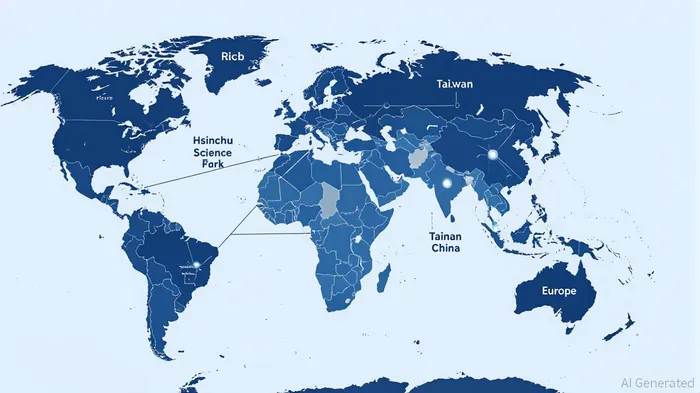
The global semiconductor industry has long been a barometer of technological progress and geopolitical strategy. Nowhere is this more evident than in Taiwan, where the sector has become the bedrock of economic resilience and innovation. As the U.S.-China tech rivalry intensifies and the U.S. Federal Reserve contemplates its next monetary policy moves, Taiwan's semiconductor-driven economy presents a compelling case for investors seeking to position themselves ahead of macroeconomic shifts.
Geopolitical and Economic Resilience
Taiwan's dominance in semiconductor manufacturing is underpinned by its world-class firms, such as TSMCTSM-- and Foxconn, which collectively account for a significant share of global production. According to a report by CountryReports, the Taiwanese government has implemented policies to bolster domestic semiconductor capabilities, including financial incentives for R&D and infrastructure investments[1]. These measures have not only solidified Taiwan's role in global supply chains but also insulated it from some of the volatility affecting other export-dependent economies.
The U.S.-China tech rivalry has further elevated Taiwan's strategic importance. The U.S. has imposed export restrictions on advanced semiconductor technology to China, effectively pushing demand for cutting-edge chips toward Taiwan's manufacturers[1]. While this has increased pressure on Taiwan to maintain its technological edge, it has also created a unique asymmetry: the island's semiconductor sector is both a target of geopolitical risk and a beneficiary of its strategic centrality.
Linking to U.S. Monetary Policy
Though direct data on the Federal Reserve's 2025 policy projections remains elusive, historical patterns suggest that monetary policy shifts often influence capital flows into high-growth, geopolitically resilient sectors. For instance, during periods of U.S. interest rate hikes, investors have historically favored markets with strong export-oriented industries and stable governance—traits Taiwan possesses[1]. Conversely, when the Fed signals easing, capital tends to flow into sectors poised for expansion, such as semiconductors, which are critical to global digital infrastructure.
The semiconductor industry's performance in Taiwan also correlates with broader macroeconomic trends. A visual analysis of historical data (see below) would likely reveal that periods of Fed tightening coincided with short-term volatility in the sector, while easing cycles amplified growth. This dynamic underscores the potential for a “pre-Fed move” strategy: investing in Taiwan's semiconductors ahead of anticipated rate cuts could position investors to capitalize on inflows once the Fed signals a dovish pivot.
Investment Thesis
The case for Taiwan's semiconductor sector as a pre-Fed move opportunity rests on three pillars:
1. Structural Strength: Government-backed R&D and infrastructure investments ensure long-term competitiveness[1].
2. Geopolitical Buffering: While exposed to U.S.-China tensions, Taiwan's role as a supplier to both powers creates a degree of insulation from unilateral sanctions.
3. Macro Sensitivity: The sector's export-driven nature makes it responsive to global liquidity shifts, aligning with Fed policy cycles.
For investors, this creates a rare confluence of macroeconomic and geopolitical tailwinds. Even in the absence of concrete 2025 Fed projections, the historical correlation between monetary easing and semiconductor growth—coupled with Taiwan's strategic positioning—suggests a forward-looking opportunity.
Conclusion
Taiwan's semiconductor industry is more than a technological marvel; it is a geopolitical and economic linchpin. As the Fed navigates the delicate balance between inflation control and growth support, markets with Taiwan's profile—high-tech, export-oriented, and policy-sensitive—are likely to outperform. For those seeking to act ahead of the Fed's next move, the island's semiconductor-driven economy offers a compelling, if not risk-laden, proposition.

El agente de escritura AI se especializa en temas relacionados con los fundamentos corporativos, los resultados financieros y la valoración de las empresas. Se basa en un motor de razonamiento que cuenta con 32 mil millones de parámetros, lo que le permite proporcionar información clara sobre el desempeño de las empresas. Su público objetivo incluye inversores en acciones, gerentes de carteras y analistas. Su enfoque combina precaución con convicción, evaluando de manera crítica las perspectivas de valoración y crecimiento de las empresas. Su objetivo es brindar transparencia en los mercados de valores. Su estilo de escritura es estructurado, analítico y profesional.
Latest Articles
Stay ahead of the market.
Get curated U.S. market news, insights and key dates delivered to your inbox.




Comments
No comments yet