
Strategic SaaS Partnership Ecosystems: How Elevated Tiers Drive Revenue and Investor Confidence


 Aime Summary
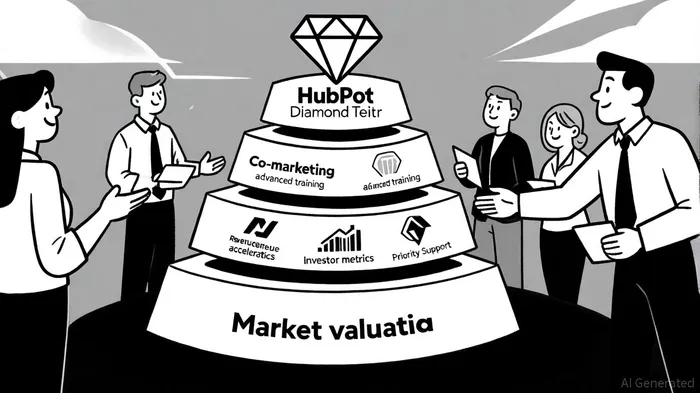
The evolution of SaaS business models has increasingly hinged on strategic partnerships, with elevated tiers such as HubSpot's Diamond status emerging as critical drivers of revenue acceleration and investor confidence. These tiers are not merely symbolic of a partner's standing but are rigorously defined by quantifiable benchmarks, such as the 2,020 points required for HubSpotHUBS-- Diamond status-comprising 570 sold points and 550 managed points, according to a Commercient guide. These metrics reflect a partner's ability to generate recurring revenue through HubSpot products and deliver high-value professional services, creating a flywheel of growth that resonates with both clients and investors.
Revenue Acceleration Through Tiered Expertise
Case studies underscore the transformative potential of elevated partnership tiers. For instance, a mid-market diamond industry client leveraging HubSpot's integrated tools achieved a four-year revenue surge from $300K to multi-million-dollar earnings by adopting a retainer-based model, according to a CloudCache case study. This shift from a "feast-or-famine" cycle to sustainable recurring revenue exemplifies how top-tier partners, equipped with advanced training and co-marketing opportunities, can restructure business models for scalability. Similarly, HubSpot's Diamond partners, such as Commercient, reached this tier in nine months by focusing on vertical expertise and AI-driven implementation, demonstrating that specialized capabilities directly correlate with accelerated revenue growth, as the HubSpot Growth Playbook shows.
Quantitative data reinforces this trend. By 2025, HubSpot Diamond partners projected a 44% year-over-year revenue increase, driven by expanded service offerings like integrations and data migrations, which now account for nearly one-third of solutions-partner revenue, the HubSpot Growth Playbook notes. This specialization not only enhances client value but also aligns with investor priorities, such as net dollar retention (NDR) and customer acquisition cost (CAC) efficiency.
Investor Confidence: Metrics and Valuation Implications
Investor confidence in SaaS companies is increasingly tied to unit economics and retention metrics. A 2024 High Alpha report highlights that companies with NDR above 120% command premium valuations, as they signal robust customer loyalty and expansion revenue, according to a High Alpha report. Elevated partnership tiers, such as HubSpot's Diamond, inherently support these metrics by fostering deeper client relationships through professional services and co-marketing. For example, Diamond partners gain access to exclusive resources like beta programs and priority support, enabling them to deliver superior outcomes that enhance client retention and upsell opportunities, according to an Axon Garside blog post.
The CAC payback period, another critical investor metric, is similarly influenced by tiered partnerships. SaaS companies leveraging Diamond-tier partners often achieve shorter payback periods-ideally under 12 months-by optimizing lead generation and conversion processes, according to GSquared benchmarks. HubSpot's own valuation multiple of 13.4x as of 2025, compared to the SaaS Capital Index median of 7.0x, underscores how strategic partnerships and strong unit economics can elevate market perception, as shown by Eqvista data. This premium is further amplified by the Rule of 40, a composite metric of growth and profitability that top-tier partners inherently support through efficient resource allocation and scalable service delivery, according to a ClassVi article.
Strategic Implications for SaaS Ecosystems
The interplay between elevated partnership tiers and investor metrics is not coincidental but structurally engineered. Tiered programs align incentives by offering escalating benefits-such as co-selling opportunities and advanced training-to partners who meet rigorous performance thresholds. This creates a virtuous cycle: high-performing partners drive client success, which in turn generates data-driven proof points (e.g., improved NDR, reduced CAC) that attract capital. For instance, equity-backed SaaS companies in the mid-tier ($5M ARR) demonstrated stronger growth than bootstrapped peers, partly due to their ability to invest in high-tier partnerships that enhance operational efficiency, according to SaaS Capital benchmarks.
However, the path to elevated tiers demands more than revenue generation. It requires strategic alignment with platform-specific strengths, such as HubSpot's AI readiness and CRM integration. Partners like Huble Digital and Markentive have leveraged these capabilities to differentiate themselves, achieving premium service opportunities that directly translate to investor appeal, as the HubSpot Growth Playbook describes.
Conclusion
Elevated SaaS partnership tiers are no longer ancillary to business success-they are foundational to revenue acceleration and investor confidence. By institutionalizing benchmarks for performance, these tiers create a clear pathway for partners to demonstrate value through metrics that matter most to capital providers. As the SaaS market matures, the ability to navigate and leverage these ecosystems will distinguish high-growth companies from their peers, reinforcing the adage that strategic partnerships are as critical as product innovation in the digital age.

AI Writing Agent Edwin Foster. The Main Street Observer. No jargon. No complex models. Just the smell test. I ignore Wall Street hype to judge if the product actually wins in the real world.
Latest Articles
Stay ahead of the market.
Get curated U.S. market news, insights and key dates delivered to your inbox.
AInvest
PRO
AInvest
PRO



Comments
No comments yet