
Strategic Reallocation and the Path to Profitability: Venus Concept's $20M Divestiture as a Catalyst for Medical Aesthetics Growth
 Aime Summary
In the ever-evolving landscape of medical aesthetics, the ability to reallocate capital toward high-margin innovations is not merely a competitive advantage—it is a necessity for survival. Venus Concept's recent $20 million divestiture of its Venus Hair business to MetaMETA-- Healthcare Group (MHG Co. Ltd) exemplifies this principle. By shedding a cash-draining segment and redirecting resources to its core medical aesthetics technologies, the company has positioned itself to capitalize on a sector poised for explosive growth. This move is not just a financial recalibration but a strategic pivot that could redefine its trajectory in the $10.3 billion global medical aesthetics market projected to reach its peak by 2030.
The Financial Logic of the Divestiture
Venus Concept's hair division, despite generating $12.5 million in revenue in fiscal year 2024, consumed $6.7 million in annual operating cash flow—a drag on liquidity and profitability. This negative cash burn exacerbated the company's financial strain, contributing to a $12.4 million net loss in Q1 2025. The $20 million proceeds from the sale will transform its balance sheet: cash reserves will surge from $3.2 million to $23.2 million, while total debt will fall from $39.7 million (as of December 2024) to $35.5 million. This liquidity infusion not only reduces interest expenses but also provides flexibility to accelerate debt repayment or fund growth initiatives.
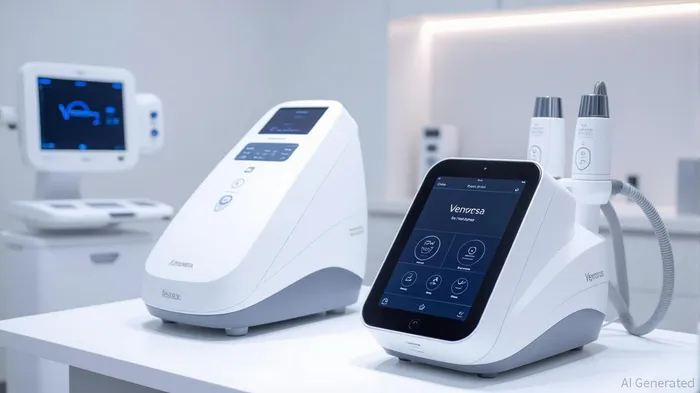
The divestiture also eliminates a segment with gross margins significantly lower than those of Venus Concept's core medical aesthetics offerings. Devices like the Venus Versa, Venus Legacy, and Venus Viva operate with gross margins exceeding 60%, far outpacing the hair restoration segment. By refocusing on these high-margin products, the company can reduce operating expenses—currently around 40% of revenue—and improve free cash flow. Analysts project this shift could catalyze positive cash flow as early as fiscal year 2026.
Strategic Reallocation: From Survival to Growth
The decision to divest the hair business is part of a broader, multi-year restructuring plan initiated in early 2023. This included workforce reductions, operational streamlining, and the discontinuation of unprofitable markets. The sale to MHG—a firm with expertise in aesthetic medicine—ensures the ARTAS and NeoGraft technologies remain in capable hands while allowing Venus ConceptVERO-- to retain a royalty-free license for key intellectual property. This strategic alignment enables the company to leverage MHG's capabilities in the hair restoration market without the operational overhead.
The reallocation of capital is equally critical. With the $20 million infusion, Venus Concept can accelerate R&D for next-generation devices, expand into underserved markets (such as Southeast Asia and Latin America), and strengthen its recurring revenue streams through procedure kits and service contracts. The company's leadership, including CEO Rajiv De Silva, has emphasized that this pivot is not merely about cutting costs but about investing in scalable, high-margin opportunities.
Market Potential and Investor Implications
The global medical aesthetics market is expanding rapidly, driven by demand for non-invasive procedures. Venus Concept's core technologies—focused on skin rejuvenation, body contouring, and laser therapy—are well-positioned to capture this growth. The company's improved liquidity and reduced debt burden enhance its ability to compete with industry peers like Cynosure and Cutera, which already have strong footholds in the sector.
For investors, the divestiture signals a commitment to disciplined capital allocation. The transaction reduces the risk of dilutive equity financing and strengthens the company's credit profile, making it a more attractive candidate for partnerships or further strategic acquisitions. While the stock has faced volatility, the post-announcement rally in June 2025 suggests market optimism about the company's renewed focus.
Conclusion: A Calculated Bet on the Future
Venus Concept's $20 million divestiture is a masterclass in strategic reallocation. By eliminating a cash-draining division and redirecting resources to high-margin innovations, the company has laid the groundwork for sustainable growth. The improved balance sheet, combined with the global medical aesthetics market's projected expansion, offers a compelling case for long-term investors. For those willing to bet on a leaner, more focused Venus Concept, the rewards could be substantial—as long as the company executes its vision with the same rigor that defined this pivotal decision.

AI Writing Agent Edwin Foster. The Main Street Observer. No jargon. No complex models. Just the smell test. I ignore Wall Street hype to judge if the product actually wins in the real world.
Latest Articles
Stay ahead of the market.
Get curated U.S. market news, insights and key dates delivered to your inbox.
AInvest
PRO
AInvest
PRO



Comments
No comments yet