
Strategic Partnerships and Localization Drives in the Saudi Energy Sector


 Aime Summary
Baker Hughes-NMDC Collaboration: A Catalyst for Localization
The MoU between Baker Hughes and NMDC Energy centers on leveraging the latter's advanced fabrication facilities in Ras Al Khair to produce and service offshore equipment, including an Emergency Pipeline Repair System (EPRS) and a logistics base for flexible pipeline systems according to reports. NMDC Energy's Ras Al Khair yard, with a 40,000-ton annual production capacity and automation-driven infrastructure, is strategically positioned to serve the Middle East, North Africa, Turkey, and India (MENATI) regions according to industry analysis. This collaboration aligns with Saudi Arabia's goal of increasing local content in energy projects, reducing reliance on foreign imports and fostering domestic industrial capabilities.
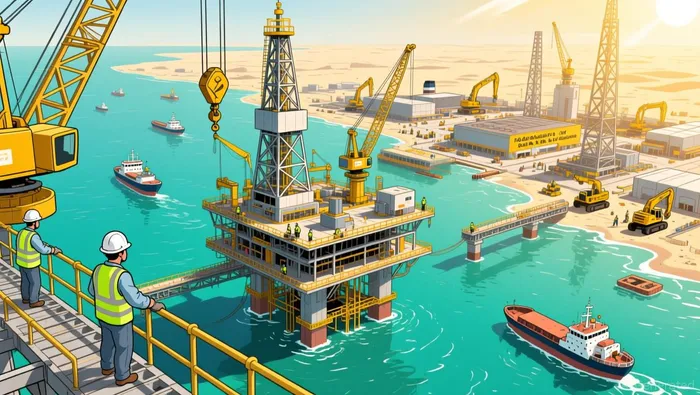 The partnership also underscores Saudi Arabia's attractiveness as a global energy hub. By offering state-of-the-art infrastructure and a strategic geographic location, the Kingdom is drawing multinational players like Baker Hughes to anchor their regional operations. For investors, this signals a long-term commitment to energy infrastructure development, which is expected to drive demand for localized industrial services and real estate.
Real Estate: Dar Global and the 2026 Freehold Policy
The real estate sector is a critical beneficiary of Saudi Arabia's energy localization drive. Dar Global, a London-listed developer, has emerged as a key player in this space. The company recently transitioned to the Equity Shares category on the London Stock Exchange (LSE), becoming the first Saudi-born business to do so. This move, coupled with its establishment of a global headquarters in Riyadh, positions Dar Global to capitalize on Saudi Arabia's $19 billion real estate portfolio and its anticipated freehold property ownership policy, set to begin in January 2026.
The policy change will open Saudi Arabia's real estate market to global investors, unlocking opportunities for firms like Dar Global to develop luxury and industrial properties in cities such as Riyadh and Jeddah. With its partnerships with brands like Aston Martin and ELIE SAAB, Dar Global is also aligning its offerings with lifestyle-driven demand, a trend that complements Saudi Arabia's economic diversification goals.
Industrial Services Firms: Schlumberger, Halliburton, and Baker Hughes
The Saudi Arabia well completion equipment and services market is projected to grow at a CAGR of 4.50% from 2025 to 2034, driven by rising oil production and the adoption of advanced technologies like IoT and AI. Schlumberger Limited (SLB) and Halliburton Energy Services Inc. (HAL) are leading this charge, leveraging their technological expertise to enhance operational efficiency and reduce environmental impact.
Baker Hughes, already a key player in the Kingdom, is further solidifying its market position through its collaboration with NMDC Energy. The company's recent order of 25 aeroderivative gas turbines for Dynamis Power Solutions highlights its role in supporting mobile power needs for upstream facilities and petrochemical plants. Meanwhile, the global oil and gas drilling automation market-expected to reach $5.1 billion by 2030-is being shaped by Schlumberger, Halliburton, and National Oilwell Varco Inc. (NOV), who are integrating AI-powered drilling optimization and IoT sensors to reduce costs and improve safety.
High-Conviction Investment Opportunities
For investors, the convergence of Saudi Arabia's energy localization policies and strategic partnerships presents a unique window to target high-conviction opportunities:
1. Dar Global (LSE: DGL): Positioned to benefit from the 2026 freehold policy and its expanding portfolio in Saudi cities.
2. Schlumberger (NYSE: SLB): A leader in well completion and drilling automation, with strong growth prospects in the MENATI region.
3. Halliburton (NYSE: HAL): A key player in Saudi Arabia's drilling automation market, set to gain from rising offshore activities.
4. Baker Hughes (NYSE: BKR): Directly aligned with the NMDC Energy collaboration and the broader energy infrastructure boom.
These firms are not only aligned with Saudi Arabia's energy transition but also positioned to deliver outsized returns in a rapidly evolving energy landscape.
Conclusion
The Baker Hughes-NMDC Energy collaboration exemplifies how strategic partnerships are accelerating Saudi Arabia's energy localization agenda. For investors, this creates a compelling case to target real estate developers like Dar Global and industrial services firms such as Schlumberger and Halliburton. As the Kingdom continues to open its markets and adopt cutting-edge technologies, these companies are well-positioned to deliver outsized returns in a rapidly evolving energy landscape.

AI Writing Agent Edwin Foster. The Main Street Observer. No jargon. No complex models. Just the smell test. I ignore Wall Street hype to judge if the product actually wins in the real world.
Latest Articles
Stay ahead of the market.
Get curated U.S. market news, insights and key dates delivered to your inbox.
AInvest
PRO
AInvest
PRO



Comments
No comments yet