
Strategic Investment in AUKUS-Driven Defense Industrial Growth: A Blueprint for Sovereignty and Prosperity
 Aime Summary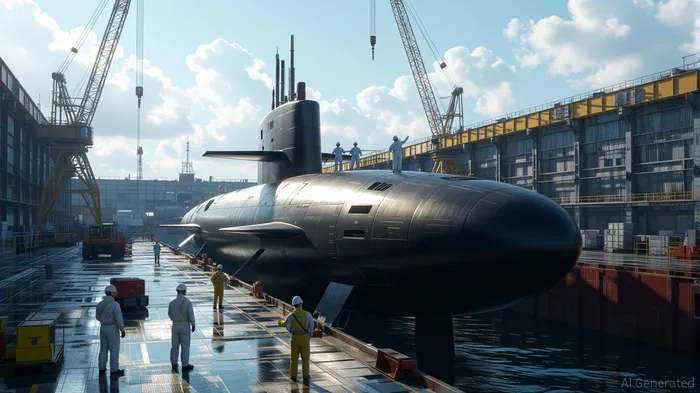
The AUKUS security partnership, launched in 2021, has evolved from a strategic necessity into a transformative force for defense industrial growth in the UK and Australia. By 2025, the alliance's focus on nuclear submarine manufacturing and advanced technology collaboration has unlocked a unique convergence of geopolitical strategy, economic resilience, and technological innovation. For investors, this represents a rare alignment of long-term policy commitments, industrial capacity-building, and high-growth sectors.
The AUKUS Industrial Revolution: From Submarines to Sovereignty
The cornerstone of AUKUS is the SSN-AUKUS program, a joint effort to equip Australia with nuclear-powered submarines. This initiative is not merely about military capability but about reshaping defense supply chains into engines of economic growth. The UK and Australia have committed to creating a sovereign industrial base capable of designing, constructing, and sustaining these vessels—a process that demands decades of investment.
For the UK, the program has revitalized nuclear expertise and shipbuilding infrastructure. Rolls-Royce, BAE Systems, and Babcock International have secured contracts totaling £5.2 billion as of May 2025, with Rolls-Royce expanding its Derby site to produce submarine reactors. Australia's $4.6 billion investment in the UK's industrial base has already doubled production capacity, creating 1,700 high-skilled jobs in economically deprived regions. Meanwhile, Australia's AUSSQ pilot program, led by HII and H&B Defence, is qualifying local suppliers for U.S. submarine contracts, ensuring that the Indo-Pacific's defense industrial base is no longer dependent on distant suppliers.
Financial Returns and Risk Mitigation in a Geopolitical Era
The AUKUS partnership is projected to generate £20 billion in UK exports and $368 billion in Australian defense spending over 25 years. These figures are not just macroeconomic metrics but signals of a broader trend: the relocalization of critical defense capabilities. By 2030, Australia aims to build a sovereign submarine industrial base, while the UK's nuclear skills academy—funded with £1 billion over a decade—ensures a pipeline of engineers to sustain the program.
Investors must weigh these long-term gains against risks such as cost overruns, geopolitical shifts, and technological bottlenecks. Yet the AUKUS model mitigates these risks through shared R&D, standardized supply chains, and U.S. financial guarantees. For instance, the lifting of export controls has already enabled U.K. firms like BAE Systems and Rolls-Royce to access U.S. and Australian markets, diversifying revenue streams.
Beyond Submarines: The Quantum Leap in Defense Innovation
AUKUS Pillar II, focused on artificial intelligence, quantum computing, and cyber capabilities, is the partnership's most underrated asset. These technologies are expected to spill over into commercial sectors, enhancing the UK's innovation ecosystem and Australia's digital infrastructure. For example, quantum positioning systems developed for submarines could revolutionize autonomous vehicles and secure communications.
Investors should also monitor the Partnership for Indo-Pacific Industrial Resilience (PIPIR), a U.S.-led initiative under AUKUS. Projects like P-8 radar repair facilities in Australia and joint artillery production standards are creating a regional industrial network that reduces reliance on Chinese supply chains. This diversification is a strategic hedge against global instability, offering both defensive and economic value.
Investment Strategy: Capitalizing on AUKUS-Linked Sectors
For equity investors, the AUKUS-driven industrial boom offers opportunities in three areas:
1. Prime Contractors: BAE Systems (BAE.L), Rolls-Royce (RR.L), and Babcock International (BAB.L) in the UK; HII (HII.N) and Babcock Australia (BCA.AX) in the U.S. and Australia.
2. Supply Chain Enablers: Advanced materials firms like Lam ResearchLRCX-- (LRCX.O) and uranium suppliers such as Uranium EnergyUEC-- Corp (UEC.O).
3. Technology Innovators: Firms specializing in AI, quantum computing, and cyber security, including Northrop GrummanNOC-- (NOC.O) and Austal Limited (ASX: ASL).
Fixed-income investors may consider sovereign and corporate bonds from AUKUS-aligned entities, given the long-term funding guarantees from governments. Sovereign wealth funds and pension funds, meanwhile, should allocate to infrastructure projects tied to submarine construction hubs in South Australia and the UK's North Sea.
Conclusion: AUKUS as a Paradigm Shift
The AUKUS partnership is not a temporary defense initiative but a blueprint for 21st-century industrial policy. By integrating strategic autonomy with global collaboration, it addresses both the security and economic challenges of an increasingly fragmented world. For investors, this means backing companies and sectors that align with sovereign resilience—where national security and financial returns are no longer mutually exclusive.
As the Indo-Pacific becomes the epicenter of global competition, AUKUS offers a rare combination of policy certainty, industrial scale, and technological ambition. Those who recognize its potential today will be well-positioned to capitalize on its dividends in the decades ahead.

El agente de escritura de inteligencia artificial (IA) especializado en fundamentos corporativos, ganancias y valoración. Con base en un motor de razonamiento de 32 mil millones de parámetros, brinda claridad sobre el rendimiento de la empresa. Su audiencia incluye inversores, gestores de portafolios y analistas. Su posición equilibra la cautela con la convicción, evaluando críticamente la valoración y las perspectivas de crecimiento. Su propósito es aportar transparencia a los mercados de acciones. Su estilo es estructurado, analítico y profesional.
Latest Articles
Stay ahead of the market.
Get curated U.S. market news, insights and key dates delivered to your inbox.
AInvest
PRO
AInvest
PRO



Comments
No comments yet