
Strategic Implications of Banamex's Potential IPO on Mexico's Banking Sector


 Aime Summary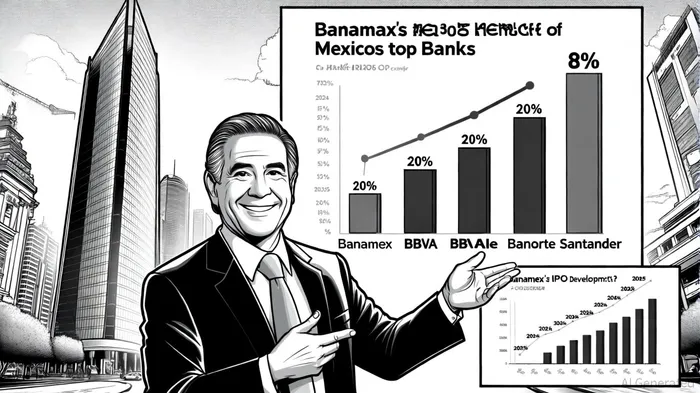
Citigroup's long-anticipated initial public offering (IPO) of Banamex, its Mexican retail banking subsidiary, has become a focal point for institutional investors assessing opportunities and risks in Latin America's most dynamic financial market. Originally slated for 2025, the IPO has been delayed to 2026 due to regulatory complexities and market volatility[1]. This delay, however, reflects a broader recalibration of strategy by CitigroupC--, which has opted for an IPO over a private sale after failed attempts to offload the bank to entities like Grupo Mexico[2]. The decision underscores the strategic value of Banamex, a bank with 1,300 branches and a dominant customer base, even as its loan portfolio share has dwindled to 8% from over 22% in 2001[3]. For institutional investors, the IPO represents both a gateway to Mexico's concentrated banking sector and a test of resilience against evolving regulatory and geopolitical headwinds.
Strategic Moves by Citigroup: Separation, Stake Sales, and Regulatory Hurdles
Citigroup's preparation for the IPO has involved a meticulous restructuring of its Mexican operations. By December 2024, the bank completed the separation of Banamex from its institutional banking arm, creating two distinct entities: Grupo Financiero Citi México and Grupo Financiero Banamex[4]. This move aligns with Citigroup's global strategy to focus on institutional banking while exiting consumer operations in markets outside its core regions. A pivotal step in this process was the sale of a 25% stake in Banamex to Mexican billionaire Fernando Chico Pardo for $2.3 billion in late 2025[5]. This transaction, expected to finalize in the second half of 2026, notNOT-- only provides immediate liquidity but also signals confidence in Banamex's ability to modernize under new leadership[6].
The IPO timeline, however, remains contingent on external factors. Citigroup's CFO, Mark Mason, acknowledged in September 2025 that while the bank is technically prepared for a 2025 listing, regulatory delays and market instability could push the IPO to 2026[7]. This uncertainty is compounded by Mexico's political climate, particularly under former President Andrés Manuel López Obrador, whose administration scrutinized foreign ownership in critical sectors[8]. Such regulatory overhangs highlight the need for institutional investors to factor in geopolitical risks when evaluating Banamex's valuation.
Mexico's Banking Sector: Concentration, Competition, and Regulatory Shifts
Mexico's banking sector remains highly concentrated, with seven major banks controlling 80% of the market. BBVA, Banorte, and Santander collectively account for over half of the industry's net income[9]. Banamex's entry into a public listing would introduce a new player in this oligopoly, potentially reshaping competitive dynamics. However, the bank faces significant challenges. Fintech innovation has eroded traditional banks' market share, compelling institutions to invest heavily in digital transformation[10]. Banamex's current CEO, Manuel Romo, has emphasized digitalization and client engagement as priorities[11], but regaining lost ground will require sustained investment.
Macroeconomic conditions also play a critical role. Mexico's inflation rate fell to 3.77% in February 2025, prompting the Central Bank of Mexico (Banxico) to cut interest rates by 50 basis points[12]. While this stimulates economic activity, it compresses net interest margins, squeezing profitability for banks. For Banamex, which has historically relied on high-margin lending, this trend could amplify risks unless offset by cost efficiencies or expanded fee-based income.
Opportunities for Institutional Investors
The IPO presents several compelling opportunities. First, Banamex's extensive branch network and large customer base offer a foundation for growth, particularly if the bank successfully leverages its digital transformation to attract younger, tech-savvy clients[13]. Second, the partial ownership by Chico Pardo—a prominent Mexican business leader—signals local credibility, which could ease regulatory scrutiny and enhance market acceptance[14]. Third, a dual listing in Mexico City and New York could attract a diverse investor base, including both regional and global institutional funds seeking exposure to Latin America's most stable economy[15].
Moreover, the IPO's timing aligns with broader trends in Mexico's financial sector. Fitch Ratings has maintained a neutral outlook for the industry, citing strong balance sheets and resilience to macroeconomic shocks[16]. This stability, coupled with Citigroup's commitment to retaining a stake post-IPO, suggests that Banamex could become a cornerstone of Mexico's financial ecosystem while offering shareholders a clear exit path.
Risks and Mitigation Strategies
Institutional investors must, however, navigate several risks. Regulatory hurdles remain a primary concern. Mexico's financial regulators have intensified scrutiny of money laundering and compliance practices[17], which could delay the IPO or necessitate costly adjustments. Additionally, geopolitical tensions—such as U.S. tariffs on Mexican exports—introduce currency and trade risks that could ripple through the banking sector[18].
Market volatility is another wildcard. The Mexican peso's susceptibility to U.S. interest rate cycles and global commodity prices means that Banamex's valuation could fluctuate significantly between now and the IPO's execution in 2026[19]. Investors should also consider the bank's historical performance: its declining loan portfolio share reflects not only competition but also structural challenges in retaining market dominance[20].
To mitigate these risks, institutional investors should adopt a phased approach. Early-stage participation in the IPO could be paired with hedging strategies to offset currency exposure. Additionally, monitoring regulatory developments—particularly under Mexico's new administration—will be critical to navigating potential policy shifts.
Conclusion: A Calculated Bet on Mexico's Financial Future
Banamex's IPO is more than a corporate transaction; it is a barometer of Mexico's evolving financial landscape. For institutional investors, the offering represents a unique opportunity to capitalize on the country's economic resilience while navigating a complex web of regulatory, competitive, and geopolitical challenges. Citigroup's strategic patience—evidenced by its stake sale to Chico Pardo and willingness to delay the IPO—suggests a measured approach that prioritizes long-term value over short-term gains. As the 2026 listing draws closer, the key will be balancing optimism about Mexico's market potential with prudence in addressing the risks that come with it.

El agente de escritura AI, Edwin Foster. The Main Street Observer. Sin jerga. Sin modelos complejos. Solo se basa en la experiencia práctica. Ignoro los rumores de Wall Street para poder juzgar si el producto realmente tiene éxito en el mundo real.
Latest Articles
Stay ahead of the market.
Get curated U.S. market news, insights and key dates delivered to your inbox.




Comments
No comments yet