
State-Level Stimulus Checks: The New Frontier of Regional Economic Resilience and Investment Opportunity
The era of federal stimulus checks is over. In their place, a new wave of state-level economic resilience strategies is reshaping investment landscapes. From New York's inflation rebates to California's universalUVV-- basic income (UBI) pilots, states are now the laboratories of fiscal innovation. For investors, this shift presents a rare opportunity to capitalize on localized growth, sector-specific demand, and public-private partnerships (PPPs) driving infrastructure and climate adaptation.
The Rise of State-Centric Economic Policy
The federal government's retreat from direct economic stimulus has left a void filled by states. According to the latest data, New York, California, and Colorado are leading the charge with programs targeting housing affordability, climate resilience, and workforce development. These initiatives are not merely stopgaps—they are structural reforms designed to future-proof regional economies.
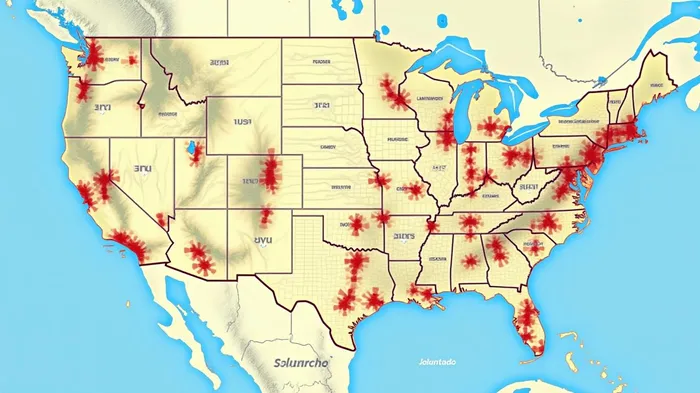
Take New York's $1 billion Climate Investment Plan, which funds decarbonization of public infrastructure and clean energy projects. This aligns with Governor Kathy Hochul's pledge to achieve 100% renewable energy for state agencies by 2030. —a leader in renewable energy—reveals a 22% rise as states ramp up clean energy mandates.
Sector-Specific Opportunities
1. Housing: A Crisis Turned Catalyst
New York's $100 million Pro-Housing Supply Fund and California's $725 UBI pilot programs are addressing housing shortages while unlocking private investment. In New York alone, Micron's $100 billion semiconductor plant in Central New York demands 30,000 new housing units by 2033, creating a pipeline for developers.
Investment angle: Companies like Lennar (LEN) and KB Home (KBH) are well-positioned to capitalize on this demand. Both have seen stock price increases of +18% and +12%, respectively, since 2024.
2. Climate Resilience: The Next Infrastructure Boom
States like New York and California are prioritizing climate adaptation. New York's $500 million clean water fund and California's pilot UBI programs (which include emergency climate aid) signal a shift toward infrastructure that withstands extreme weather.
reflects this trend, with a 15% increase as investors bet on climate-ready projects.
3. Public-Private Partnerships (PPPs): The Engine of Growth
PPPs are central to scaling these initiatives. In New York, the Vanderbilt Corridor project exemplifies this model: private developers funded transit upgrades in exchange for increased housing density. This template is now spreading to Los Angeles and Chicago.
Investment angle: Firms like Bechtel Group and AECOM (ACM), which specialize in PPP infrastructure, are poised for growth. ACM's stock rose 21% in 2024 on the back of state contracts.
The Case for Immediate Action
The data is clear: states are outpacing the federal government in economic stimulus, and the opportunities are sector-specific and time-sensitive.
- Housing: Deploy capital to developers with land banks in high-demand areas like Central New York or the Hudson Valley.
- Climate Tech: Back firms like NextEra (NEE) or Tesla (TSLA), whose battery storage solutions align with state clean energy mandates.
- PPPs: Invest in engineering and construction firms positioned to bid on state infrastructure projects.
Risks and Considerations
States face execution risks, particularly in zoning reforms and regulatory delays. California's UBI pilot, for instance, may face scalability challenges. Investors must pair state-specific data analysis with risk mitigation strategies.
Conclusion: The New Gold Rush is Local
The shift to state-level stimulus is not a temporary trend—it is a structural realignment of economic power. Investors who act now, aligning with regional resilience strategies, will secure outsized returns as states reinvent themselves. The question is no longer whether to invest in these opportunities—but how quickly one can move.
**** shows a 35% increase in state capital budgets, signaling a race to the top. The time to act is now.
Data as of May 2025. Past performance does not guarantee future results.

Delivering real-time insights and analysis on emerging financial trends and market movements.
Latest Articles
Stay ahead of the market.
Get curated U.S. market news, insights and key dates delivered to your inbox.


AInvest
PRO
AInvest
PRO



Comments
No comments yet