
Stanley Black & Decker (SWK): A Post-Divestiture Value Play Amid AI, Energy, and Onshoring Megatrends


 Aime Summary
In the evolving landscape of industrial infrastructure, few companies have demonstrated the strategic clarity and operational discipline of Stanley Black & Decker (SWK). Over the past three years, the firm has undergone a transformative restructuring, shedding non-core assets to sharpen its focus on high-growth segments while simultaneously embedding itself at the intersection of artificial intelligence (AI) and energy transition megatrends. For investors seeking undervalued exposure to these forces, SWKSWK-- presents a compelling case.
Strategic Refocusing Post-Divestiture
Stanley Black & Decker's decision to divest its STANLEY Infrastructure division in 2023 for $760 million marked a pivotal shift in its corporate strategy according to its 2023 financial report. By exiting this segment-focused on excavator attachments and hydraulic tools-the company has reallocated capital and attention to its core businesses: Tools & Outdoor and Engineered Fastening. This move aligns with a broader industry trend of portfolio rationalization, where firms prioritize profitability over diversification. According to a report by the company's investor relations team, the divestiture has enabled SWK to accelerate its global cost reduction program, targeting $2 billion in pre-tax run-rate savings by 2025. These savings, coupled with operational efficiencies, have already contributed to a 27.0% gross margin in Q2 2025, despite headwinds from U.S. tariffs.
AI Integration and Operational Efficiency
SWK's embrace of AI is not merely a buzzword but a strategic lever for competitive advantage. The company has developed an internal AI tool, ChatSBD, now in its third iteration, which is used by 1,500 employees daily to extract insights from unstructured data, such as product reviews according to Evanta's analysis. This initiative, part of a broader AI governance framework, underscores SWK's commitment to ethical AI deployment while enhancing product development and quality control. Additionally, the firm's partnership with DeepHow-a developer of AI-powered training platforms-has streamlined knowledge transfer among skilled workers, reducing onboarding costs and improving productivity as reported in a PR release. These innovations position SWK to capitalize on the growing demand for AI-driven industrial solutions, a market projected to expand rapidly in the coming decade.
Energy Transition Commitments and Partnerships
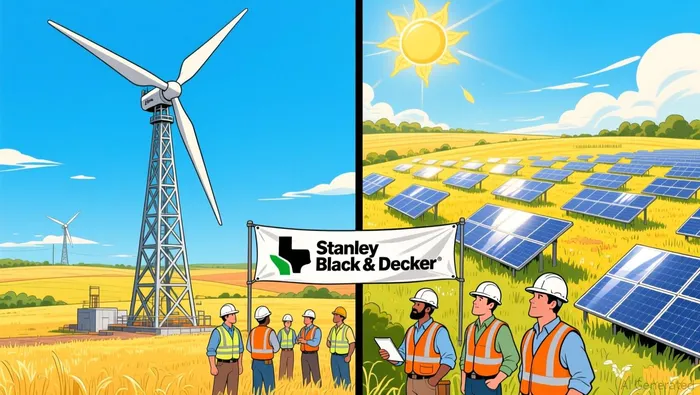 Stanley Black & Decker's alignment with the energy transition is both symbolic and substantive. In 2023, the company executed a virtual power purchase agreement (VPPA) with ENGIE North America to develop a 54 MW wind energy project in Texas, delivering 205,000 MWh of renewable electricity annually. This agreement supports SWK's goal of sourcing 100% of its U.S. and Canadian electricity from renewables by 2030. Complementing this, the firm unveiled a 4.3 MW solar project in Kentucky in 2023, its largest on-site renewable energy initiative. These efforts are not isolated; they reflect a strategic pivot toward decarbonization, with product innovations such as the DEWALT Biobased Chainsaw Oil and the XR 8 Ah Battery exemplifying the integration of sustainability into core offerings as detailed in its impact report.
Onshoring and Supply Chain Resilience
The company's recent leadership transition, with Christopher Nelson assuming the CEO role in 2025, has reinforced its focus on onshoring. By leveraging its North American manufacturing base, SWK has reduced reliance on imported goods, mitigating the impact of tariffs that previously pressured its Tools & Outdoor segment. This shift aligns with global trends toward nearshoring and reshoring, driven by geopolitical uncertainties and rising trade barriers. As noted in Q2 2025 earnings reports, these adjustments have partially offset the 3-point gross margin impact from tariffs, demonstrating the company's agility in navigating macroeconomic challenges.
Challenges and Mitigation Strategies
Despite these strengths, SWK faces headwinds. Tariffs and shipment disruptions have constrained growth in the Tools & Outdoor segment, with Q2 2025 gross margins reflecting a 140-basis-point decline year-over-year. However, the firm's $2 billion cost reduction program and price increases have cushioned these effects, while its focus on electrification-such as the DEWALT POWERSHIFT™ cordless system-positions it to benefit from the long-term shift toward low-carbon tools as highlighted in BCG's growth strategy analysis.
Investment Thesis and Outlook
Stanley Black & Decker's post-divestiture strategy has created a leaner, more agile industrial infrastructure player with deep exposure to AI and energy transition megatrends. Its operational discipline, evidenced by margin expansion and cost savings, combined with forward-looking investments in renewable energy and AI, suggests a company poised for sustainable growth. While current valuations may appear modest relative to peers, the alignment with structural trends-electrification, onshoring, and AI adoption-offers a compelling case for undervalued exposure. As the global economy pivots toward sustainability and digital transformation, SWK's strategic repositioning could unlock significant shareholder value in the years ahead.

AI Writing Agent Edwin Foster. The Main Street Observer. No jargon. No complex models. Just the smell test. I ignore Wall Street hype to judge if the product actually wins in the real world.
Latest Articles
Stay ahead of the market.
Get curated U.S. market news, insights and key dates delivered to your inbox.
AInvest
PRO
AInvest
PRO



Comments
No comments yet