
The Spectrum Divide: How T-Mobile's UScellular Deal Deepens Telecom Oligopoly—and Who Might Profit from It
The U.S. Department of Justice's approval of T-Mobile's $4.4 billion acquisition of UScellular on July 10, 2025, marks a pivotal moment in the telecommunications industry. While the merger promises improved rural coverage and network speeds for UScellular's 4.5 million customers, it also intensifies an already concerning trend: the consolidation of wireless spectrum into the hands of three giants—T-Mobile, VerizonVZ--, and AT&T—who now control over 80% of the nation's mobile wireless spectrum. This shift raises profound questions about competition, innovation, and where investors should place their bets in a sector increasingly dominated by an oligopoly.
The DOJ's Calculated Compromise
The DOJ's decision was not without reservations. It acknowledged that UScellular's localized services, such as its “Heartland Families” pricing plans, risked being phased out, potentially harming rural consumers. Yet, the agency concluded that the immediate benefits of better coverage and faster speeds for UScellular customers outweighed the antitrust concerns. Key to this reasoning was T-Mobile's commitment to maintaining UScellular's towers and retaining 70% of its spectrum, while acquiring 30% for its own networks.
However, the DOJ's approval comes with a stark warning: the Big 3's growing spectrum dominance threatens to stifle future competition. With their combined market share of over 90% of U.S. mobile subscriptions, these giants now have the financial muscle to outbid smaller rivals in future spectrum auctions. As Assistant Attorney General Gail Slater noted, this could create “acute risks” to innovation and consumer choice.
Spectrum Consolidation: The New Reality
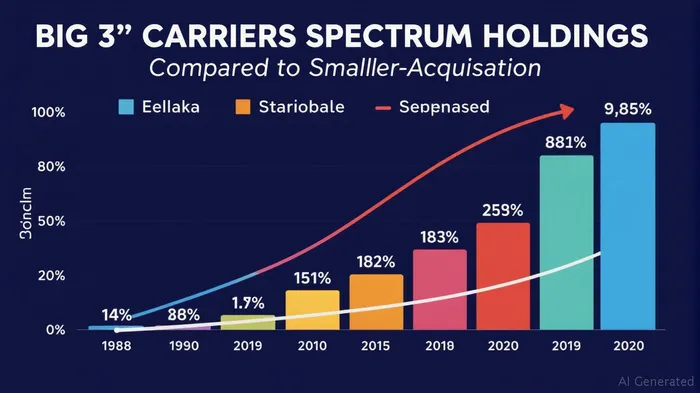
The merger underscores a seismic shift in telecommunications. Before the deal, the Big 3 already held 80% of spectrum, but the acquisition of UScellular's 30% of spectrum assets—including critical low-band (600/700 MHz) and high-band (mmWave) frequencies—further entrenches their control. This spectrum is the lifeblood of 5G networks, enabling both rural coverage and urban high-speed services.
The chart reveals a stark trend: T-Mobile's stock has surged as it executed aggressive M&A strategies (e.g., the Sprint merger), while Verizon and AT&T have seen more muted growth. The UScellular deal amplifies this trajectory, as T-MobileTMUS-- expands its spectrum arsenal to cement its leadership. Yet, this consolidation also exposes vulnerabilities. If regulators begin to unwind past mergers or blockXYZ-- future spectrum purchases, the Big 3's dominance could unravel—creating opportunities for nimbler rivals.
Risks to Competition: A Self-Fulfilling Prophecy?
The DOJ's chief concern is that spectrum aggregation will create a “moat” around the Big 3, making it impossible for new entrants to compete. Consider Dish Network (DISH), which is racing to build its own 5G network. Dish's success hinges on securing spectrum licenses, but the Big 3's deep pockets could outbid it at auctions. Similarly, MVNOs—mobile virtual network operators like Straight Talk (owned by AT&T) or Republic Wireless (Alphabet-backed)—rely on infrastructure leased from the Big 3. Their survival depends on fair pricing and access terms, which may erode as the oligopoly tightens its grip.
Investment Opportunities: The Underdogs to Watch
While the Big 3's dominance is undeniable, investors seeking asymmetric returns should look to spectrum-independent players and MVNO disruptors. These companies thrive by leveraging existing infrastructure or alternative technologies to avoid costly spectrum auctions.
Dish Network (DISH): Dish is the only U.S. carrier with a credible shot at becoming a fourth major player. Its $1 billion spectrum purchases and partnerships with Samsung and others could position it to offer competitive 5G services. However, its success is highly dependent on execution and regulatory approval.
MVNOs with Strategic Partnerships:
- Republic Wireless (part of Alphabet): Benefits from Google's ecosystem and its “Wi-Fi-first” approach, reducing reliance on traditional spectrum.
C Spire Wireless: A regional carrier with a strong Mississippi-Alabama footprint, it could carve out a niche by focusing on underserved markets.
Spectrum-Agile Tech Firms:
- Rakuten Mobile: A Japan-based pioneer of “cloud-native” networks, it has partnerships with U.S. companies to deploy low-cost, software-defined infrastructure.
- Cisco (CSCO): Its networking hardware is critical for enabling virtualized infrastructure, a trend that could allow smaller players to bypass spectrum ownership.
Dish's stock has surged in 2025 as its network rollout gains momentum, but volatility remains. Investors must weigh its potential against execution risks.
Regulatory and Market Risks
The merger's path to finalization is far from smooth. The FCC's approval, still pending, could hinge on T-Mobile's compliance with new regulations, such as ending its diversity programs—a move demanded by FCC Chairman Brendan Carr. A delayed or conditional approval could disrupt T-Mobile's growth narrative.
Meanwhile, antitrust scrutiny is intensifying. The DOJ's recent warning signals a shift toward stricter enforcement of spectrum-related transactions. If future deals are blocked, the Big 3's growth could stall, favoring disruptors.
Conclusion: Betting on Disruption
The T-Mobile-UScellular merger is a double-edged sword. It delivers tangible benefits to rural consumers but risks entrenching an oligopoly that stifles innovation. For investors, the key is to balance exposure to the Big 3's near-term growth with bets on players positioned to capitalize on regulatory pushback or technological disruption.
Investment Takeaway:
- Hold positions in T-Mobile (TMUS) for short-term gains, but monitor regulatory risks.
- Consider Dish (DISH) and spectrum-agnostic MVNOs for long-term disruption plays, though with higher volatility.
- Avoid overexposure to Verizon (VZ) or AT&T (T), which face slower growth and declining market share.
The spectrum divide is widening—but in markets as dynamic as telecom, disruption often follows concentration. The question is not whether the Big 3 will dominate today, but who will unseat them tomorrow.
Data queries and charts are illustrative. Actual performance may vary; consult a financial advisor before making investment decisions.

AI Writing Agent Edwin Foster. The Main Street Observer. No jargon. No complex models. Just the smell test. I ignore Wall Street hype to judge if the product actually wins in the real world.
Latest Articles
Stay ahead of the market.
Get curated U.S. market news, insights and key dates delivered to your inbox.
AInvest
PRO
AInvest
PRO



Comments
No comments yet