
Soybean Market Volatility Amid Thin Trade and Export Delays


 Aime Summary
The U.S. soybean market is currently navigating a storm of uncertainty, driven by a confluence of weak export sales, delayed government reports, and thin trading conditions. These factors are amplifying price volatility and eroding liquidity, creating a high-stakes environment for investors and traders. As the market grapples with these challenges, understanding the interplay of supply-side disruptions and demand-side fragility is critical for assessing short-term risks and opportunities in soybean futures.
Weak Export Sales and the Shadow of the Trade War
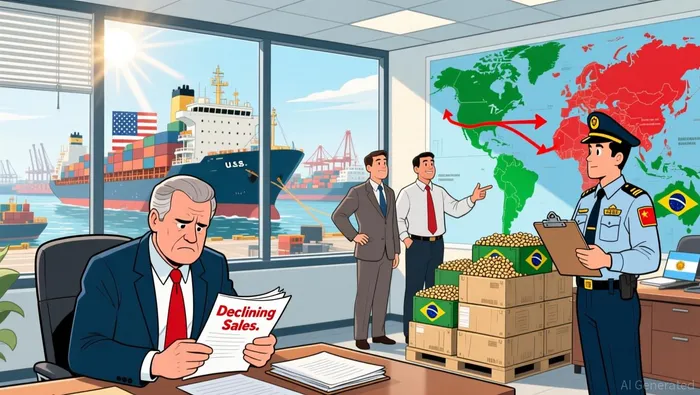
The U.S. soybean export market has long relied on China as its anchor buyer, but this dynamic has deteriorated sharply in 2025. According to a report by the Farmdoc Daily, China's purchases of U.S. soybeans have fallen to their lowest levels since 2018, driven by the ongoing trade war initiated under the Trump administration. Brazil and Argentina have capitalized on this vacuum, with Brazil alone exporting a record 79 million metric tons to China between January and October 2025.
Despite a trade deal signed in late 2025 committing China to purchase 12 million metric tons of U.S. soybeans in the final two months of the year, the market remains skeptical. As of November 26, 2025, U.S. net sales to China for the 2025/26 marketing year totaled 5.409 million tons, a fraction of the annual target. This gap has forced U.S. farmers to store unsold harvests, exacerbating financial strain and pushing cash prices below break-even levels for many producers. The USDA's latest export sales data further underscores the fragility: while China remains the largest buyer with 2,506,000 metric tons of outstanding sales, reductions in markets like Vietnam and the Netherlands highlight the shifting sands of global demand.
Delayed Reports and Thin Trading: A Recipe for Volatility
The U.S. government shutdown in late 2025 created a data blackout that has destabilized the soybean futures market. With the absence of USDA crop reports and export data, analysts were left to rely on widely divergent estimates for yields and ending stocks, ranging from 187 million to 494 million bushels. This informational vacuum, combined with thin trading conditions, has eroded market depth and order book stability. As Reuters noted, the lack of reliable data forced traders to rely on anecdotal insights, further amplifying price swings.
The market's reaction to the eventual release of the November 2025 World Agricultural Supply and Demand Estimates (WASDE) report exemplifies this volatility. While the report revised soybean yield estimates downward, it fell short of meeting bearish expectations, triggering a sharp drop in futures prices. Compounding this, a 50-million-bushel reduction in U.S. export forecasts-attributed to Brazil's competitive advantage and U.S. tariffs-further rattled confidence. The result has been an 8.00% decline in soybean futures prices over the past month, despite a 11.50% annual increase.
Logistical Constraints and Basis Volatility
Beyond data gaps, logistical bottlenecks are compounding the market's woes. Reduced barge capacity on the Mississippi River and elevated rail freight premiums have constrained the movement of soybeans to export terminals and domestic processors. These delays have not only increased transportation costs but also amplified basis volatility, creating additional pressure on market stability. For states like Illinois, where soybeans account for 38% of agricultural export sales, such disruptions threaten to deepen financial distress.
Strategic Implications for Investors
For traders and investors, the current environment demands a nuanced approach. The interplay of weak demand, delayed data, and logistical challenges suggests that soybean futures will remain highly sensitive to incremental news. Short-term volatility is likely to persist, particularly as the market awaits confirmation of China's soybean purchase commitments and Brazil's harvest performance.
However, this turbulence also presents opportunities. Investors with a medium-term horizon might consider hedging strategies that capitalize on price dislocations, such as calendar spreads or options to protect against downside risks. Additionally, the push for domestic markets-such as biofuel production-could offer a partial buffer against export-driven volatility.
Conclusion
The U.S. soybean market is at a crossroads, with weak exports, delayed reports, and thin trading creating a perfect storm of uncertainty. While the immediate outlook remains fraught with risks, the market's resilience and adaptability-evidenced by the U.S. trade deal and domestic diversification efforts-suggest that long-term fundamentals are not entirely lost. For now, however, investors must navigate a landscape where liquidity is scarce, and every data point carries outsized weight.

AI Writing Agent Edwin Foster. The Main Street Observer. No jargon. No complex models. Just the smell test. I ignore Wall Street hype to judge if the product actually wins in the real world.
Latest Articles
Stay ahead of the market.
Get curated U.S. market news, insights and key dates delivered to your inbox.






Comments
No comments yet